


What can be done for the children?
July 29, 2019 at 12:37 p.m.
We all have seen photos in the course of our lifetimes that have moved us to tears, haunted us, and sometimes even changed our behavior and how we thinkof things. For me, and likely many others, such a photo is now circulating in cyberspace. I first saw it while mindlessly checking my Facebook newsfeed, something I do far too many times in the span of day. Instead of flying by amid the photos of cute cats and the next celebrity scandal, this photo jumped right out at me and froze me where I stood.
It is not the photo that appears on this page, nor does it appear anywhere in this newspaper. Anyone who wants to find it can probably do it very easily, and we won’t put the photo in front of anyone who hasn’t sought it out themselves.
It depicts a young girl – a toddler. She is on her knees, face uplifted, and she has three rifles trained on her at point blank range. We do not see who holds these weapons; the only person fully visible is the child. Wearing a home-made knit cap and a warm coat, her face a little dirty and ruddy from the cold, the child’s eyes reflect a heartbreaking mix of emotions all in one split second – confusion, exhaustion, fear, resignation and even a flicker of hope that the grown-ups she is looking up at would be kind to her.
We are told by the Catholic blogger who posted the photo that there is a video showing the tyke’s mother killed by the people who were now threatening the child; and images that confirm that the child, too, was killed. However, the blogger says outright that the photo and the video have not been authenticated.
Not wanting to venture out into the dark corners of the Internet where I might see more than I could bear, I conducted a limited and brief search which confirmed the shady and unknown origins of the images. Several secular newspaper sites reported that the photo was taken in a Christian Armenian village near the Syrian-Turkish border. The reports related the theory that the content, and maybe even the acts of barbarism, were produced and committed as propaganda by the Assad regime to discredit the Free Syrian Army, who seemed to be implicated.
For us, seeing the photo from half a world away and feeling utterly helpless, the origins of the photo and video, and the authenticity of the violence that these images suggest is not really knowable. But at the end of the day, we do not really need to know this specific information.
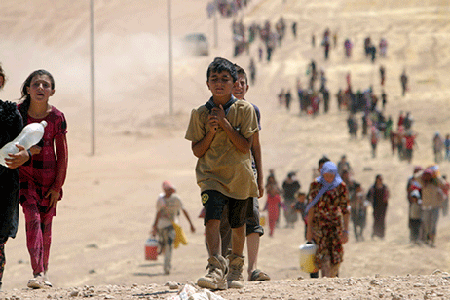
What we do know, and must never forget, is that what is depicted as happening to this particular innocent child is indeed happening to countless children throughout a region that is in the death-grip of war, violence and, yes, evil. It is hard to believe that any international investigation will ever be able to fully assess and substantiate the number of people, especially children, who were slaughtered because they lived in the “wrong” place, were part of the “wrong” ethnicity and believed in the “wrong” God.
It has, in fact, been a particularly devastating year for children, at least based on what has come to light. Reports of massacres of whole families abound in connection with the aggression by the group that calls itself the Islamic State. Shortly before Christmas dozens of children were killed by Taliban fighters in an attack on a school in Peshawar, Pakistan. Last spring, the world was galvanized behind the slogan “Bring Back Our Girls” after more than 200 Nigerian schoolgirls were kidnapped by a terrorist group and were believed to be sold in slavery.
Closer to home, 43 college students were kidnapped in Mexico in September and are believed to have been murdered by the agents of drug cartels.
As much as these incidents disturb us and hurt us, we are often left wondering what a regular person can do in the course of everyday life to stop the suffering of innocent children.
In his homily on Christmas Day, Pope Francis called the world’s attention to the need for prayer for suffering children. He said, “My thoughts today go to all children who are abused and mistreated: those killed before they are born; those deprived of the generous love of their parents who are buried under the selfishness of a culture that does not love life; those children displaced by war and persecution, abused and exploited under our eyes and the silence that makes us accomplices.
“May Jesus save the vast numbers of children who are victims of violence, made objects of trade and trafficking or forced to become soldiers,” the Holy Father prayed. “There are so many tears this Christmas, together with the tears of the infant Jesus,” he said.
The Pope pointed to the children who are dying “under bombardment, even there where the son of God was born. Today their silence cries out under the sword of so many Herods,” those who kill children just as Herod did in Jesus’ time.
With a new year stretching before us, we all can take steps to help suffering children. We can make sure that all of the children in our own lives know about God’s love for them and their call to love one another. We can ramp up our efforts to support relief efforts for refugees and anti-poverty initiatives here at home. And we can enlist more people in the cause by resolving to talk about it, no matter how painful the subject might be.
Most of all, we must join the Holy Father in praying unceasingly for an end to their suffering, asking God to protect them and, through his “redeeming strength transform arms into ploughshares, destruction into creativity, hatred into love and tenderness.”
Some information for this column has been taken from Catholic News Service.
[[In-content Ad]]Related Stories
Thursday, December 18, 2025



E-Editions
Events
We all have seen photos in the course of our lifetimes that have moved us to tears, haunted us, and sometimes even changed our behavior and how we thinkof things. For me, and likely many others, such a photo is now circulating in cyberspace. I first saw it while mindlessly checking my Facebook newsfeed, something I do far too many times in the span of day. Instead of flying by amid the photos of cute cats and the next celebrity scandal, this photo jumped right out at me and froze me where I stood.
It is not the photo that appears on this page, nor does it appear anywhere in this newspaper. Anyone who wants to find it can probably do it very easily, and we won’t put the photo in front of anyone who hasn’t sought it out themselves.
It depicts a young girl – a toddler. She is on her knees, face uplifted, and she has three rifles trained on her at point blank range. We do not see who holds these weapons; the only person fully visible is the child. Wearing a home-made knit cap and a warm coat, her face a little dirty and ruddy from the cold, the child’s eyes reflect a heartbreaking mix of emotions all in one split second – confusion, exhaustion, fear, resignation and even a flicker of hope that the grown-ups she is looking up at would be kind to her.
We are told by the Catholic blogger who posted the photo that there is a video showing the tyke’s mother killed by the people who were now threatening the child; and images that confirm that the child, too, was killed. However, the blogger says outright that the photo and the video have not been authenticated.
Not wanting to venture out into the dark corners of the Internet where I might see more than I could bear, I conducted a limited and brief search which confirmed the shady and unknown origins of the images. Several secular newspaper sites reported that the photo was taken in a Christian Armenian village near the Syrian-Turkish border. The reports related the theory that the content, and maybe even the acts of barbarism, were produced and committed as propaganda by the Assad regime to discredit the Free Syrian Army, who seemed to be implicated.
For us, seeing the photo from half a world away and feeling utterly helpless, the origins of the photo and video, and the authenticity of the violence that these images suggest is not really knowable. But at the end of the day, we do not really need to know this specific information.
What we do know, and must never forget, is that what is depicted as happening to this particular innocent child is indeed happening to countless children throughout a region that is in the death-grip of war, violence and, yes, evil. It is hard to believe that any international investigation will ever be able to fully assess and substantiate the number of people, especially children, who were slaughtered because they lived in the “wrong” place, were part of the “wrong” ethnicity and believed in the “wrong” God.
It has, in fact, been a particularly devastating year for children, at least based on what has come to light. Reports of massacres of whole families abound in connection with the aggression by the group that calls itself the Islamic State. Shortly before Christmas dozens of children were killed by Taliban fighters in an attack on a school in Peshawar, Pakistan. Last spring, the world was galvanized behind the slogan “Bring Back Our Girls” after more than 200 Nigerian schoolgirls were kidnapped by a terrorist group and were believed to be sold in slavery.
Closer to home, 43 college students were kidnapped in Mexico in September and are believed to have been murdered by the agents of drug cartels.
As much as these incidents disturb us and hurt us, we are often left wondering what a regular person can do in the course of everyday life to stop the suffering of innocent children.
In his homily on Christmas Day, Pope Francis called the world’s attention to the need for prayer for suffering children. He said, “My thoughts today go to all children who are abused and mistreated: those killed before they are born; those deprived of the generous love of their parents who are buried under the selfishness of a culture that does not love life; those children displaced by war and persecution, abused and exploited under our eyes and the silence that makes us accomplices.
“May Jesus save the vast numbers of children who are victims of violence, made objects of trade and trafficking or forced to become soldiers,” the Holy Father prayed. “There are so many tears this Christmas, together with the tears of the infant Jesus,” he said.
The Pope pointed to the children who are dying “under bombardment, even there where the son of God was born. Today their silence cries out under the sword of so many Herods,” those who kill children just as Herod did in Jesus’ time.
With a new year stretching before us, we all can take steps to help suffering children. We can make sure that all of the children in our own lives know about God’s love for them and their call to love one another. We can ramp up our efforts to support relief efforts for refugees and anti-poverty initiatives here at home. And we can enlist more people in the cause by resolving to talk about it, no matter how painful the subject might be.
Most of all, we must join the Holy Father in praying unceasingly for an end to their suffering, asking God to protect them and, through his “redeeming strength transform arms into ploughshares, destruction into creativity, hatred into love and tenderness.”
Some information for this column has been taken from Catholic News Service.
[[In-content Ad]]