


Welcoming strangers is key to peace
July 29, 2019 at 12:37 p.m.
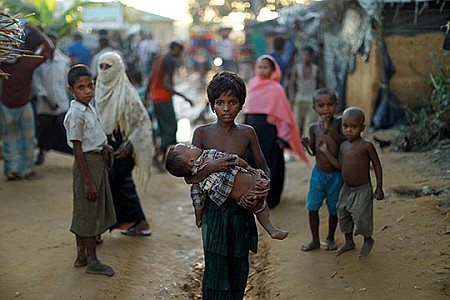
The following unsigned editorial first appeared in the Jan. 6 issue of The Tablet, a London-based international Catholic weekly. It is provided here through Catholic News Service.
Pope Francis has begun the new year as he no doubt intends to continue, stressing that society must not lose sight of the human dignity of every migrant and every refugee. It has been one of the most consistent themes of his papacy so far and one of the most pressing, as Europe and the world face refugee crisis after crisis.
He told worshippers gathered around the Nativity scene in St. Peter’s Square that refugees fleeing conflict were seeking peace. “For this peace, which is the right of all, many of them are willing to risk their lives in a journey that, in most cases, is long and dangerous, facing trials and suffering,” he said.
It is an intelligent point, for it encompasses some of the complexity of the refugee situation. Many refugees are not just fleeing overt persecution, as Syrian and Iraqi Christians escaping from lands under Islamic State control are. They also include young men who refuse to join the Syrian army and families whose homes or livelihoods have been destroyed by civil war. They may not qualify for asylum under international law, but they want peace and are escaping from the lack of it. And they do not find peace when they are received by unwelcoming host societies where racial and religious discrimination – or unsympathetic incomprehension – awaits them. That is why Pope Francis stresses the vital role of the institutions in civil society, including the churches, in building an attitude of solidarity and compassion toward migrants. But there is a corollary of this. The arrival of refugees should be managed so that it does not occur in such numbers or over such a short space of time as to impose an intolerable strain on physical resources and social cohesion.
Host communities are entitled to peace as well and it takes hard work to achieve that. But it can be done. Multiracial and multicultural Britain – London especially – is an example to other European countries of how communal peace can be achieved with effort and goodwill, in spite of unresolved difficulties. Europe’s largest city has a Muslim mayor, and is proud of the fact. On the other hand, real peace cannot be said to exist in some heavily segregated towns in Britain, whose communities hardly know each other and where there is little mutual respect.
Culture matters: This is how generations transmit their values down the years. While cultures are enriched by diversity, hard-won cultural progress can seem threatened by sudden change. The tolerance of ethnic differences cannot ignore injustice and prejudice. That is not true peace.
Common humanity transcends state boundaries, and nobody is less of a person because of their skin color, religion or language. Nor because of their nationality, gender or sexuality. Respect for “the other” – someone “not like me” – as one possessing equal value and equal rights, has become one of the defining challenges of modern civilization. As Pope Francis insists, it is the only true meaning of peace.
The views or positions presented in this or any guest editorial are those of the originating publication and do not necessarily represent the views of Catholic News Service, the U.S. Conference of Catholic Bishops, The Monitor or The Diocese of Trenton.
[[In-content Ad]]
Related Stories
Saturday, December 20, 2025





E-Editions
Events
The following unsigned editorial first appeared in the Jan. 6 issue of The Tablet, a London-based international Catholic weekly. It is provided here through Catholic News Service.
Pope Francis has begun the new year as he no doubt intends to continue, stressing that society must not lose sight of the human dignity of every migrant and every refugee. It has been one of the most consistent themes of his papacy so far and one of the most pressing, as Europe and the world face refugee crisis after crisis.
He told worshippers gathered around the Nativity scene in St. Peter’s Square that refugees fleeing conflict were seeking peace. “For this peace, which is the right of all, many of them are willing to risk their lives in a journey that, in most cases, is long and dangerous, facing trials and suffering,” he said.
It is an intelligent point, for it encompasses some of the complexity of the refugee situation. Many refugees are not just fleeing overt persecution, as Syrian and Iraqi Christians escaping from lands under Islamic State control are. They also include young men who refuse to join the Syrian army and families whose homes or livelihoods have been destroyed by civil war. They may not qualify for asylum under international law, but they want peace and are escaping from the lack of it. And they do not find peace when they are received by unwelcoming host societies where racial and religious discrimination – or unsympathetic incomprehension – awaits them. That is why Pope Francis stresses the vital role of the institutions in civil society, including the churches, in building an attitude of solidarity and compassion toward migrants. But there is a corollary of this. The arrival of refugees should be managed so that it does not occur in such numbers or over such a short space of time as to impose an intolerable strain on physical resources and social cohesion.
Host communities are entitled to peace as well and it takes hard work to achieve that. But it can be done. Multiracial and multicultural Britain – London especially – is an example to other European countries of how communal peace can be achieved with effort and goodwill, in spite of unresolved difficulties. Europe’s largest city has a Muslim mayor, and is proud of the fact. On the other hand, real peace cannot be said to exist in some heavily segregated towns in Britain, whose communities hardly know each other and where there is little mutual respect.
Culture matters: This is how generations transmit their values down the years. While cultures are enriched by diversity, hard-won cultural progress can seem threatened by sudden change. The tolerance of ethnic differences cannot ignore injustice and prejudice. That is not true peace.
Common humanity transcends state boundaries, and nobody is less of a person because of their skin color, religion or language. Nor because of their nationality, gender or sexuality. Respect for “the other” – someone “not like me” – as one possessing equal value and equal rights, has become one of the defining challenges of modern civilization. As Pope Francis insists, it is the only true meaning of peace.
The views or positions presented in this or any guest editorial are those of the originating publication and do not necessarily represent the views of Catholic News Service, the U.S. Conference of Catholic Bishops, The Monitor or The Diocese of Trenton.
[[In-content Ad]]