


The new evangelization seeks to renew, recapture hearts for Christ
July 29, 2019 at 12:37 p.m.
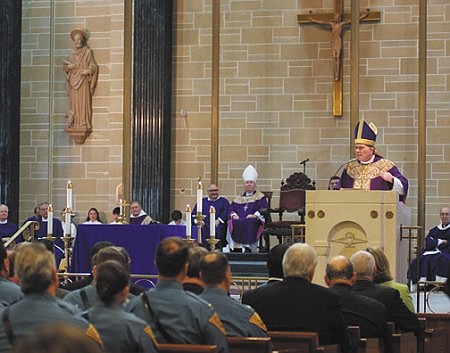
As the focus of the Second Vatican Council, evangelization and the call to transform the modern world included re-evangelizing those who have fallen away from Christ. This call was taken up by Blessed John Paul II, who coined the term “new evangelization” early in his pontificate when speaking about the need to awaken faith within the Church. It must be “new in ardor, methods and expression,” said the late pontiff.
The new evangelization has been moved forward by Pope Benedict XVI who created a special council for this purpose, and who declared a Year of Faith to re-focus hearts and minds on faith in Jesus Christ.
Inspired by the Year of Faith and the emphasis on the new evangelization in the Church, Bishop David M. O’Connell, C.M., published his first pastoral letter in September and called for the first diocesan Eucharistic Congress to open the Year of the Faith in October.
In his pastoral letter, Bishop O’Connell stresses, as greater numbers distance themselves from their faith and Church, “That the Church is ‘one, holy, catholic and apostolic’ … is a truth that must be recovered wherever and however it may be overshadowed by doubt or some other reason.”
The pastoral letter and the Eucharistic Congress have served as a foundation for an on-going revitalization of evangelization efforts in the diocese.
Formed in Faith
“It’s an exciting time,” said Father Douglas Freer, vicar, Office of Catholic Education and director of the Ministry of Catechesis and Evangelization, who explained that “evangelization and catechesis are two sides of the same coin.”
He noted that learning the faith is necessary in order to share the faith, which is the goal of evangelization. It is, he explained, a call to an encounter with Jesus Christ, reaching out in the love of Jesus Christ to others.
This need to learn the faith has been an impetus to integrating evangelization concepts in new catechetical materials and revamping how catechists – religious educators – are prepared.
In a letter to catechetical leaders, Father Freer stressed, “We live in a time when the new evangelization is in the forefront. Our task as catechists is not just to teach, but to form and to evangelize, or even re-evangelize those for whom the fire of faith may be just a small flicker.”
To this end, the new diocesan elementary religious education curriculum focuses on the basics of the faith, ties community service to the works of mercy, reconnects the Gospel and social justice, and connects all to the Eucharist. New catechetical materials also include components for engaging the family as the primary place of faith formation.
Noting there are more than 57,000 children in parish religious education programs and some 4,500 catechists, Father Freer explained there has also been a complete revamping of the catechetical certification program, a process for training religious educators to undertake their ministry, which includes online courses through the Satellite Theological Education Program in the Institute for Church Life at the University of Notre Dame, Ind., along with diocesan courses taught in person to adults. The program is run through the diocesan Department of Lay Formation.
These courses strengthen the foundational knowledge of the faith of those who are both evangelizing and catechizing children, explained Father Freer, allowing them to share what they know.
The diocesan curriculum for elementary schools has also been redesigned to add a section on evangelization to each area of content, and the sacramental preparation program is being strengthened with a special emphasis on reconciliation – a time of transformation and encountering Christ in mercy and forgiveness, said Father Freer.
Grown in Prayer
With the renewal of parish and family life an integral part of the new evangelization, there is a renewed focus on encouraging evangelization through a deeper, more informed practice of the faith. Adult faith formation opportunities, which allow participants to learn more about their faith and deepen their relationship with God, include Scripture study and prayer workshops.
There are a minimum of 40 scripture studies going on across the diocese, said Robert Bursley, diocesan coordinator of Small Christian Community Ministry, with some of the popular programs being the Great Adventure Bible Study, Ascension Press; Threshold Bible Studies, 23rd Publications, and Little Rock Bible Study, Liturgical Press.
Efforts are underway at both the diocesan and parish levels to introduce some of the Church’s richest prayer experiences to the faithful.
Lectio Divina, a Latin term which means ‘divine reading,’ is a way of reading the Scriptures slowly and reflectively and allowing a word or phrase to speak to the heart; a way of prayer that opens hearts to God.
Liturgy of the Hours, also called the Divine Office, is a response to Jesus’ command to pray without ceasing and provides the whole people of God with the opportunity to keep the day sacred through prayer at each hour of the day.
Together with the Mass, the Liturgy of the Hours is the official public worship of the Church. Its connection to the Eucharist is pivotal, said Bursley, who noted that participation in the Mass is the most powerful time of evangelization, of hearing the Gospel preached and being strengthened to go out and share faith and serve others.
In addition, said Bursley, gatherings such as small Christian communities and retreats are times of prayer, faith sharing, learning and support as participants go out in mission to evangelize each other and their respective communities.
Of special emphasis as agents of a new evangelization are lay ecclesial movements such as Catholic Charismatic Renewal and groups like Catholic Men for Jesus Christ.
Members of the CCR embrace the transforming power and gifts of the Holy Spirit for the work of the new evangelization. The vision of CCR is accomplished through prayer, study, community and evangelizing experiences such as the annual Diocesan Charismatic Rally, Life in the Spirit seminars, retreats, prayer meetings, Eucharistic Adoration and healing Masses. During the year some 2,500 participants engage in CCR activities, including an average of 700 people attending Life in Spirit Seminars and more than 800 at the 2012 CCR Rally.
CMFJC, which serves as a catalyst for men to form groups in their parishes, and which hosts an annual conference, provides men with an opportunity for prayer and faith exchange in a culture that is often hostile to faith. It also offers a youth component, supporting the direction of the bishops who stressed that youth “are not only the future but also the present (and gift) in the Church. They are not only the recipients but also agents of evangelization, especially with their peers.” Last year’s CMFJC conference hosted some 800 men, nearly double the number from the previous year.
Expressed in Community
A unique and widely embraced program designed as an invitation to inactive Catholics, is the award-winning, annual Christmas Carol Festival program, created by John Boucher, associate director of the diocesan Ministry of Catechesis and Evangelization, and his wife Therese, an adult religious educator. The program consists of a relaxed but structured hour-long experience of singing religious Christmas carols, prayer, witness statements and a procession of the statue of baby Jesus to the manger. The Gospel of Luke is read to close the event, followed by fellowship and invitations to future parish programs to encourage guests into a more active role within the parish family.
Some 21 parishes and 5,500 participants marked the sixth year of this innovative program, the key focus of which is “invitation,” explained Boucher, who also said that a similar focus is changing the culture in many parishes, as well. They are becoming “more welcoming and inviting,” he added.
Boucher also pointed to the availability of a parish partnership program in catechesis and evangelization providing training for parish-based outreach to inactive Catholics and the unchurched, offering as many as 12 varied programs running from two hours to a full day, serving as workshops, talks or retreats.
One topic in particular, “Walking with Jesus When the Power Goes Out!” focuses on suffering and the experience of loss, and is reflective of the Catholic pastoral call and spirituality of suffering “to reach out to those in need and share your faith,” said Boucher. The topic is particularly relevant in the wake of Hurricane Sandy and the continued needs of those impacted by the storm, said Boucher, who stressed that it’s not enough to serve. “We have to speak; we have to share that the reason we spearhead assistance efforts is because of who Jesus is to us,” he said.
Boucher also noted that, in cooperation with the diocesan Department of Lay Formation, a New Evangelization and Adult Faith Formation certificate program is being offered. The importance of such an offering, said Boucher, is so the “believing Catholic will know how to share their faith and offer the invitation.”
Transformed in Worship
Reflecting on the Mass as a profound opportunity in the lives of the faithful for transformation through an encounter with Christ in the Eucharist, Father Freer underscored the importance of formation for priests as leaders, shepherds and preachers. For this reason, he said, Bishop O’Connell has directed that specially prepared catechetical homilies aimed at building understanding of the main tenets of the faith be preached in all parishes on the second weekend of every month.
Recognizing the importance of the many and varied forms of evangelization efforts taking place is parishes, schools, ministries and organizations, Father Freer stressed the need to see “the bigger picture, which finds Catholics drawing an image of the Church from media and society.”
The response, said Father Freer, is to hold out the “invitation for the Year of Faith to come back to Church and encounter Christ, remembering that the Church is a vehicle, not the destination.”
For more information on evangelization programs and resources call John Boucher at 609-403-7190, or email at [email protected].
[[In-content Ad]]Related Stories
Friday, December 19, 2025


E-Editions
Events
As the focus of the Second Vatican Council, evangelization and the call to transform the modern world included re-evangelizing those who have fallen away from Christ. This call was taken up by Blessed John Paul II, who coined the term “new evangelization” early in his pontificate when speaking about the need to awaken faith within the Church. It must be “new in ardor, methods and expression,” said the late pontiff.
The new evangelization has been moved forward by Pope Benedict XVI who created a special council for this purpose, and who declared a Year of Faith to re-focus hearts and minds on faith in Jesus Christ.
Inspired by the Year of Faith and the emphasis on the new evangelization in the Church, Bishop David M. O’Connell, C.M., published his first pastoral letter in September and called for the first diocesan Eucharistic Congress to open the Year of the Faith in October.
In his pastoral letter, Bishop O’Connell stresses, as greater numbers distance themselves from their faith and Church, “That the Church is ‘one, holy, catholic and apostolic’ … is a truth that must be recovered wherever and however it may be overshadowed by doubt or some other reason.”
The pastoral letter and the Eucharistic Congress have served as a foundation for an on-going revitalization of evangelization efforts in the diocese.
Formed in Faith
“It’s an exciting time,” said Father Douglas Freer, vicar, Office of Catholic Education and director of the Ministry of Catechesis and Evangelization, who explained that “evangelization and catechesis are two sides of the same coin.”
He noted that learning the faith is necessary in order to share the faith, which is the goal of evangelization. It is, he explained, a call to an encounter with Jesus Christ, reaching out in the love of Jesus Christ to others.
This need to learn the faith has been an impetus to integrating evangelization concepts in new catechetical materials and revamping how catechists – religious educators – are prepared.
In a letter to catechetical leaders, Father Freer stressed, “We live in a time when the new evangelization is in the forefront. Our task as catechists is not just to teach, but to form and to evangelize, or even re-evangelize those for whom the fire of faith may be just a small flicker.”
To this end, the new diocesan elementary religious education curriculum focuses on the basics of the faith, ties community service to the works of mercy, reconnects the Gospel and social justice, and connects all to the Eucharist. New catechetical materials also include components for engaging the family as the primary place of faith formation.
Noting there are more than 57,000 children in parish religious education programs and some 4,500 catechists, Father Freer explained there has also been a complete revamping of the catechetical certification program, a process for training religious educators to undertake their ministry, which includes online courses through the Satellite Theological Education Program in the Institute for Church Life at the University of Notre Dame, Ind., along with diocesan courses taught in person to adults. The program is run through the diocesan Department of Lay Formation.
These courses strengthen the foundational knowledge of the faith of those who are both evangelizing and catechizing children, explained Father Freer, allowing them to share what they know.
The diocesan curriculum for elementary schools has also been redesigned to add a section on evangelization to each area of content, and the sacramental preparation program is being strengthened with a special emphasis on reconciliation – a time of transformation and encountering Christ in mercy and forgiveness, said Father Freer.
Grown in Prayer
With the renewal of parish and family life an integral part of the new evangelization, there is a renewed focus on encouraging evangelization through a deeper, more informed practice of the faith. Adult faith formation opportunities, which allow participants to learn more about their faith and deepen their relationship with God, include Scripture study and prayer workshops.
There are a minimum of 40 scripture studies going on across the diocese, said Robert Bursley, diocesan coordinator of Small Christian Community Ministry, with some of the popular programs being the Great Adventure Bible Study, Ascension Press; Threshold Bible Studies, 23rd Publications, and Little Rock Bible Study, Liturgical Press.
Efforts are underway at both the diocesan and parish levels to introduce some of the Church’s richest prayer experiences to the faithful.
Lectio Divina, a Latin term which means ‘divine reading,’ is a way of reading the Scriptures slowly and reflectively and allowing a word or phrase to speak to the heart; a way of prayer that opens hearts to God.
Liturgy of the Hours, also called the Divine Office, is a response to Jesus’ command to pray without ceasing and provides the whole people of God with the opportunity to keep the day sacred through prayer at each hour of the day.
Together with the Mass, the Liturgy of the Hours is the official public worship of the Church. Its connection to the Eucharist is pivotal, said Bursley, who noted that participation in the Mass is the most powerful time of evangelization, of hearing the Gospel preached and being strengthened to go out and share faith and serve others.
In addition, said Bursley, gatherings such as small Christian communities and retreats are times of prayer, faith sharing, learning and support as participants go out in mission to evangelize each other and their respective communities.
Of special emphasis as agents of a new evangelization are lay ecclesial movements such as Catholic Charismatic Renewal and groups like Catholic Men for Jesus Christ.
Members of the CCR embrace the transforming power and gifts of the Holy Spirit for the work of the new evangelization. The vision of CCR is accomplished through prayer, study, community and evangelizing experiences such as the annual Diocesan Charismatic Rally, Life in the Spirit seminars, retreats, prayer meetings, Eucharistic Adoration and healing Masses. During the year some 2,500 participants engage in CCR activities, including an average of 700 people attending Life in Spirit Seminars and more than 800 at the 2012 CCR Rally.
CMFJC, which serves as a catalyst for men to form groups in their parishes, and which hosts an annual conference, provides men with an opportunity for prayer and faith exchange in a culture that is often hostile to faith. It also offers a youth component, supporting the direction of the bishops who stressed that youth “are not only the future but also the present (and gift) in the Church. They are not only the recipients but also agents of evangelization, especially with their peers.” Last year’s CMFJC conference hosted some 800 men, nearly double the number from the previous year.
Expressed in Community
A unique and widely embraced program designed as an invitation to inactive Catholics, is the award-winning, annual Christmas Carol Festival program, created by John Boucher, associate director of the diocesan Ministry of Catechesis and Evangelization, and his wife Therese, an adult religious educator. The program consists of a relaxed but structured hour-long experience of singing religious Christmas carols, prayer, witness statements and a procession of the statue of baby Jesus to the manger. The Gospel of Luke is read to close the event, followed by fellowship and invitations to future parish programs to encourage guests into a more active role within the parish family.
Some 21 parishes and 5,500 participants marked the sixth year of this innovative program, the key focus of which is “invitation,” explained Boucher, who also said that a similar focus is changing the culture in many parishes, as well. They are becoming “more welcoming and inviting,” he added.
Boucher also pointed to the availability of a parish partnership program in catechesis and evangelization providing training for parish-based outreach to inactive Catholics and the unchurched, offering as many as 12 varied programs running from two hours to a full day, serving as workshops, talks or retreats.
One topic in particular, “Walking with Jesus When the Power Goes Out!” focuses on suffering and the experience of loss, and is reflective of the Catholic pastoral call and spirituality of suffering “to reach out to those in need and share your faith,” said Boucher. The topic is particularly relevant in the wake of Hurricane Sandy and the continued needs of those impacted by the storm, said Boucher, who stressed that it’s not enough to serve. “We have to speak; we have to share that the reason we spearhead assistance efforts is because of who Jesus is to us,” he said.
Boucher also noted that, in cooperation with the diocesan Department of Lay Formation, a New Evangelization and Adult Faith Formation certificate program is being offered. The importance of such an offering, said Boucher, is so the “believing Catholic will know how to share their faith and offer the invitation.”
Transformed in Worship
Reflecting on the Mass as a profound opportunity in the lives of the faithful for transformation through an encounter with Christ in the Eucharist, Father Freer underscored the importance of formation for priests as leaders, shepherds and preachers. For this reason, he said, Bishop O’Connell has directed that specially prepared catechetical homilies aimed at building understanding of the main tenets of the faith be preached in all parishes on the second weekend of every month.
Recognizing the importance of the many and varied forms of evangelization efforts taking place is parishes, schools, ministries and organizations, Father Freer stressed the need to see “the bigger picture, which finds Catholics drawing an image of the Church from media and society.”
The response, said Father Freer, is to hold out the “invitation for the Year of Faith to come back to Church and encounter Christ, remembering that the Church is a vehicle, not the destination.”
For more information on evangelization programs and resources call John Boucher at 609-403-7190, or email at [email protected].
[[In-content Ad]]