


The moral imperative of a living wage
July 29, 2019 at 12:37 p.m.
We’re in the homestretch of Christmas preparations, especially in relation to the material expressions of the season – the tree, the decorations, the cookies and the gifts to name but a few. Most family members who haven’t managed to get everything done by this point are likely spending a bit of time at their kitchen tables making their lists, checking them twice and trying to come up with a way to stretch their resources in order to get everything accomplished in time for the arrival of Christmas Day.
It is precisely at this time in the season, when we are in and out of stores, grabbing food on the go and seeing tired and harried employees working so hard to keep up with customers’ needs, that we might take the time to consider the plight of the minimum wage worker. While those of us who are fortunate enough to make a living wage warily watch our bank and credit card balances creep ever higher from all the Christmas purchases, we might consider what it is like for families who make only enough money to place them at or just above the nation’s poverty level. These are folks who struggle to pay their rent and put food on the table, sometimes working up to three jobs. Many are a paycheck away from being out on the street.
If we believe that our cultural celebration of Christmas with all the trimmings is a representation of the joy and beauty of the Christ Child coming into the world, we might ask ourselves what prospects exist for these families to experience this beauty and joy that we so fervently embrace for our own families. With one or both parents spending many hours working outside the home just to survive, and scant financial resources to even partially fill children’s wish lists, how can we realistically expect that their experience of Christmas will be filled with the same richness that reminds us of God’s abundant love for each and every one of his children?
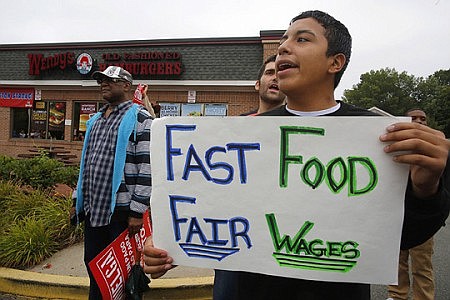
The debate over raising the minimum wage has made its way into our homes of late from the news coverage of fast food and retail employees walking off their jobs to demand an increase in pay. The labor action has drawn support from some factions, while others have said that a higher minimum wage will result in fewer jobs and overall be a detriment to the economy.
While people of good will might disagree on exactly what a living wage might be, few would argue that $7.25 per hour gets you there. And while many in the public square would regard the debate over the minimum wage as political, the moral imperative of paying workers a just wage has been enshrined in Catholic social teaching dating back to Pope Leo XIII’s encyclical “Rerum Novarum” in 1891.
At the turn of the century, the labor activist priest, Msgr. John Ryan, described a living wage in a document of the same name. He wrote that it is a term that describes the amount of wages needed to enable a person and one’s family “to live in a manner worthy of a human being.” We would understand that to go beyond paying for one’s basic needs, and be ample enough to give someone a source of hope, anticipation and motivation.
More recently, another measure that has been widely suggested is that no one who works full time should live in poverty. Period.
The debate over raising the minimum wage is an important issue for Catholics because of our beliefs. Let us hold those who are burdened with the constraints of low income in our prayers, especially through this Christmas season. And let us commit to advancing the cause of a living wage for all the members of our communities.
Some of the information for this piece was based on a Catholic News Service story written by Carol Zimmerman.
Related Stories
Thursday, December 18, 2025



E-Editions
Events
We’re in the homestretch of Christmas preparations, especially in relation to the material expressions of the season – the tree, the decorations, the cookies and the gifts to name but a few. Most family members who haven’t managed to get everything done by this point are likely spending a bit of time at their kitchen tables making their lists, checking them twice and trying to come up with a way to stretch their resources in order to get everything accomplished in time for the arrival of Christmas Day.
It is precisely at this time in the season, when we are in and out of stores, grabbing food on the go and seeing tired and harried employees working so hard to keep up with customers’ needs, that we might take the time to consider the plight of the minimum wage worker. While those of us who are fortunate enough to make a living wage warily watch our bank and credit card balances creep ever higher from all the Christmas purchases, we might consider what it is like for families who make only enough money to place them at or just above the nation’s poverty level. These are folks who struggle to pay their rent and put food on the table, sometimes working up to three jobs. Many are a paycheck away from being out on the street.
If we believe that our cultural celebration of Christmas with all the trimmings is a representation of the joy and beauty of the Christ Child coming into the world, we might ask ourselves what prospects exist for these families to experience this beauty and joy that we so fervently embrace for our own families. With one or both parents spending many hours working outside the home just to survive, and scant financial resources to even partially fill children’s wish lists, how can we realistically expect that their experience of Christmas will be filled with the same richness that reminds us of God’s abundant love for each and every one of his children?
The debate over raising the minimum wage has made its way into our homes of late from the news coverage of fast food and retail employees walking off their jobs to demand an increase in pay. The labor action has drawn support from some factions, while others have said that a higher minimum wage will result in fewer jobs and overall be a detriment to the economy.
While people of good will might disagree on exactly what a living wage might be, few would argue that $7.25 per hour gets you there. And while many in the public square would regard the debate over the minimum wage as political, the moral imperative of paying workers a just wage has been enshrined in Catholic social teaching dating back to Pope Leo XIII’s encyclical “Rerum Novarum” in 1891.
At the turn of the century, the labor activist priest, Msgr. John Ryan, described a living wage in a document of the same name. He wrote that it is a term that describes the amount of wages needed to enable a person and one’s family “to live in a manner worthy of a human being.” We would understand that to go beyond paying for one’s basic needs, and be ample enough to give someone a source of hope, anticipation and motivation.
More recently, another measure that has been widely suggested is that no one who works full time should live in poverty. Period.
The debate over raising the minimum wage is an important issue for Catholics because of our beliefs. Let us hold those who are burdened with the constraints of low income in our prayers, especially through this Christmas season. And let us commit to advancing the cause of a living wage for all the members of our communities.
Some of the information for this piece was based on a Catholic News Service story written by Carol Zimmerman.