


'That all may be one': Embracing the spirit of the Reformation
July 29, 2019 at 12:37 p.m.
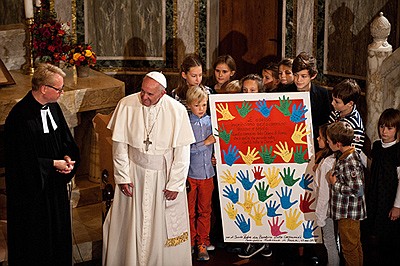
The following commentary first appeared in the Jan. 27 issue of Our Sunday Visitor, a national Catholic newsweekly based in Huntington, Indiana. It was written by the newspaper's editorial board and appears here through Catholic News Service.
The Vatican announced Jan. 25 that Pope Francis will travel to Sweden in October to commemorate the 500th anniversary of the start of the Reformation, which begins in 2017. The event will be ecumenical in nature, and Pope Francis will be joined by leaders of the Lutheran World Federation and other representatives of Christian faiths. According to Vatican Radio, the event will "highlight the important ecumenical developments that have taken place during the past 50 years of dialogue between Catholics and Lutherans."
In the 50 years since the conclusion of the Second Vatican Council, the Church has made great advancements in terms of ecumenical and interreligious dialogue. They continue today, both at the Vatican level and also here in the United States.
For Pope Francis, ecumenical dialogue continues the pattern of his predecessors, especially St. John Paul II and Pope Benedict XVI. St. John Paul greatly advanced Christian unity, establishing the Pontifical Council for Promoting Christian Unity and issuing the encyclical "Ut unum sint" ("On commitment to ecumenism"). Pope Benedict carried on this effort toward unity, both outside of and within the Church, urging the commitment of all.
"The full and visible Christian unity that we long for demands that we let ourselves be transformed and that we conform ever more perfectly to the image of Christ," Pope Benedict said. "The unity we pray for requires an inner conversion that is both common and personal. It is not merely a matter of cordiality or cooperation, it is necessary above all to strengthen our faith in God, in the God of Jesus Christ, who spoke to us and made himself one of us."
Pope Francis brings ecumenism to a personal level. During the recent Week of Prayer for Christian Unity at the end of January, Pope Francis called the "sins of our divisions" an "open wound in the body of Christ." Modeling the way, he, too, asked "for mercy and forgiveness for the behavior of Catholics toward Christians of other Churches, which has not reflected Gospel values." He encouraged all Catholics at the same time to forgive other Christians who may have at one time offended them. "We cannot cancel out what has happened, but we do not want to let the weight of past faults continue to contaminate our relationships," he said. "God's mercy will renew our relationships."
Christian unity has a natural tension, and to ignore it would be to make light of some very real challenges. Pope Benedict's careful teachings reminded the Church that, while dialogue between faiths is critical, it's essential for this dialogue to "aim at something more than a consensus regarding ways to implement practical strategies for advancing peace. The broader purpose of dialogue is to discover the truth," he said. While the Church is a strong proponent of ecumenism, it also must be honest. The challenge is to continue to find points of convergence, while at the same time honestly recognizing differences. The Church desires a unity, but unity must rest in truth.
All signs point to ecumenism as a main theme of Pope Francis' pontificate in 2016 and beyond. For Catholics in the pew, in a more practical way, ecumenism is a challenge, but a challenge first presented by the Lord himself, "that all may be one." This mindset is especially needed as affiliation with religion continues to drop in both the United States and Europe. Now is the time for people of faith to band together in prayer and to work together in friendship and faith.- - -
The views or positions presented in this or any guest editorial are those of the individual publication and do not necessarily represent the views of Catholic News Service, the U.S. Conference of Catholic Bishops, the Diocese of Trenton or The Monitor.
[[In-content Ad]]Related Stories
Friday, December 19, 2025




E-Editions
Events
The following commentary first appeared in the Jan. 27 issue of Our Sunday Visitor, a national Catholic newsweekly based in Huntington, Indiana. It was written by the newspaper's editorial board and appears here through Catholic News Service.
The Vatican announced Jan. 25 that Pope Francis will travel to Sweden in October to commemorate the 500th anniversary of the start of the Reformation, which begins in 2017. The event will be ecumenical in nature, and Pope Francis will be joined by leaders of the Lutheran World Federation and other representatives of Christian faiths. According to Vatican Radio, the event will "highlight the important ecumenical developments that have taken place during the past 50 years of dialogue between Catholics and Lutherans."
In the 50 years since the conclusion of the Second Vatican Council, the Church has made great advancements in terms of ecumenical and interreligious dialogue. They continue today, both at the Vatican level and also here in the United States.
For Pope Francis, ecumenical dialogue continues the pattern of his predecessors, especially St. John Paul II and Pope Benedict XVI. St. John Paul greatly advanced Christian unity, establishing the Pontifical Council for Promoting Christian Unity and issuing the encyclical "Ut unum sint" ("On commitment to ecumenism"). Pope Benedict carried on this effort toward unity, both outside of and within the Church, urging the commitment of all.
"The full and visible Christian unity that we long for demands that we let ourselves be transformed and that we conform ever more perfectly to the image of Christ," Pope Benedict said. "The unity we pray for requires an inner conversion that is both common and personal. It is not merely a matter of cordiality or cooperation, it is necessary above all to strengthen our faith in God, in the God of Jesus Christ, who spoke to us and made himself one of us."
Pope Francis brings ecumenism to a personal level. During the recent Week of Prayer for Christian Unity at the end of January, Pope Francis called the "sins of our divisions" an "open wound in the body of Christ." Modeling the way, he, too, asked "for mercy and forgiveness for the behavior of Catholics toward Christians of other Churches, which has not reflected Gospel values." He encouraged all Catholics at the same time to forgive other Christians who may have at one time offended them. "We cannot cancel out what has happened, but we do not want to let the weight of past faults continue to contaminate our relationships," he said. "God's mercy will renew our relationships."
Christian unity has a natural tension, and to ignore it would be to make light of some very real challenges. Pope Benedict's careful teachings reminded the Church that, while dialogue between faiths is critical, it's essential for this dialogue to "aim at something more than a consensus regarding ways to implement practical strategies for advancing peace. The broader purpose of dialogue is to discover the truth," he said. While the Church is a strong proponent of ecumenism, it also must be honest. The challenge is to continue to find points of convergence, while at the same time honestly recognizing differences. The Church desires a unity, but unity must rest in truth.
All signs point to ecumenism as a main theme of Pope Francis' pontificate in 2016 and beyond. For Catholics in the pew, in a more practical way, ecumenism is a challenge, but a challenge first presented by the Lord himself, "that all may be one." This mindset is especially needed as affiliation with religion continues to drop in both the United States and Europe. Now is the time for people of faith to band together in prayer and to work together in friendship and faith.- - -
The views or positions presented in this or any guest editorial are those of the individual publication and do not necessarily represent the views of Catholic News Service, the U.S. Conference of Catholic Bishops, the Diocese of Trenton or The Monitor.
[[In-content Ad]]