


Symposium on Sacred Liturgy enlightens ministers
July 29, 2019 at 12:37 p.m.
By David Kilby | Correspondent
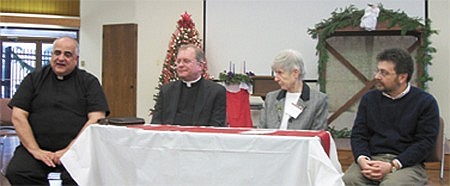
Fifty years after the Second Vatican Council, liturgical scholars are still unpacking the Constitution of the Sacred Liturgy promulgated by the council. On Dec. 14, St. Robert Bellarmine Parish, Freehold, hosted a symposium on the constitution with Msgr. Sam Sirianni, pastor; Father Dennis Gill, director of the Office of Divine Worship in the Archdiocese of Philadelphia; Kean University history professor, Dr. Christopher Bellitto, and Sister of St. Joseph Rose McDermott of the diocesan Office of Clergy and Consecrated Life. The symposium was sponsored by the diocesan office of worship.
“It took 50 years to get us where we are now,” Msgr. Sirianni said, adding that it will take 150 years to unpack the constitution. “The first 50 years will get us in the same book. The next 50 years will get us in the same chapter. The last 50 years will get us on the same page.”
Sister Rose, a former professor of canon law in The Catholic University of America, Washington, recalled once speaking with Cardinal John Krol, former archbishop of Philadelphia about his experience in attending the council. The cardinal mentioned how the world’s bishops were ‘at the knees of theologians’ who were experts in their specialized fields.
Sister Rose noted that if it was difficult for the bishops to unpack all they absorbed from experts, it’s going to take everyone else a long time as well.
In his talk “Effects of the Constitution of Sacred Liturgy on Liturgical Ministries and Ministers,” Father Gill spoke of the significant number of Catholics who do not see the value in the structure of the liturgical calendar.
“The one thing we’ve lost sight of is that the calendar in itself is a medium of the mystery of Christ,” Father Gill told the approximately 50 liturgical ministers gathered at the symposium.
“Unless we wait, we cannot prepare,” he said. “Unless we prepare, we will not be ready.”
He also discussed the importance of sacred music, art and architecture and its relation to the liturgy.
“The music is to be suitable to the celebration” and must communicate the mystery being celebrated, he explained. “When it comes to the art and architecture... is it truly oriented to God and what he does?”
He also mentioned how Pope Benedict XVI saw beauty as a way to the divine, echoing his idea that ‘when we see something beautiful we’re immediately drawn to something else, something higher; we’re immediately drawn to God.’ Father Gill spoke of the need for a “liturgical spirituality” that is “always living in communion with him, offering our life to him,” explaining that everything liturgical ministers do must be about evangelization, pointing people to Christ.
Dr. Bellitto gave a summary of the history of reform in the Church in his talk “Liturgical Path Back to the Future.”
“Reform is never neat and clean,” he said, “nor black and white. It’s messy and grey, and Pope Francis is asking us to be comfortable with that climate. He’s asking people at the grassroots level to take charge of that reform.”
Deacon George Swanson of St. Barnabas Parish, Bayville, said the symposium helped to clarify contemporary liturgical concepts related to his ministry.
“It has challenged me to live my faith as a way of preaching. I’m very grateful,” he said.
Deacon Nick Stranieri of Visitation Parish, Brick said the symposium reminded liturgical ministers of “the purpose, the need, the want for the Mass.”
“It enlightened us more, besides continuing our education through life.... Every now and then you need this reawakening – and in this Advent season, we need that.”
Related Stories
Thursday, December 18, 2025

E-Editions
Events
By David Kilby | Correspondent
Fifty years after the Second Vatican Council, liturgical scholars are still unpacking the Constitution of the Sacred Liturgy promulgated by the council. On Dec. 14, St. Robert Bellarmine Parish, Freehold, hosted a symposium on the constitution with Msgr. Sam Sirianni, pastor; Father Dennis Gill, director of the Office of Divine Worship in the Archdiocese of Philadelphia; Kean University history professor, Dr. Christopher Bellitto, and Sister of St. Joseph Rose McDermott of the diocesan Office of Clergy and Consecrated Life. The symposium was sponsored by the diocesan office of worship.
“It took 50 years to get us where we are now,” Msgr. Sirianni said, adding that it will take 150 years to unpack the constitution. “The first 50 years will get us in the same book. The next 50 years will get us in the same chapter. The last 50 years will get us on the same page.”
Sister Rose, a former professor of canon law in The Catholic University of America, Washington, recalled once speaking with Cardinal John Krol, former archbishop of Philadelphia about his experience in attending the council. The cardinal mentioned how the world’s bishops were ‘at the knees of theologians’ who were experts in their specialized fields.
Sister Rose noted that if it was difficult for the bishops to unpack all they absorbed from experts, it’s going to take everyone else a long time as well.
In his talk “Effects of the Constitution of Sacred Liturgy on Liturgical Ministries and Ministers,” Father Gill spoke of the significant number of Catholics who do not see the value in the structure of the liturgical calendar.
“The one thing we’ve lost sight of is that the calendar in itself is a medium of the mystery of Christ,” Father Gill told the approximately 50 liturgical ministers gathered at the symposium.
“Unless we wait, we cannot prepare,” he said. “Unless we prepare, we will not be ready.”
He also discussed the importance of sacred music, art and architecture and its relation to the liturgy.
“The music is to be suitable to the celebration” and must communicate the mystery being celebrated, he explained. “When it comes to the art and architecture... is it truly oriented to God and what he does?”
He also mentioned how Pope Benedict XVI saw beauty as a way to the divine, echoing his idea that ‘when we see something beautiful we’re immediately drawn to something else, something higher; we’re immediately drawn to God.’ Father Gill spoke of the need for a “liturgical spirituality” that is “always living in communion with him, offering our life to him,” explaining that everything liturgical ministers do must be about evangelization, pointing people to Christ.
Dr. Bellitto gave a summary of the history of reform in the Church in his talk “Liturgical Path Back to the Future.”
“Reform is never neat and clean,” he said, “nor black and white. It’s messy and grey, and Pope Francis is asking us to be comfortable with that climate. He’s asking people at the grassroots level to take charge of that reform.”
Deacon George Swanson of St. Barnabas Parish, Bayville, said the symposium helped to clarify contemporary liturgical concepts related to his ministry.
“It has challenged me to live my faith as a way of preaching. I’m very grateful,” he said.
Deacon Nick Stranieri of Visitation Parish, Brick said the symposium reminded liturgical ministers of “the purpose, the need, the want for the Mass.”
“It enlightened us more, besides continuing our education through life.... Every now and then you need this reawakening – and in this Advent season, we need that.”