


Seminarian clerkship's case study approach praised by participants
July 29, 2019 at 12:37 p.m.
By EmmaLee Italia | Contributing Editor
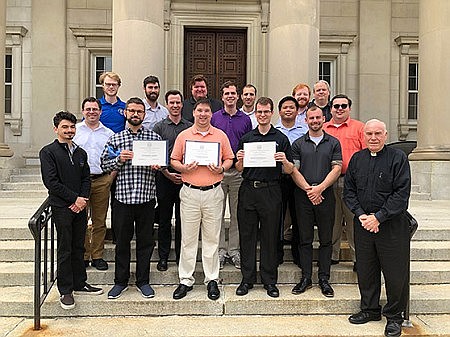
For the fifth year running, the clerkship program for seminarians saw robust participation, including 14 seminarians of the Diocese of Trenton and two from the Archdiocese of Philadelphia.
“The week was excellent – the men were impressed,” said Msgr. Thomas Mullelly, diocesan vicar for clergy and consecrated life and director of seminarians.
The one-week program held June 3-7 at St. Charles Borromeo Seminary in Wynnewood, Pa., was instituted in 2015 by Bishop David M. O’Connell, C.M. It is a collaboration between the Diocese of Trenton and the Center for Church Management and Business Ethics in Villanova University, Villanova, Pa. The intensive workshop introduces seminarians to various practical aspects of church management. Topics covered fall outside the traditional seminary curricula – parish finances, marriage counseling, strategic planning and legal responsibilities related to parish ministry.
“They liked the case study approach – they were given a project the first day and had to work in a group of three to analyze decision-making based on what they received in the various classes,” Msgr. Mullelly said.
A new addition this year, the case study project involved a real diocese, the Diocese of St. John’s in Canada, and the seminarians had to decide how to deal with the need to link, close or merge a variety of parishes, and make a recommendation for what should be done. The project concluded with a group presentation in lieu of a final exam.
“They actually had to play the role of bishop, to say which of the options would be used to reduce the whole diocese to 17, 10 and four parishes,” Msgr. Mullelly said. “The techniques that they learned – dealing with employees, human resource management, fiscal management, legal issues and group dynamics – were very helpful.”
The project, he said, was based on how business and law schools use case studies as teaching tools, training students to use cases as examples of how issues were handled in similar situations.
Seminarians participate in the program each year of their formation, receiving a certificate after three years, then continuing to participate up until ordination.
“They hear it, they hear it again, and there’s kind of a change-up [of information] – but we want to be ‘eyes wide open,’ aware of those issues that may beyond what they get in seminary,” Msgr. Mullelly explained. “They may not become an expert business manager, but they become attentive to issues that they need, as a pastor and even as a parochial vicar, to be sensitive to. And most importantly, [they learn] to understand [their] limitations. You make think you know it all, but you don’t – so refer to diocesan and other resources, and develop and utilize the great talents that may exist in your congregation.”
Practically, the clerkship program gives seminarians some real tools and awareness for what they will face as future pastors of parishes.
“Not everything’s a theological issue,” Msgr. Mullelly noted. “[The clerkship introduces] issues like working with other people; the ability to refer an issue to somebody who perhaps is in a better position and has the insights and experience to better respond to that issue; to be attentive to the public policy issues which may impact on ministry … We don’t live in isolation from the circumspection of other constituencies in our society – that’s important for us to realize.”
William Clingerman, a seminarian in his third year of formation in Mount St. Mary Seminary, Emmitsburg, Md., received a Certificate of Church Management following his participation in the clerkship this year.
“I thought the program was better [this year], insofar as it was more engaging with the case studies, and actually getting to look at real parish situations,” Clingerman said. “The lectures … definitely helped solidify the more practical aspects of parish life.”
A native of East Windsor who now lives in Jackson, Clingerman found his third year of the clerkship program valuable.
“Finance, human resource management – these are essential tools for running a parish effectively,” he affirmed. “It’s not just a general understanding, but some more particular knowledge … I definitely took away a few things I didn’t know previously, particularly in personal finance. Hopefully, it will make us all better priests in the future.”
[[In-content Ad]]
Related Stories
Sunday, December 28, 2025

E-Editions
Events
By EmmaLee Italia | Contributing Editor
For the fifth year running, the clerkship program for seminarians saw robust participation, including 14 seminarians of the Diocese of Trenton and two from the Archdiocese of Philadelphia.
“The week was excellent – the men were impressed,” said Msgr. Thomas Mullelly, diocesan vicar for clergy and consecrated life and director of seminarians.
The one-week program held June 3-7 at St. Charles Borromeo Seminary in Wynnewood, Pa., was instituted in 2015 by Bishop David M. O’Connell, C.M. It is a collaboration between the Diocese of Trenton and the Center for Church Management and Business Ethics in Villanova University, Villanova, Pa. The intensive workshop introduces seminarians to various practical aspects of church management. Topics covered fall outside the traditional seminary curricula – parish finances, marriage counseling, strategic planning and legal responsibilities related to parish ministry.
“They liked the case study approach – they were given a project the first day and had to work in a group of three to analyze decision-making based on what they received in the various classes,” Msgr. Mullelly said.
A new addition this year, the case study project involved a real diocese, the Diocese of St. John’s in Canada, and the seminarians had to decide how to deal with the need to link, close or merge a variety of parishes, and make a recommendation for what should be done. The project concluded with a group presentation in lieu of a final exam.
“They actually had to play the role of bishop, to say which of the options would be used to reduce the whole diocese to 17, 10 and four parishes,” Msgr. Mullelly said. “The techniques that they learned – dealing with employees, human resource management, fiscal management, legal issues and group dynamics – were very helpful.”
The project, he said, was based on how business and law schools use case studies as teaching tools, training students to use cases as examples of how issues were handled in similar situations.
Seminarians participate in the program each year of their formation, receiving a certificate after three years, then continuing to participate up until ordination.
“They hear it, they hear it again, and there’s kind of a change-up [of information] – but we want to be ‘eyes wide open,’ aware of those issues that may beyond what they get in seminary,” Msgr. Mullelly explained. “They may not become an expert business manager, but they become attentive to issues that they need, as a pastor and even as a parochial vicar, to be sensitive to. And most importantly, [they learn] to understand [their] limitations. You make think you know it all, but you don’t – so refer to diocesan and other resources, and develop and utilize the great talents that may exist in your congregation.”
Practically, the clerkship program gives seminarians some real tools and awareness for what they will face as future pastors of parishes.
“Not everything’s a theological issue,” Msgr. Mullelly noted. “[The clerkship introduces] issues like working with other people; the ability to refer an issue to somebody who perhaps is in a better position and has the insights and experience to better respond to that issue; to be attentive to the public policy issues which may impact on ministry … We don’t live in isolation from the circumspection of other constituencies in our society – that’s important for us to realize.”
William Clingerman, a seminarian in his third year of formation in Mount St. Mary Seminary, Emmitsburg, Md., received a Certificate of Church Management following his participation in the clerkship this year.
“I thought the program was better [this year], insofar as it was more engaging with the case studies, and actually getting to look at real parish situations,” Clingerman said. “The lectures … definitely helped solidify the more practical aspects of parish life.”
A native of East Windsor who now lives in Jackson, Clingerman found his third year of the clerkship program valuable.
“Finance, human resource management – these are essential tools for running a parish effectively,” he affirmed. “It’s not just a general understanding, but some more particular knowledge … I definitely took away a few things I didn’t know previously, particularly in personal finance. Hopefully, it will make us all better priests in the future.”
[[In-content Ad]]