


On Journey -- Catechists receive instruction, encouragement during workshop
July 29, 2019 at 12:37 p.m.
By Mary Stadnyk |Associate Editor
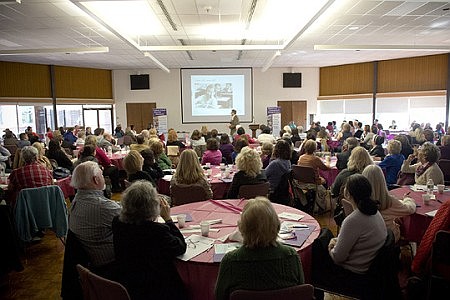
When it comes to providing instruction on the Catholic faith, Bishop David M. O’Connell, C.M., pointed out that catechists are presented with some major challenges.
On one hand, catechists have to remember that the mission of the Catholic Church has not changed in the more than 2,000 years since it was established. On the other hand, they have to find ways to present the teachings of the Catholic Church in a contemporary fashion to their students.
“Adaption is the key to survival,” Bishop O’Connell said in his homily to the approximately 250 catechists from around the Diocese who gathered for an April 5 Mass and workshop in St. Robert Bellarmine Parish, Freehold.
“The Church has continued to call on, believe in, preach and teach Jesus Christ, the Gospel, the deposit of faith. That aspect of the Church has not changed,” said Bishop O’Connell. “What has and continues to change is the way that the Church presents the Catholic faith to an ever changing community of believers.”
Hosted by the diocesan Ministry of Catechesis and Evangelization, the day began with a Mass celebrated by Bishop O’Connell in St. Robert Bellarmine Church. A keynote presentation followed by renowned catechist and author Joe Paprocki, who focused his topic on the day’s theme, “A Catechists’ Journey.”
Essential Elements of Catechesis
In his homily, Bishop O’Connell reflected on the privilege it is to serve in catechetical ministry. Although he acknowledged that there are many credible models of catechesis, the Bishop reviewed what he regarded as being “essential elements” for effective catechesis and to serve as effective catechists. The “essential elements” were: identity, instruction, imagination, inspiration and invitation.
“Know what you are teaching about faith, doctrine, morality, justice as the Church instructs,” the Bishop cautioned when he spoke on the element of instruction. “Don’t make it up as you go along…”
Encouraging the catechists to use their imaginations when instructing their students, Bishop O’Connell exhorted them to “use every creative bone in your body to engage your students and keep their interest by appealing to their imagination. Make real connections between what you teach and the world we live in.”
In their instruction, Bishop O’Connell reminded the catechists that their ministry “has to lead somewhere.”
“It has to make a difference; there has to be a take away for them…The work you do as catechists is the Lord Jesus Christ alive,” said Bishop O’Connell. “He makes evangelization ‘new’ all the time, every time. Call on him whenever you teach… since he is what you are teaching.”
Bringing young people to Jesus
In his keynote presentation, Paprocki discussed practical classroom techniques that can help children and teenagers come to know Jesus in a more personal way.
Paprocki, a father of two and catechist in his Illinois parish, is the national consultant for faith formation for Loyola Press. He has written several books aimed at teaching the Catholic faith to young people.
“As catechists, we need to remember that we are not teaching a subject; we are facilitating an encounter with Jesus,” said Paprocki.
“Such an encounter involves more than words: it requires a language of mystery (sign and symbol) that goes deeper than words. We use this language of mystery at Mass. However, too often, when we are engaged in catechesis, we forget this language and rely totally on words. We need to incorporate liturgical language – sign, symbol, gesture – into our catechists so that our faith formation sessions resemble Mass more than class!” Paprocki asserted.
Paprocki reminded the audience of predominantly religious education instructors that the teaching techniques he offered were “not just for children,” but also applicable to other ministries such as Rite of Christian Initiation of Adults, adult faith formation and youth ministry.
“It is especially key in the Rite of Christian Initiation of Adults which is primarily a liturgical rite, not a class!” he said.
“Any catechetical gathering can and should include liturgical actions and language,” he said, offering the examples of people blessing themselves with holy water, making the three-fold Sign of the Cross with their thumb on their foreheads, lips and chest, incorporating sacred art and symbols or participating in a procession.
A Prayerful Environment
Paprocki also cautioned that prayer “must never be sacrificed in catechesis because we feel pressured to teach doctrinal content.”
“Prayer is part of our content!” Paprocki said. “It is one of the four pillars of the Catechism of the Catholic Church and I believe it holds the key for transforming our catechetical experiences from teaching a subject to facilitating an encounter with the Risen Christ.”
Susan Carpenter, a second grade catechist in St. John Parish, Lakehurst, and Rich Haas, a self-described first-year “rookie” catechist in Visitation Parish, Brick, remarked on Paprocki’s session and how teaching catechesis effectively can be accomplished.
“It was good to learn new ideas to keep the kids’ attention and interested,” said Carpenter, adding that she was especially interested to hear the importance of establishing a climate of prayer for her students.
“We have to remember that we are not teaching a subject, we are helping to facilitate an encounter with Christ,” she said.
“I was very impressed on the convergence between Bishop O’Connell’s homily and the thrust of Joe Paprocki’s presentation. Both men emphasized the fact that instruction is only part of the catechist’s mission,” Haas added.
[[In-content Ad]]Related Stories
Friday, December 19, 2025





E-Editions
Events
By Mary Stadnyk |Associate Editor
When it comes to providing instruction on the Catholic faith, Bishop David M. O’Connell, C.M., pointed out that catechists are presented with some major challenges.
On one hand, catechists have to remember that the mission of the Catholic Church has not changed in the more than 2,000 years since it was established. On the other hand, they have to find ways to present the teachings of the Catholic Church in a contemporary fashion to their students.
“Adaption is the key to survival,” Bishop O’Connell said in his homily to the approximately 250 catechists from around the Diocese who gathered for an April 5 Mass and workshop in St. Robert Bellarmine Parish, Freehold.
“The Church has continued to call on, believe in, preach and teach Jesus Christ, the Gospel, the deposit of faith. That aspect of the Church has not changed,” said Bishop O’Connell. “What has and continues to change is the way that the Church presents the Catholic faith to an ever changing community of believers.”
Hosted by the diocesan Ministry of Catechesis and Evangelization, the day began with a Mass celebrated by Bishop O’Connell in St. Robert Bellarmine Church. A keynote presentation followed by renowned catechist and author Joe Paprocki, who focused his topic on the day’s theme, “A Catechists’ Journey.”
Essential Elements of Catechesis
In his homily, Bishop O’Connell reflected on the privilege it is to serve in catechetical ministry. Although he acknowledged that there are many credible models of catechesis, the Bishop reviewed what he regarded as being “essential elements” for effective catechesis and to serve as effective catechists. The “essential elements” were: identity, instruction, imagination, inspiration and invitation.
“Know what you are teaching about faith, doctrine, morality, justice as the Church instructs,” the Bishop cautioned when he spoke on the element of instruction. “Don’t make it up as you go along…”
Encouraging the catechists to use their imaginations when instructing their students, Bishop O’Connell exhorted them to “use every creative bone in your body to engage your students and keep their interest by appealing to their imagination. Make real connections between what you teach and the world we live in.”
In their instruction, Bishop O’Connell reminded the catechists that their ministry “has to lead somewhere.”
“It has to make a difference; there has to be a take away for them…The work you do as catechists is the Lord Jesus Christ alive,” said Bishop O’Connell. “He makes evangelization ‘new’ all the time, every time. Call on him whenever you teach… since he is what you are teaching.”
Bringing young people to Jesus
In his keynote presentation, Paprocki discussed practical classroom techniques that can help children and teenagers come to know Jesus in a more personal way.
Paprocki, a father of two and catechist in his Illinois parish, is the national consultant for faith formation for Loyola Press. He has written several books aimed at teaching the Catholic faith to young people.
“As catechists, we need to remember that we are not teaching a subject; we are facilitating an encounter with Jesus,” said Paprocki.
“Such an encounter involves more than words: it requires a language of mystery (sign and symbol) that goes deeper than words. We use this language of mystery at Mass. However, too often, when we are engaged in catechesis, we forget this language and rely totally on words. We need to incorporate liturgical language – sign, symbol, gesture – into our catechists so that our faith formation sessions resemble Mass more than class!” Paprocki asserted.
Paprocki reminded the audience of predominantly religious education instructors that the teaching techniques he offered were “not just for children,” but also applicable to other ministries such as Rite of Christian Initiation of Adults, adult faith formation and youth ministry.
“It is especially key in the Rite of Christian Initiation of Adults which is primarily a liturgical rite, not a class!” he said.
“Any catechetical gathering can and should include liturgical actions and language,” he said, offering the examples of people blessing themselves with holy water, making the three-fold Sign of the Cross with their thumb on their foreheads, lips and chest, incorporating sacred art and symbols or participating in a procession.
A Prayerful Environment
Paprocki also cautioned that prayer “must never be sacrificed in catechesis because we feel pressured to teach doctrinal content.”
“Prayer is part of our content!” Paprocki said. “It is one of the four pillars of the Catechism of the Catholic Church and I believe it holds the key for transforming our catechetical experiences from teaching a subject to facilitating an encounter with the Risen Christ.”
Susan Carpenter, a second grade catechist in St. John Parish, Lakehurst, and Rich Haas, a self-described first-year “rookie” catechist in Visitation Parish, Brick, remarked on Paprocki’s session and how teaching catechesis effectively can be accomplished.
“It was good to learn new ideas to keep the kids’ attention and interested,” said Carpenter, adding that she was especially interested to hear the importance of establishing a climate of prayer for her students.
“We have to remember that we are not teaching a subject, we are helping to facilitate an encounter with Christ,” she said.
“I was very impressed on the convergence between Bishop O’Connell’s homily and the thrust of Joe Paprocki’s presentation. Both men emphasized the fact that instruction is only part of the catechist’s mission,” Haas added.
[[In-content Ad]]