


New diocesan initiative works to strengthen marriage, family
July 29, 2019 at 12:37 p.m.
Rated high among today’s TV reality shows are those having to do with weddings. “Bridezilla,” “For Better or For Worse,” “Whose Wedding Is It Anyway,” and “Say ‘Yes’ to the Dress” offer a variety of scenarios created around planning a wedding, some funny, some entertaining and some downright disturbing.
But when it comes to learning what it means to say “yes” to a spouse on that life-changing day when couples marry, there is a dirth of opportunity within the prevailing culture for a genuine understanding of the reality of marriage – particularly, for Catholics, as a sacrament.
“Society is putting the emphasis on the wedding. We are helping prepare people for a lifelong sacrament, a covenant, that is the Sacrament of Marriage,” said Linda Richardson, diocesan director, Department of Youth, Marriage and Family Life, who explained a three-stage diocesan initiative to emphasize the importance of sacramental marriage to the Church and society, and to discover ways to support those entering and living within the sacrament.
Richardson, along with Terry Ginther, executive director for the Office of Pastoral Life and Mission, and Peg Hensler, program coordinator for Marriage Ministries, began crafting a plan in early 2012. A pivotal point of emphasis is the Sacrament of Marriage as part of the continuum of faith formation within the Church. Because preparation for this sacrament begins at the start of the life, and must be nurtured throughout, the trio agreed it was important to have all pastoral care ministries represented in the process.
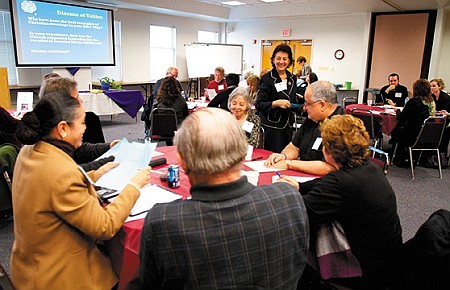
Stage one of the plan included a number of marriage symposiums scheduled in each county between Sept. 22 and Dec. 11 to examine pastoral practices concerning marriage. Five-hour sessions were held in the Diocesan Chancery, Lawrenceville; St. Barnabas Parish, Bayville; St. Mary Parish, Colts Neck, and Holy Eucharist Parish, Tabernacle. Nearly 100 representatives from all areas of pastoral ministry participated, including priests, campus ministers, Pre-Cana instructors, youth ministers, social workers, counselors, teachers, parishioners and others who minister to Catholics throughout the life spectrum.
During each symposium participants had an opportunity to explore current data, share lived experience and delve into marriage-related issues from a variety of perspectives. Among the data shared by symposia presenters, Ginther, Hensler and Richardson, included the fact that the number of Catholic marriages in the Diocese of Trenton has declined at a rate of almost three times that of the general four-county population. The number of Catholic marriages decreased by 50 percent between 1990 and 2007. The decline for the general population, including Catholic marriage, stood at 18 percent.
“This represents a real challenge – how do we help Catholics understand the treasure of Catholic marriage?” Richardson reflected, noting that each person’s understanding of marriage and family life is developed from the earliest phases of life.
She explained that, according to the Pontifical Council for Family, remote formation begins in the womb, when a child first absorbs the emotional atmosphere in which he or she is awaited and welcomed by his parents. At different ages, the human person grows in their understanding of relationships, and interactions with persons of the same and opposite gender take on new meaning as the child becomes an adolescent, gradually maturing into a young adult. Formation in marriage continues throughout adulthood.
Symposia participants agreed that secular culture is having a profound effect on the idea of marriage within the younger population. Reality shows portray weddings as high-budget parties and give little attention to the wedding as the celebration of a sacrament that unites two people for a lifetime.
Participating groups also felt it was important to re-focus on the positives of marriage as a source of ongoing grace for the couple and its benefit in further cementing one’s relationship with God and the Church. Some of the “barriers” they often hear about when talking to young engaged couples: 12-month advance preparation requirement, participation in a Pre-Cana workshop, and the lack of geographic choices for the wedding itself, participants shared.
Additional observations related to the changing make-up of today’s engaged couples, from older parishioners who are marrying for the second time, to the increasing number of people who meet online. Attendees felt it was critical to offer a warm welcome and congratulations to all those who wish to marry in the Church, and many supported a formalized mentoring program for couples entering into marriage.
As part of the next stage, all feedback will be entrusted to a Committee on Marriage to be formed by Bishop David M. O’Connell, C. M., in early 2013. According to Ginther and Richardson, “This committee will take up
to a year studying both the assessments and recommendations for the diocese, as well as for parish committees.” Focus groups will be conducted, gathering feedback from people within and outside the Church.
All of these efforts will culminate in the third stage, a Marriage Summit, which will take place in 2014. Information gained from this process will then be incorporated into the set of pastoral priorities which is expected to be updated in 2014.
At the close of the symposia, Richardson offered, “We were able to get a wide variety of perspectives from the participants, who came from many different areas of ministry and walks of life. This was part of our plan – because the work of strengthening marriages and family life is shared by all of the members of the Church, in a variety of ways and circumstances.
“As this initiative develops,” said Richardson, “it is hoped that we can identify welcoming and effective ministry for couples and families throughout the life cycle. We want to lift up marriage as a true good, and help strengthen marriages and families in the process.
“We are seeking pastoral solutions to the challenges that exist in American society, and these solutions must be consistent with Catholic teaching about the dignity and sacredness of marriage and family.”
Msgr. John K. Dermond, judicial vicar, Offices of Canonical Services and Tribunal, said he came away from the symposium he attended with an appreciation of the gap in an understanding of marriage between Catholics practicing their faith and connected to Mass and those on the fringes or who have abandoned the practice of their faith. There is a need to “bridge the gulf,” he stressed, noting that marriage prep, done well, will integrate both information and formation.
“One of the challenges,” said Msgr. Dermond, “is how to reach out to those whose family experience has not led them to an understanding of marriage.”
Adriane Gullotta-Gsell, a psychologist and lay ecclesial minister from Holy Cross Parish, Rumson, and symposium participant, was very positive about the workshops and their future implications. “I’m glad to see that we’re stretching to deal with this kind of issue. I’m hopeful and excited that we’re facing this head-on. It’s such a teachable moment. We need to be able to evangelize to people in all stages of life.”
[[In-content Ad]]Related Stories
Friday, December 19, 2025



E-Editions
Events
Rated high among today’s TV reality shows are those having to do with weddings. “Bridezilla,” “For Better or For Worse,” “Whose Wedding Is It Anyway,” and “Say ‘Yes’ to the Dress” offer a variety of scenarios created around planning a wedding, some funny, some entertaining and some downright disturbing.
But when it comes to learning what it means to say “yes” to a spouse on that life-changing day when couples marry, there is a dirth of opportunity within the prevailing culture for a genuine understanding of the reality of marriage – particularly, for Catholics, as a sacrament.
“Society is putting the emphasis on the wedding. We are helping prepare people for a lifelong sacrament, a covenant, that is the Sacrament of Marriage,” said Linda Richardson, diocesan director, Department of Youth, Marriage and Family Life, who explained a three-stage diocesan initiative to emphasize the importance of sacramental marriage to the Church and society, and to discover ways to support those entering and living within the sacrament.
Richardson, along with Terry Ginther, executive director for the Office of Pastoral Life and Mission, and Peg Hensler, program coordinator for Marriage Ministries, began crafting a plan in early 2012. A pivotal point of emphasis is the Sacrament of Marriage as part of the continuum of faith formation within the Church. Because preparation for this sacrament begins at the start of the life, and must be nurtured throughout, the trio agreed it was important to have all pastoral care ministries represented in the process.
Stage one of the plan included a number of marriage symposiums scheduled in each county between Sept. 22 and Dec. 11 to examine pastoral practices concerning marriage. Five-hour sessions were held in the Diocesan Chancery, Lawrenceville; St. Barnabas Parish, Bayville; St. Mary Parish, Colts Neck, and Holy Eucharist Parish, Tabernacle. Nearly 100 representatives from all areas of pastoral ministry participated, including priests, campus ministers, Pre-Cana instructors, youth ministers, social workers, counselors, teachers, parishioners and others who minister to Catholics throughout the life spectrum.
During each symposium participants had an opportunity to explore current data, share lived experience and delve into marriage-related issues from a variety of perspectives. Among the data shared by symposia presenters, Ginther, Hensler and Richardson, included the fact that the number of Catholic marriages in the Diocese of Trenton has declined at a rate of almost three times that of the general four-county population. The number of Catholic marriages decreased by 50 percent between 1990 and 2007. The decline for the general population, including Catholic marriage, stood at 18 percent.
“This represents a real challenge – how do we help Catholics understand the treasure of Catholic marriage?” Richardson reflected, noting that each person’s understanding of marriage and family life is developed from the earliest phases of life.
She explained that, according to the Pontifical Council for Family, remote formation begins in the womb, when a child first absorbs the emotional atmosphere in which he or she is awaited and welcomed by his parents. At different ages, the human person grows in their understanding of relationships, and interactions with persons of the same and opposite gender take on new meaning as the child becomes an adolescent, gradually maturing into a young adult. Formation in marriage continues throughout adulthood.
Symposia participants agreed that secular culture is having a profound effect on the idea of marriage within the younger population. Reality shows portray weddings as high-budget parties and give little attention to the wedding as the celebration of a sacrament that unites two people for a lifetime.
Participating groups also felt it was important to re-focus on the positives of marriage as a source of ongoing grace for the couple and its benefit in further cementing one’s relationship with God and the Church. Some of the “barriers” they often hear about when talking to young engaged couples: 12-month advance preparation requirement, participation in a Pre-Cana workshop, and the lack of geographic choices for the wedding itself, participants shared.
Additional observations related to the changing make-up of today’s engaged couples, from older parishioners who are marrying for the second time, to the increasing number of people who meet online. Attendees felt it was critical to offer a warm welcome and congratulations to all those who wish to marry in the Church, and many supported a formalized mentoring program for couples entering into marriage.
As part of the next stage, all feedback will be entrusted to a Committee on Marriage to be formed by Bishop David M. O’Connell, C. M., in early 2013. According to Ginther and Richardson, “This committee will take up
to a year studying both the assessments and recommendations for the diocese, as well as for parish committees.” Focus groups will be conducted, gathering feedback from people within and outside the Church.
All of these efforts will culminate in the third stage, a Marriage Summit, which will take place in 2014. Information gained from this process will then be incorporated into the set of pastoral priorities which is expected to be updated in 2014.
At the close of the symposia, Richardson offered, “We were able to get a wide variety of perspectives from the participants, who came from many different areas of ministry and walks of life. This was part of our plan – because the work of strengthening marriages and family life is shared by all of the members of the Church, in a variety of ways and circumstances.
“As this initiative develops,” said Richardson, “it is hoped that we can identify welcoming and effective ministry for couples and families throughout the life cycle. We want to lift up marriage as a true good, and help strengthen marriages and families in the process.
“We are seeking pastoral solutions to the challenges that exist in American society, and these solutions must be consistent with Catholic teaching about the dignity and sacredness of marriage and family.”
Msgr. John K. Dermond, judicial vicar, Offices of Canonical Services and Tribunal, said he came away from the symposium he attended with an appreciation of the gap in an understanding of marriage between Catholics practicing their faith and connected to Mass and those on the fringes or who have abandoned the practice of their faith. There is a need to “bridge the gulf,” he stressed, noting that marriage prep, done well, will integrate both information and formation.
“One of the challenges,” said Msgr. Dermond, “is how to reach out to those whose family experience has not led them to an understanding of marriage.”
Adriane Gullotta-Gsell, a psychologist and lay ecclesial minister from Holy Cross Parish, Rumson, and symposium participant, was very positive about the workshops and their future implications. “I’m glad to see that we’re stretching to deal with this kind of issue. I’m hopeful and excited that we’re facing this head-on. It’s such a teachable moment. We need to be able to evangelize to people in all stages of life.”
[[In-content Ad]]