


New diocesan document a tool for building sacred spaces
July 29, 2019 at 12:37 p.m.
By Mary Morrell | Managing Editor
In a 2005 article, “Sacred Places: The Significance of the Church Building,” Pope Benedict XVI teaches that at the heart of a church is worship: “The calling together, the assembly, has a purpose, and that purpose is worship. The call comes from worship and leads back to worship. It is worship that unites the people called together and gives their being together its meaning and worth: they are united in that ‘peace’ which the world cannot give.”
From his perspective as diocesan director of the Office of Construction and Property, Deacon Bill Wilson, explained that those designing worship sites sometimes “place more emphasis on the building structure and materials than on what would be taking place in the building. A building to be used for worship should be designed mainly with that as the driving force behind the design. The building should first and foremost reflect and invite worship rather than just be an architectural statement.”
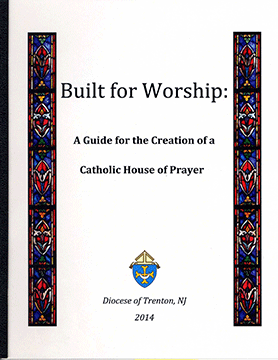
To provide a tool for building or renovating worship spaces such as a church, chapel, oratory or place of worship in a cemetery, a new diocesan document two years in the making, “Built for Worship: A Guide for the Creation of a Catholic House of Prayer,” was recently promulgated by Bishop David M. O’Connell, C. M.
Mercy Sister Eleanor McCann, associate director, diocesan Office of Worship, who spearheaded a working group of clergy and laypersons to develop the document, explained that “Built for Worship,” was an expansion of the 1995 diocesan document, “Guidelines for Church Art and Architecture in Catholic Worship.” “Built for Worship” was developed in light of the foundational documents of the United States Conference of Catholic Bishops, “Built of Living Stones,” and the “General Instruction of the Roman Missal,” both of which are centered around the celebration of the Eucharist in light of the Second Vatican Council and the subsequent Vatican II document, “Constitution on the Sacred Liturgy.”
“Built for Worship” is designed to take parish building or liturgy committees through a reflective process prior to actually beginning to build, and poses such questions as, “What is our history? Who are we by culture? Who are we becoming and what are our resources?” The process piece, explained Sister Eleanor, “is there to give into bricks and mortar.”
“The emphasis on process was intentional,” explained Msgr. Michael J. Walsh, pastor, St. James Church, Pennington, and member of the working group, “and the process is huge in the building of a new church so that the decision to build is made in the context of prayer, reflection and sharing. Many different tools help a parish in preparing for a new building and hopefully ‘Built for Worship’ will be one that they use. If they pray their way through building it they will have great peace praying in it.”
Sister Eleanor explained that every element of design in a new church or worship space, whether it be the shape of the room, the position of the altar, ambo or baptismal font – even the location of the choir and the use of light, sound and art – can affect the prayer and worship of the assembly.
She also pointed out that to build or renovate a church costs millions of dollars which requires ownership by the members. Deacon Wilson noted that since the turn of the century, six new or renovated worship spaces have been built in the Diocese, each costing, on average, some $7 million.
Ownership, said Sister Eleanor, “takes time, prayer, education, and community interaction by the donors. We know that, as staff persons, we are often the ones to move on but, more frequently, the members stay.
“In order that they feel at home in their worship space, [members] need to understand what the formation design will mean and how it will help them to pray and worship God better. They need time to absorb how each of the sacraments and rituals have required spaces and to be taken through the liturgical cycles and times to once again see the significance of each area of the church and how it serves these Gospel events of Easter, Pentecost, Advent, Christmas, Lent and Ordinary Time,” Sister Eleanor said.
Caryn Wohn, owner of Inter-Arc, LLC, an architecture firm specializing in liturgical, commercial and residential design, and a member of the working group, stressed that the “opportunity given to us by the Bishop to update the previous [diocesan]document will benefit all parishes of the Diocese undertaking building projects by bringing to light the many facets requiring prayerful consideration. All ‘bricks and mortar’ concerns need to be approached with theological knowledge of our Catholic faith.”
“Built for Worship,” which flows from existing Church documents, is a tool meant to address that need, said Deacon Wilson. “I believe this document can provide answers and act as a guideline in the planning process at the parish and at the Diocesan level, providing valuable insight as to the sacredness of the space and its intent to encourage prayer and strengthen the spiritual life of the parishioners,” he noted.
Reiterating the importance of prayer in the planning process, Msgr. Walsh, said, “The yearning for a new church has to be something that people in the community have strengthened over time in prayer. The building of a place to have Mass has to be thought of as a long term experience for a community of faith and has to have central to it the fact that the people of God are going to be using it long after any priest leaders are gone.”
Additional members of the working group included Janis Bell, former diocesan advocate for persons with special needs; John Dalton, acoustical consultant, IT Initiatives, and Carolyn Norbut, administrative assistant, Office of Worship, and secretary for the working group.
[[In-content Ad]]Related Stories
Sunday, December 21, 2025




E-Editions
Events
By Mary Morrell | Managing Editor
In a 2005 article, “Sacred Places: The Significance of the Church Building,” Pope Benedict XVI teaches that at the heart of a church is worship: “The calling together, the assembly, has a purpose, and that purpose is worship. The call comes from worship and leads back to worship. It is worship that unites the people called together and gives their being together its meaning and worth: they are united in that ‘peace’ which the world cannot give.”
From his perspective as diocesan director of the Office of Construction and Property, Deacon Bill Wilson, explained that those designing worship sites sometimes “place more emphasis on the building structure and materials than on what would be taking place in the building. A building to be used for worship should be designed mainly with that as the driving force behind the design. The building should first and foremost reflect and invite worship rather than just be an architectural statement.”
To provide a tool for building or renovating worship spaces such as a church, chapel, oratory or place of worship in a cemetery, a new diocesan document two years in the making, “Built for Worship: A Guide for the Creation of a Catholic House of Prayer,” was recently promulgated by Bishop David M. O’Connell, C. M.
Mercy Sister Eleanor McCann, associate director, diocesan Office of Worship, who spearheaded a working group of clergy and laypersons to develop the document, explained that “Built for Worship,” was an expansion of the 1995 diocesan document, “Guidelines for Church Art and Architecture in Catholic Worship.” “Built for Worship” was developed in light of the foundational documents of the United States Conference of Catholic Bishops, “Built of Living Stones,” and the “General Instruction of the Roman Missal,” both of which are centered around the celebration of the Eucharist in light of the Second Vatican Council and the subsequent Vatican II document, “Constitution on the Sacred Liturgy.”
“Built for Worship” is designed to take parish building or liturgy committees through a reflective process prior to actually beginning to build, and poses such questions as, “What is our history? Who are we by culture? Who are we becoming and what are our resources?” The process piece, explained Sister Eleanor, “is there to give into bricks and mortar.”
“The emphasis on process was intentional,” explained Msgr. Michael J. Walsh, pastor, St. James Church, Pennington, and member of the working group, “and the process is huge in the building of a new church so that the decision to build is made in the context of prayer, reflection and sharing. Many different tools help a parish in preparing for a new building and hopefully ‘Built for Worship’ will be one that they use. If they pray their way through building it they will have great peace praying in it.”
Sister Eleanor explained that every element of design in a new church or worship space, whether it be the shape of the room, the position of the altar, ambo or baptismal font – even the location of the choir and the use of light, sound and art – can affect the prayer and worship of the assembly.
She also pointed out that to build or renovate a church costs millions of dollars which requires ownership by the members. Deacon Wilson noted that since the turn of the century, six new or renovated worship spaces have been built in the Diocese, each costing, on average, some $7 million.
Ownership, said Sister Eleanor, “takes time, prayer, education, and community interaction by the donors. We know that, as staff persons, we are often the ones to move on but, more frequently, the members stay.
“In order that they feel at home in their worship space, [members] need to understand what the formation design will mean and how it will help them to pray and worship God better. They need time to absorb how each of the sacraments and rituals have required spaces and to be taken through the liturgical cycles and times to once again see the significance of each area of the church and how it serves these Gospel events of Easter, Pentecost, Advent, Christmas, Lent and Ordinary Time,” Sister Eleanor said.
Caryn Wohn, owner of Inter-Arc, LLC, an architecture firm specializing in liturgical, commercial and residential design, and a member of the working group, stressed that the “opportunity given to us by the Bishop to update the previous [diocesan]document will benefit all parishes of the Diocese undertaking building projects by bringing to light the many facets requiring prayerful consideration. All ‘bricks and mortar’ concerns need to be approached with theological knowledge of our Catholic faith.”
“Built for Worship,” which flows from existing Church documents, is a tool meant to address that need, said Deacon Wilson. “I believe this document can provide answers and act as a guideline in the planning process at the parish and at the Diocesan level, providing valuable insight as to the sacredness of the space and its intent to encourage prayer and strengthen the spiritual life of the parishioners,” he noted.
Reiterating the importance of prayer in the planning process, Msgr. Walsh, said, “The yearning for a new church has to be something that people in the community have strengthened over time in prayer. The building of a place to have Mass has to be thought of as a long term experience for a community of faith and has to have central to it the fact that the people of God are going to be using it long after any priest leaders are gone.”
Additional members of the working group included Janis Bell, former diocesan advocate for persons with special needs; John Dalton, acoustical consultant, IT Initiatives, and Carolyn Norbut, administrative assistant, Office of Worship, and secretary for the working group.
[[In-content Ad]]