


Milestone RCIA anniversary celebrates journey of faith, looks to future
July 29, 2019 at 12:37 p.m.
By Lois Rogers, Correspondent
In the 30 years since the U.S. Bishops mandated that the Rite of Christian Initiation of Adults serve as the formal process of conversion for adults, hundreds of thousands have sought and gained entry into the Catholic Church through its ministrations.
On May 12, many of those who guide those faithful along the way in the Church of Trenton gathered in St. Robert Bellarmine Co-Cathedral, Freehold, where a daylong celebration marked the milestone anniversary of the restored rites with prayer, reflection and dialogue in a series of workshops.
The day also offered a glimpse into what the future will hold as a series of catechetical sessions unfolds over the next two years for those ministering in RCIA in parishes around the Diocese.
Steve Bulvanoski, diocesan RCIA coordinator, said the day was a way of explaining that in the RCIA, “you are always on a journey, examining new things that will enhance the relationship with Jesus. You are not standing out, you are not standing above, you are all together on the journey.”
Taking Root
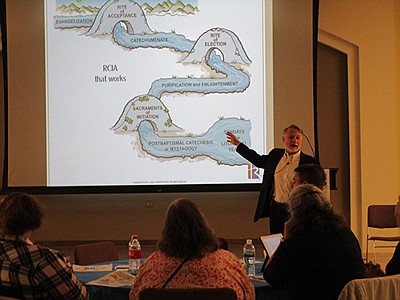
In his keynote address, Nick Wagner, co-founder and co-director of Team RCIA – a free, online resource for RCIA team members – reflected on the RCIA’s past and future.
The RCIA grew out of the Second Vatican Council’s call for a restoration of the catechumenate and a revision of the Rite of Baptism for Adults. It is structured to recreate in a limited way, the process of initiation of the early Church with an emphasis on a call to conversion by a parish community and a series of liturgically based steps concluding with reception of the Sacraments of Initiation at Easter.
Wagner was quick to point out that his talk would be less on the logistics involved in the restored rites and more on how to lead people to a relationship with Jesus.
Explaining that his own history with the RCIA goes back to “just after college,” he described what it was like when the RCIA first emerged onto the parish landscape in St. Louis, Mo., his hometown.
“When I first heard it discussed in St. Louis, a very Catholic town in the 80s, priests asked [parishioners] if they could deal with people leaving during the middle of Mass [for lessons],” he said. People were curious. Some thought the RCIA was a [Catholic] intelligence agency,” he added, prompting laughter from the group.
He said it raised a lot of interest when catechumens began leaving Mass before Communion. “All across St. Louis, people asked … ‘What is this all about?’”
That the question still needs to be raised drives Wagner’s continuing evangelization on the subject.
“It’s why it was important for me to come here today,” said Wagner, who called conversation about the process vitally important as it has the power to draw people into the faith. “It’s important across the world to [be able to] name our faith, to talk about why [RCIA], to remember when we first heard of it.”
Wagner offered, as an example, the first time he heard Pope Francis speak of Church as a mission field. “I dream of a mission option” for the RCIA, he said, where everything “we do will be channeled for evangelization, inspiring disciples to go forth.”
The best way to do that, he said, is to set an example as Christian faithful committed to the Word, focusing on the RCIA as a sacramental journey. It is about committing to accompanying, day by day, faith seekers on the journey.
He urged participants to share the stories of their own faith journeys as they encourage seekers to explore becoming “members of the Church – members of the household.”
Everyday Encounters
During the day, which was hosted by the diocesan Department of Catechesis, participants attended breakout workshops focusing on the stages of the RCIA process. The workshops offered a preview of the formation sessions on the stages that will be offered in greater detail over the next two years.
John Lyle, who works with his wife on the RCIA team in Keyport’s St. Joseph Parish, said the workshop opened his eyes to more ways to encourage those who have just come into the Church.
“I was surprised about the fact that there is actually a lot more that we could be doing,” he said.
He also appreciated focusing on the Catechist’s Manual designed as practical help for those crafting the catechetical portion of any RCIA session. “The book sits physically in reach, and many of us have flipped through it without seriously reading it. Now we are going to spend time with it.”
Deacon John Klincewicz of Holy Innocents Parish, Neptune, said the day offered many resources and insights.
“The keynote presentation helped to remind us about the ‘why’ [of RCIA] – that the goal of evangelization is to help people to know Jesus, not just know about Jesus,” he said.
“Then the breakout sessions gave us a chance to address the ‘how’ with practical details of implementing RCIA in the parish,” continued Deacon Klincewicz, who has been working with the RCIA for more than 25 years. “Just being able to share my knowledge of faith with people is a gratifying experience, and the day gave us the chance to do that.”
[[In-content Ad]]
Related Stories
Saturday, December 27, 2025



E-Editions
Events
By Lois Rogers, Correspondent
In the 30 years since the U.S. Bishops mandated that the Rite of Christian Initiation of Adults serve as the formal process of conversion for adults, hundreds of thousands have sought and gained entry into the Catholic Church through its ministrations.
On May 12, many of those who guide those faithful along the way in the Church of Trenton gathered in St. Robert Bellarmine Co-Cathedral, Freehold, where a daylong celebration marked the milestone anniversary of the restored rites with prayer, reflection and dialogue in a series of workshops.
The day also offered a glimpse into what the future will hold as a series of catechetical sessions unfolds over the next two years for those ministering in RCIA in parishes around the Diocese.
Steve Bulvanoski, diocesan RCIA coordinator, said the day was a way of explaining that in the RCIA, “you are always on a journey, examining new things that will enhance the relationship with Jesus. You are not standing out, you are not standing above, you are all together on the journey.”
Taking Root
In his keynote address, Nick Wagner, co-founder and co-director of Team RCIA – a free, online resource for RCIA team members – reflected on the RCIA’s past and future.
The RCIA grew out of the Second Vatican Council’s call for a restoration of the catechumenate and a revision of the Rite of Baptism for Adults. It is structured to recreate in a limited way, the process of initiation of the early Church with an emphasis on a call to conversion by a parish community and a series of liturgically based steps concluding with reception of the Sacraments of Initiation at Easter.
Wagner was quick to point out that his talk would be less on the logistics involved in the restored rites and more on how to lead people to a relationship with Jesus.
Explaining that his own history with the RCIA goes back to “just after college,” he described what it was like when the RCIA first emerged onto the parish landscape in St. Louis, Mo., his hometown.
“When I first heard it discussed in St. Louis, a very Catholic town in the 80s, priests asked [parishioners] if they could deal with people leaving during the middle of Mass [for lessons],” he said. People were curious. Some thought the RCIA was a [Catholic] intelligence agency,” he added, prompting laughter from the group.
He said it raised a lot of interest when catechumens began leaving Mass before Communion. “All across St. Louis, people asked … ‘What is this all about?’”
That the question still needs to be raised drives Wagner’s continuing evangelization on the subject.
“It’s why it was important for me to come here today,” said Wagner, who called conversation about the process vitally important as it has the power to draw people into the faith. “It’s important across the world to [be able to] name our faith, to talk about why [RCIA], to remember when we first heard of it.”
Wagner offered, as an example, the first time he heard Pope Francis speak of Church as a mission field. “I dream of a mission option” for the RCIA, he said, where everything “we do will be channeled for evangelization, inspiring disciples to go forth.”
The best way to do that, he said, is to set an example as Christian faithful committed to the Word, focusing on the RCIA as a sacramental journey. It is about committing to accompanying, day by day, faith seekers on the journey.
He urged participants to share the stories of their own faith journeys as they encourage seekers to explore becoming “members of the Church – members of the household.”
Everyday Encounters
During the day, which was hosted by the diocesan Department of Catechesis, participants attended breakout workshops focusing on the stages of the RCIA process. The workshops offered a preview of the formation sessions on the stages that will be offered in greater detail over the next two years.
John Lyle, who works with his wife on the RCIA team in Keyport’s St. Joseph Parish, said the workshop opened his eyes to more ways to encourage those who have just come into the Church.
“I was surprised about the fact that there is actually a lot more that we could be doing,” he said.
He also appreciated focusing on the Catechist’s Manual designed as practical help for those crafting the catechetical portion of any RCIA session. “The book sits physically in reach, and many of us have flipped through it without seriously reading it. Now we are going to spend time with it.”
Deacon John Klincewicz of Holy Innocents Parish, Neptune, said the day offered many resources and insights.
“The keynote presentation helped to remind us about the ‘why’ [of RCIA] – that the goal of evangelization is to help people to know Jesus, not just know about Jesus,” he said.
“Then the breakout sessions gave us a chance to address the ‘how’ with practical details of implementing RCIA in the parish,” continued Deacon Klincewicz, who has been working with the RCIA for more than 25 years. “Just being able to share my knowledge of faith with people is a gratifying experience, and the day gave us the chance to do that.”
[[In-content Ad]]