


Making Death 'Less Frightening' -- Via Lucis workshop encourages difficult conversations about end-of-life care
July 29, 2019 at 12:37 p.m.
By David Karas | Correspondent
What does death look like?
What is the Catholic approach to end-of-life care?
What does it mean to die in 21st century America?
These difficult, pressing questions were among the many addressed in the ninth annual “Now and at the Hour of our Death” workshop, presented by Via Lucis – the Samaritan Healthcare & Hospice Ministry for Catholic Patients & Families. Held Oct. 23 in St. John of God Community Services, Westville, the program was offered to faithful throughout the region in collaboration with the Dioceses of Trenton and Camden.
“It is really (designed) to get people to start talking about things that are often so difficult to talk about,” said Brother Thomas Osorio, OH, of St. John of God Community Services.
A nurse with experience serving the needs of the elderly, the disabled and those with mental illness, Brother Thomas was among a panel of five experts. Following dinner and fellowship among the nearly 90 attendees, the panel offered insights in five segments of the conference that covered topics ranging from the realities of grappling with a life-threatening illness to striking the balance between hoping and planning.
Each segment also featured showing of a portion of the award-winning documentary, “Consider the Conversation: A documentary on a taboo subject.”
The Via Lucis program added a Catholic focus to the conversation. While faith involvement is an important part of Catholics’ lives, Brother Thomas said, “It should be more so at the end of life.”
Guests included parishioners from parishes throughout the region, along with clergy, caretakers and others involved in hospice medicine and care. For the first time, the Diocese of Camden’s Office of Ministry for the Deaf was able to arrange for an interpreter to be present – to assist the first deaf attendees of the annual event.
Carol Paprocki, director of communications for Samaritan Healthcare & Hospice, said that the program regularly draws both faithful who are attending for the first time, as well as others who come back each year.
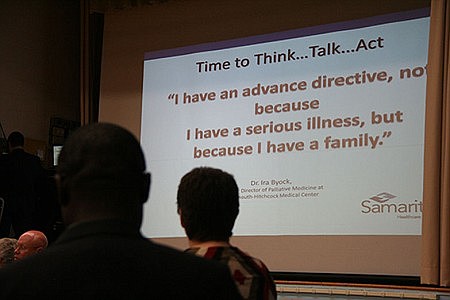
“Our goal has really been to encourage timely conversation,” she said, posing the question, “what would our wish be if we suddenly could not talk for ourselves?”
She continued, “by having conversation around the kitchen table,” the planning process can begin.
She shared Samaritan’s phrase, “Think, Talk, Act,” which emphasizes the importance not only of considering end-of-life issues, but also communicating with family members and loved ones to ensure that actions can be in keeping with personal wishes.
The program featured panel discussions as well as interaction among members of the audience, who shared stories and experiences in their own lives. The evening concluded with a traditional dance using gestures while praying the Hail Mary, emphasizing the Catholic focus of the program.
Mary Ann Boccolini, president and CEO of Samaritan, reiterated the faith component of end-of-life decisions and processes.
“What happens at the end of life,” she posed when discussing the program, “and what is considered God’s natural course?”
Her husband, Bob, was attending for the first time, and before the program began he shared that he was looking forward to an informative evening. A member of Christ Our Light Parish, Cherry Hill, he reflected on the importance of his faith and “the comfort” it provides when he considers such challenging matters as death and end-of-life preparations.
“My faith has been important in my life,” he said, “and I think it will be important when my life is over. It makes death less frightening.”
Throughout the evening, various topics came up, including how those nearing death can ponder what is next to come, as well as how wishes can be best shared and communicated before illness or disability prevents or hastens such conversations. Another segment discussed the necessary balance of hope and planning.
Panelist Father Joseph Monahan, TOR, director of the Pastoral Care Department of Our Lady of Lourdes Medical Center, shared some of his experiences over his more than 25 years spent in Catholic health care. At one point, he reflected on witnessing “sacred moments” in hospital ministry – being present for the first breath of infants, and the final breath of those at the end of their lives.
In a recent interview, Deanna Sass, director of the diocesan Department of Pastoral Care, stressed the importance of having the very conversations that the Via Lucis program facilitated and encouraged.
“If you don’t consider these issues and engage in these conversations now, someone else may do it for you, later – someone who may not know your own preferences, or what your Catholic faith teaches,” she said. “We must encourage our families to have these kinds of conversations with our aging relatives, in a hope-filled and informed manner,” she said.
[[In-content Ad]]
Related Stories
Monday, December 22, 2025



E-Editions
Events
By David Karas | Correspondent
What does death look like?
What is the Catholic approach to end-of-life care?
What does it mean to die in 21st century America?
These difficult, pressing questions were among the many addressed in the ninth annual “Now and at the Hour of our Death” workshop, presented by Via Lucis – the Samaritan Healthcare & Hospice Ministry for Catholic Patients & Families. Held Oct. 23 in St. John of God Community Services, Westville, the program was offered to faithful throughout the region in collaboration with the Dioceses of Trenton and Camden.
“It is really (designed) to get people to start talking about things that are often so difficult to talk about,” said Brother Thomas Osorio, OH, of St. John of God Community Services.
A nurse with experience serving the needs of the elderly, the disabled and those with mental illness, Brother Thomas was among a panel of five experts. Following dinner and fellowship among the nearly 90 attendees, the panel offered insights in five segments of the conference that covered topics ranging from the realities of grappling with a life-threatening illness to striking the balance between hoping and planning.
Each segment also featured showing of a portion of the award-winning documentary, “Consider the Conversation: A documentary on a taboo subject.”
The Via Lucis program added a Catholic focus to the conversation. While faith involvement is an important part of Catholics’ lives, Brother Thomas said, “It should be more so at the end of life.”
Guests included parishioners from parishes throughout the region, along with clergy, caretakers and others involved in hospice medicine and care. For the first time, the Diocese of Camden’s Office of Ministry for the Deaf was able to arrange for an interpreter to be present – to assist the first deaf attendees of the annual event.
Carol Paprocki, director of communications for Samaritan Healthcare & Hospice, said that the program regularly draws both faithful who are attending for the first time, as well as others who come back each year.
“Our goal has really been to encourage timely conversation,” she said, posing the question, “what would our wish be if we suddenly could not talk for ourselves?”
She continued, “by having conversation around the kitchen table,” the planning process can begin.
She shared Samaritan’s phrase, “Think, Talk, Act,” which emphasizes the importance not only of considering end-of-life issues, but also communicating with family members and loved ones to ensure that actions can be in keeping with personal wishes.
The program featured panel discussions as well as interaction among members of the audience, who shared stories and experiences in their own lives. The evening concluded with a traditional dance using gestures while praying the Hail Mary, emphasizing the Catholic focus of the program.
Mary Ann Boccolini, president and CEO of Samaritan, reiterated the faith component of end-of-life decisions and processes.
“What happens at the end of life,” she posed when discussing the program, “and what is considered God’s natural course?”
Her husband, Bob, was attending for the first time, and before the program began he shared that he was looking forward to an informative evening. A member of Christ Our Light Parish, Cherry Hill, he reflected on the importance of his faith and “the comfort” it provides when he considers such challenging matters as death and end-of-life preparations.
“My faith has been important in my life,” he said, “and I think it will be important when my life is over. It makes death less frightening.”
Throughout the evening, various topics came up, including how those nearing death can ponder what is next to come, as well as how wishes can be best shared and communicated before illness or disability prevents or hastens such conversations. Another segment discussed the necessary balance of hope and planning.
Panelist Father Joseph Monahan, TOR, director of the Pastoral Care Department of Our Lady of Lourdes Medical Center, shared some of his experiences over his more than 25 years spent in Catholic health care. At one point, he reflected on witnessing “sacred moments” in hospital ministry – being present for the first breath of infants, and the final breath of those at the end of their lives.
In a recent interview, Deanna Sass, director of the diocesan Department of Pastoral Care, stressed the importance of having the very conversations that the Via Lucis program facilitated and encouraged.
“If you don’t consider these issues and engage in these conversations now, someone else may do it for you, later – someone who may not know your own preferences, or what your Catholic faith teaches,” she said. “We must encourage our families to have these kinds of conversations with our aging relatives, in a hope-filled and informed manner,” she said.
[[In-content Ad]]