


Leading expert on Hispanic ministry brings message of multi-cultural ministry
July 29, 2019 at 12:37 p.m.
By Lois Rogers
Correspondent
About one-fourth of all Catholic parishes in the United States offer Mass in Spanish to the growing number of Hispanic faithful nationwide.
With Spanish Masses offered in 25 of 107 parishes, the Diocese of Trenton is running close to the national average in spiritual outreach to the broad and culturally diverse community of faithful who worship in that language. It’s a good start considering recent reports that indicate those of Hispanic background comprise 42 percent of the Catholic population in the United States and more than 50 percent of Catholics under 35.
With this demographic trend in mind, the Catholic infrastructure of Burlington, Mercer, Monmouth and Ocean counties is being called to deepening engagement with the community of Hispanic faithful.
Indeed, one of the five goals established by Bishop David M. O’Connell, C.M., for the upcoming Faith in Our Future pastoral planning initiative is to provide pastoral ministry to Hispanic Catholics, the fastest growing segment of the diocesan population.
In service to that, the Diocese brought in a leading expert, Dr. Hosffman Ospino, to deliver two presentations to priests, staff and lay ministers Nov. 20 and 21 aimed at nurturing and fostering Hispanic ministry in Catholic parishes.
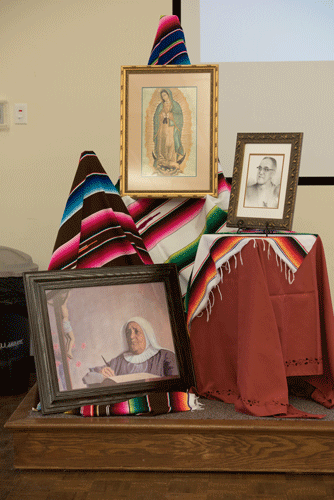
Dr. Ospino addressed 40 priests and their guests in a four-hour program given in St. Robert Bellarmine Parish, Freehold. Drawing on the groundbreaking “National Study of Catholic Parishes with Hispanic Ministry,” which he led, Ospino offered a non-stop, energetic stream of insights on everything from the complex history of Hispanic settlement in this hemisphere to the many cultural traditions, musical and artistic preferences, culinary approaches and family values all wrapped in a tilma of faith.
He highlighted the transformation of the Catholic population in the past 30-40 years and stressed the need for clergy and lay men and women with bilingual competencies. He shared how leaders have struggled to meet the needs of the growing number of Hispanic families which range from religious education resources to vibrant liturgies.
Ospino, a native of Colombia, who is assistant professor of Hispanic ministry and religious education at Boston College, spoke of the constantly evolving face of the Church in the United States and the concerns which have emerged with it – signs of disaffection among the young – that call for outreach, understanding and a willingness to “embrace our cultural differences and push open the doors.”
Despite the deep devotion of the Hispanic community in general, the same concerns that beset the U.S. Church overall, are making inroads among Hispanic Catholics with increasing numbers of young people leaving the Church, Dr. Ospino reported.
Study results indicate, he said, that over the past three decades, 14 million Hispanics have left the Church in this country. Some 80 percent of those who left, stopped self identifying. “They simply drifted away,” he said, in an atmosphere where they did not feel “welcome or engaged” in a climate he described as a “pastoral limbo.”
About 20 percent of those who left have become Evangelicals but 80 percent became secularized, he said. “Secular society [here] is very powerful. We need to focus on the New Evangelization” of St. John Paul II, Pope Benedict XVI and Pope Francis, he said. “We need to change our ways of doing ministry.”
He asked the clergy to reach out to all members of the community including those who live “at risk of violence and drugs and are in prison,” he said.
Citing statistics that show on average that young people spend eight hours “before a screen” each day and Hispanics spend even more – an estimated 12 hours a day, he implored “what are we doing to bring them back?”
“There’s a major transition affecting us in a major way. We need people trained to work in an intercultural Church. We need intercultural competencies,” he said. “This is not a time for isolation. It is a time to embrace our cultural differences and focus on ways to engage.”
Overall, his presentation offered a litany of information that clergy, staff and guests said they would take home and unpack for their teams.
Among them was Nancy Grodberg who coordinates religious education in Visitation Parish, Brick, and St. Pio of Pietrelcina, Lavallette, both of which have significant Hispanic populations. She said Ospino’s presentation offered her ideas she will draw upon in just a few weeks for the celebration of Our Lady of Guadalupe.
“He gave me insight into things that we can do” regarding the liturgy and the love of music and culture that the Hispanic community brings to the Church, she said. “The women have volunteered to sing and [lead] prayers. They are very enthusiastic whenever I ask them to do anything.”
Msgr. Leonard F. Troiano, who will retire as pastor of St. Pio of Pietrelcina Jan. 4 and serve as episcopal vicar for diocesan planning, and Msgr. Sam A. Sirianni, pastor of St. Robert Bellarmine, as well as Grodberg, found Dr. Ospino’s grasp of statistics particularly eye-opening.
“His presentation was very much on target,” said Msgr. Troiano. “He pointed out the realities of a major demographic shift, not only in the United States, but locally in the Diocese of Trenton. This is something that is a reality we are going to have to deal with.”
Msgr. Troiano said he appreciated the way Dr. Ospino outlined “several really important approaches” to the Latino community. “I was really taken by the fact that he talked about reaching out to youth in specific ways” – generally tuning into the culture and connecting to all facets of the community; from the majority – those with abiding faith and strong family relationships – to those on the margins involved in gangs.
Becoming aware of the variety of preferences in the diverse community, “being aware of cultural needs, foods, music is very important,” he said.
Where the liturgy is concerned, Msgr. Troiano said, “The fact is, we are on a mission. We need to raise consciousness at all levels.”
Msgr. Sirianni especially appreciated Dr. Ospino’s clear focus on America’s historical context. “It reminded us that recent waves of immigration have had an impact that is no different than this one. It is the same.”
“If you like the American society you have now, you must recognize that [millions] of foreign immigrants had an impact on that. You must realize that this is an evolution of who we are as a country.”
[[In-content Ad]]Related Stories
Monday, December 22, 2025




E-Editions
Events
By Lois Rogers
Correspondent
About one-fourth of all Catholic parishes in the United States offer Mass in Spanish to the growing number of Hispanic faithful nationwide.
With Spanish Masses offered in 25 of 107 parishes, the Diocese of Trenton is running close to the national average in spiritual outreach to the broad and culturally diverse community of faithful who worship in that language. It’s a good start considering recent reports that indicate those of Hispanic background comprise 42 percent of the Catholic population in the United States and more than 50 percent of Catholics under 35.
With this demographic trend in mind, the Catholic infrastructure of Burlington, Mercer, Monmouth and Ocean counties is being called to deepening engagement with the community of Hispanic faithful.
Indeed, one of the five goals established by Bishop David M. O’Connell, C.M., for the upcoming Faith in Our Future pastoral planning initiative is to provide pastoral ministry to Hispanic Catholics, the fastest growing segment of the diocesan population.
In service to that, the Diocese brought in a leading expert, Dr. Hosffman Ospino, to deliver two presentations to priests, staff and lay ministers Nov. 20 and 21 aimed at nurturing and fostering Hispanic ministry in Catholic parishes.
Dr. Ospino addressed 40 priests and their guests in a four-hour program given in St. Robert Bellarmine Parish, Freehold. Drawing on the groundbreaking “National Study of Catholic Parishes with Hispanic Ministry,” which he led, Ospino offered a non-stop, energetic stream of insights on everything from the complex history of Hispanic settlement in this hemisphere to the many cultural traditions, musical and artistic preferences, culinary approaches and family values all wrapped in a tilma of faith.
He highlighted the transformation of the Catholic population in the past 30-40 years and stressed the need for clergy and lay men and women with bilingual competencies. He shared how leaders have struggled to meet the needs of the growing number of Hispanic families which range from religious education resources to vibrant liturgies.
Ospino, a native of Colombia, who is assistant professor of Hispanic ministry and religious education at Boston College, spoke of the constantly evolving face of the Church in the United States and the concerns which have emerged with it – signs of disaffection among the young – that call for outreach, understanding and a willingness to “embrace our cultural differences and push open the doors.”
Despite the deep devotion of the Hispanic community in general, the same concerns that beset the U.S. Church overall, are making inroads among Hispanic Catholics with increasing numbers of young people leaving the Church, Dr. Ospino reported.
Study results indicate, he said, that over the past three decades, 14 million Hispanics have left the Church in this country. Some 80 percent of those who left, stopped self identifying. “They simply drifted away,” he said, in an atmosphere where they did not feel “welcome or engaged” in a climate he described as a “pastoral limbo.”
About 20 percent of those who left have become Evangelicals but 80 percent became secularized, he said. “Secular society [here] is very powerful. We need to focus on the New Evangelization” of St. John Paul II, Pope Benedict XVI and Pope Francis, he said. “We need to change our ways of doing ministry.”
He asked the clergy to reach out to all members of the community including those who live “at risk of violence and drugs and are in prison,” he said.
Citing statistics that show on average that young people spend eight hours “before a screen” each day and Hispanics spend even more – an estimated 12 hours a day, he implored “what are we doing to bring them back?”
“There’s a major transition affecting us in a major way. We need people trained to work in an intercultural Church. We need intercultural competencies,” he said. “This is not a time for isolation. It is a time to embrace our cultural differences and focus on ways to engage.”
Overall, his presentation offered a litany of information that clergy, staff and guests said they would take home and unpack for their teams.
Among them was Nancy Grodberg who coordinates religious education in Visitation Parish, Brick, and St. Pio of Pietrelcina, Lavallette, both of which have significant Hispanic populations. She said Ospino’s presentation offered her ideas she will draw upon in just a few weeks for the celebration of Our Lady of Guadalupe.
“He gave me insight into things that we can do” regarding the liturgy and the love of music and culture that the Hispanic community brings to the Church, she said. “The women have volunteered to sing and [lead] prayers. They are very enthusiastic whenever I ask them to do anything.”
Msgr. Leonard F. Troiano, who will retire as pastor of St. Pio of Pietrelcina Jan. 4 and serve as episcopal vicar for diocesan planning, and Msgr. Sam A. Sirianni, pastor of St. Robert Bellarmine, as well as Grodberg, found Dr. Ospino’s grasp of statistics particularly eye-opening.
“His presentation was very much on target,” said Msgr. Troiano. “He pointed out the realities of a major demographic shift, not only in the United States, but locally in the Diocese of Trenton. This is something that is a reality we are going to have to deal with.”
Msgr. Troiano said he appreciated the way Dr. Ospino outlined “several really important approaches” to the Latino community. “I was really taken by the fact that he talked about reaching out to youth in specific ways” – generally tuning into the culture and connecting to all facets of the community; from the majority – those with abiding faith and strong family relationships – to those on the margins involved in gangs.
Becoming aware of the variety of preferences in the diverse community, “being aware of cultural needs, foods, music is very important,” he said.
Where the liturgy is concerned, Msgr. Troiano said, “The fact is, we are on a mission. We need to raise consciousness at all levels.”
Msgr. Sirianni especially appreciated Dr. Ospino’s clear focus on America’s historical context. “It reminded us that recent waves of immigration have had an impact that is no different than this one. It is the same.”
“If you like the American society you have now, you must recognize that [millions] of foreign immigrants had an impact on that. You must realize that this is an evolution of who we are as a country.”
[[In-content Ad]]