


Have we reached a boiling point on climate change?
July 29, 2019 at 12:37 p.m.
The following editorial first appeared in the Oct. 5 issue of Our Sunday Visitor, a national Catholic newsweekly based in Huntington, Indiana. It was written by the editorial board and is provided here through Catholic News Service.
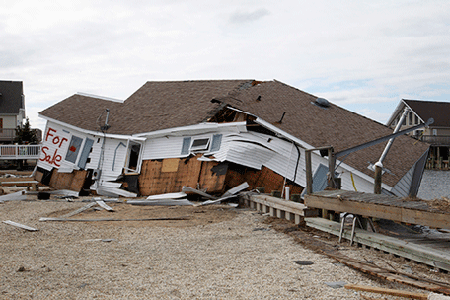
This October marks two years since Superstorm Sandy swept up the East Coast from the Caribbean killing nearly 300 people in seven countries and costing more than $68 billion. Should the same storm arrive 100 years from now, according to a recent report out of North Carolina State University, the consequences could be far worse due to the rising sea levels caused by climate change.
Increases in extreme weather events like Sandy, as well as a host of other environmental concerns, led to a U.N. Climate Summit in New York on Sept. 23. At the behest of U.N. Secretary-General Ban Ki-moon, the event brought together world leaders in government, business, finance and civil society to strategize and take bold action on the issue of climate change.
But perhaps an even more significant gathering took place in the two days ahead of the U.N. meeting, when Church leaders from around the world attended their own two-day Interfaith Summit on Climate Change, organized jointly by the World Council of Churches and Religious for Peace. Also in New York, 30 leaders from nine religions on five continents set aside differing beliefs in order to confer and collaborate on a shared one: the need to protect God’s creation. In a statement, the group expressed “deep concern for the consequences of climate change on the earth and its people.”
“Climate change is indeed a threat to life, a precious gift we have received and that we need to care for,” it said. “In our communities, and thanks to the media, we see the manifestations of climate change everywhere. From our brothers and sisters around the world, we hear about its effects on people and nature. We recognize that these effects disproportionally affect the lives, livelihoods and rights of poorer, marginalized and therefore most vulnerable populations, including indigenous peoples. When those who have done the least to cause climate change are the ones hardest hit, it becomes an issue of injustice. Equitable solutions are urgently needed.”
Several prominent Catholics, including Honduran Cardinal Oscar Rodriguez Maradiaga of Tegucigalpa, president of Caritas Internationalis, and Father Michael Czerny of the Pontifical Council for Justice and Peace, signed the statement. In a sign of Catholic-Orthodox unity on this issue, at least, it also was signed by Archbishop Demetrios of America, who represented the Ecumenical Orthodox Patriarch Bartholomew.
The gathering was a strong show of force from the world’s leaders of faith and an opportunity to underscore that climate change isn’t just a political issue -- it’s a moral one. Church leaders, of course, have long advocated for the protection of God’s creation, and perhaps none did this as eloquently as retired Pope Benedict XVI in his 2009 encyclical, “Caritas in Veritate” (“Charity in Truth”).
“The Church has a responsibility toward creation and she must assert this responsibility in the public sphere,” Pope Benedict wrote. “In so doing, she must defend not only earth, water and air as gifts of creation that belong to everyone. She must above all protect mankind from self-destruction.”
A just solution to the climate change crisis is essential for us to live out our roles as responsible stewards of God’s creation. While action on the part of world leaders is a critical component, just as meaningful is action on the part of the people of God. As Pope Francis said in a general audience in May: “Creation is ... a wonderful gift that God has given us, so that we care for it and we use it for the benefit of all, always with great respect and gratitude.”
The views or positions presented in this or any guest editorial are those of the original publication and do not necessarily represent the views of Catholic News Service, the U.S. Conference of Catholic Bishops, the Diocese of Trenton or The Monitor.
[[In-content Ad]]
Related Stories
Thursday, December 18, 2025


E-Editions
Events
The following editorial first appeared in the Oct. 5 issue of Our Sunday Visitor, a national Catholic newsweekly based in Huntington, Indiana. It was written by the editorial board and is provided here through Catholic News Service.
This October marks two years since Superstorm Sandy swept up the East Coast from the Caribbean killing nearly 300 people in seven countries and costing more than $68 billion. Should the same storm arrive 100 years from now, according to a recent report out of North Carolina State University, the consequences could be far worse due to the rising sea levels caused by climate change.
Increases in extreme weather events like Sandy, as well as a host of other environmental concerns, led to a U.N. Climate Summit in New York on Sept. 23. At the behest of U.N. Secretary-General Ban Ki-moon, the event brought together world leaders in government, business, finance and civil society to strategize and take bold action on the issue of climate change.
But perhaps an even more significant gathering took place in the two days ahead of the U.N. meeting, when Church leaders from around the world attended their own two-day Interfaith Summit on Climate Change, organized jointly by the World Council of Churches and Religious for Peace. Also in New York, 30 leaders from nine religions on five continents set aside differing beliefs in order to confer and collaborate on a shared one: the need to protect God’s creation. In a statement, the group expressed “deep concern for the consequences of climate change on the earth and its people.”
“Climate change is indeed a threat to life, a precious gift we have received and that we need to care for,” it said. “In our communities, and thanks to the media, we see the manifestations of climate change everywhere. From our brothers and sisters around the world, we hear about its effects on people and nature. We recognize that these effects disproportionally affect the lives, livelihoods and rights of poorer, marginalized and therefore most vulnerable populations, including indigenous peoples. When those who have done the least to cause climate change are the ones hardest hit, it becomes an issue of injustice. Equitable solutions are urgently needed.”
Several prominent Catholics, including Honduran Cardinal Oscar Rodriguez Maradiaga of Tegucigalpa, president of Caritas Internationalis, and Father Michael Czerny of the Pontifical Council for Justice and Peace, signed the statement. In a sign of Catholic-Orthodox unity on this issue, at least, it also was signed by Archbishop Demetrios of America, who represented the Ecumenical Orthodox Patriarch Bartholomew.
The gathering was a strong show of force from the world’s leaders of faith and an opportunity to underscore that climate change isn’t just a political issue -- it’s a moral one. Church leaders, of course, have long advocated for the protection of God’s creation, and perhaps none did this as eloquently as retired Pope Benedict XVI in his 2009 encyclical, “Caritas in Veritate” (“Charity in Truth”).
“The Church has a responsibility toward creation and she must assert this responsibility in the public sphere,” Pope Benedict wrote. “In so doing, she must defend not only earth, water and air as gifts of creation that belong to everyone. She must above all protect mankind from self-destruction.”
A just solution to the climate change crisis is essential for us to live out our roles as responsible stewards of God’s creation. While action on the part of world leaders is a critical component, just as meaningful is action on the part of the people of God. As Pope Francis said in a general audience in May: “Creation is ... a wonderful gift that God has given us, so that we care for it and we use it for the benefit of all, always with great respect and gratitude.”
The views or positions presented in this or any guest editorial are those of the original publication and do not necessarily represent the views of Catholic News Service, the U.S. Conference of Catholic Bishops, the Diocese of Trenton or The Monitor.
[[In-content Ad]]