


Faith in Our Future continues with feedback on Cohort implementation plans
July 29, 2019 at 12:37 p.m.
By Jennifer Mauro | Associate Editor
Meaningful. Complex. Opportunity. Collaborative spirit. Challenged. Prayerful.
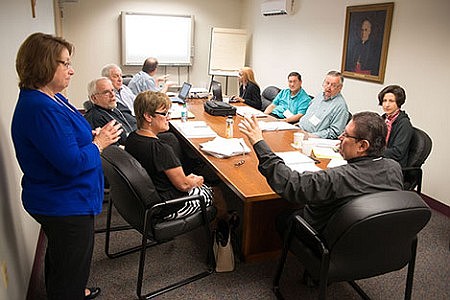
Those were just some of the words used as those involved in the diocesan Implementation Commission working retreat prayerfully reflected on their part in the Faith in Our Future process during their two-day gathering held June 20-21 in the Chancery, Lawrenceville.
Twenty-one commissioners came together to review, evaluate and respond to the implementation plans offered by each of the Diocese’s 25 Cohorts. They were joined by six individuals who have been assisting the Cohorts in this process as project managers, as well as diocesan officials and outside consultants.
Photo Gallery: Implementation Commission Meeting
The working retreat was part of the implementation phase for Faith in Our Future, the pastoral planning initiative commissioned in 2015 by Bishop David M. O’Connell, C.M., to strengthen and enliven the parishes of the Diocese. Beginning in the fall of 2015 with parish self-study, the eight-step process continued with the Diocese’s 107 parishes being formed into 25 Cohorts. Those Cohorts were tasked with their own self-studies, which were reviewed multiple times by a diocesan Planning Commission. The Commission’s feedback to the Cohorts and eventual recommendations to the Bishop for parish restructuring and development were the basis of a final consultative process involving several diocesan bodies and the presbyterate. Bishop O’Connell announced his decisions in January 2017, calling for a range of new parish models for selected locations, including merger, linkage, the suspension of operations in a few churches and the designation of Centers for Cultural Ministry.
Each Cohort – with the help of a facilitator from a newly formed diocesan Project Management Team – has since been working to develop an action plan in support of the Bishop’s decisions.
“I hope they [Cohorts] see this is a partnership and that we are working toward the same goals,” said Jessica Donohue, Implementation Commission member and director of religious education in Sacred Heart Parish, Mount Holly.
Discerning Best Practices
During the retreat, the Implementation Commission, composed of a majority of the original Planning Commission plus eight new members, reviewed and commented on the action plans, offering appreciation for the Cohorts’ hard work, affirmation on specific ideas, and further thoughts on the implementation steps planned. The commissioners also suggested future topics of discussion the Cohorts may not have addressed.
“A good action plan that includes a clear description of what is to be done, by whom and by when is one of the best tools for getting something accomplished,” said Terry Ginther, diocesan executive director of Pastoral Life and Mission. “However, the Implementation Commission also exists to hold the Cohorts accountable for what they have said they will do in the coming year.”
John Reid, a partner with the Reid Group – the pastoral planning consultant/facilitator for Faith in Our Future – agreed. “The goal is to approve and improve the plans.”
Over the two days, the commissioners met in small groups to discuss their assigned Cohorts, regrouping to prayerfully discern as a whole the Bishop’s plans for each Cohort and the action plans each Cohort submitted.
In reviewing the Cohorts’ work, the commissioners encountered common challenges, including: finding the resources needed for parishes and Cohorts to meet such priority goals as youth and young adult ministries and multicultural outreach; balancing the sometimes competing, but genuine efforts to serve individual parish needs while still collaborating as Cohorts; limiting the number of immediate goals to better ensure success while still recognizing other equally important goals held for later action, and ensuring that the action plans remained focused on the Bishop’s principles and priorities of evangelization, collaboration, stewardship, accountability and service.
“The plans of the Cohorts are heartfelt and well worked-through,” said Laura Connell of St. Elizabeth of Hungary Parish, Avon by the Sea, who serves on the Implementation Commission. “Their hard work is apparent. They’ve really given deep, prayerful thought, and it comes through in their plans.”
Elements of Success
Connell is new to the Faith in Our Future process on the Commission level, and Msgr. Leonard F. Troiano, diocesan episcopal vicar for planning, touted the benefits of new faces.
“It was a nice blend of Planning Commission members bringing the richness of what they experienced and new people bringing a fresh perspective,” Msgr. Troiano said. “The two have built a good working relationship together.”
Donohue, who is also a new member, said being a commissioner gave her a glimpse into the community of each Cohort.
“I love learning about the other parishes,” she said. “I feel like we’re getting to know the life of each church.”
Preserving that life of the Church is exactly what Faith in our Future is all about, Msgr. Troiano said.
“My hope is that these Cohorts that have put forth a very strong effort will advance in learning to work with a new vision of Church and that those who have approached it half-heartedly will see how successful working together can be in a shifting and changing world. This is a whole new way of thinking,” he said.
To ensure success, all involved stressed the importance of each Cohort having achievable goals and not taking on too many action items at once. The Bishop’s decisions are expected to be implemented over the next three years; after issuing its feedback to the Cohorts in early July, the Implementation Committee won’t meet again until almost a year.
“Our policy has been to try not to overshoot what you can do. Pick a few things, and be successful at those,” Msgr. Troiano said. “This is a learning process. We want them to set themselves up for success.”
One of the keys to success is accountability, Ginther stressed.
“Accountability is an integral part of any cycle of planning,” she said. “While there have been other planning initiatives in our Diocese, there were not effective systems of accountability put in place to monitor progress. Decisions were made and actions taken, but evaluation and accountability were neglected. As a result, the outcomes were also limited. Faith in Our Future will be different in that regard.
“Project managers will continue to accompany Cohorts and monitor their progress. Msgr. Troiano and I will be of assistance when encouragement is needed or when obstacles arise,” she added. “Bishop O’Connell has serious expectations that this Cohort work will move us forward toward our goals.”
[[In-content Ad]]Related Stories
Friday, December 26, 2025


E-Editions
Events
By Jennifer Mauro | Associate Editor
Meaningful. Complex. Opportunity. Collaborative spirit. Challenged. Prayerful.
Those were just some of the words used as those involved in the diocesan Implementation Commission working retreat prayerfully reflected on their part in the Faith in Our Future process during their two-day gathering held June 20-21 in the Chancery, Lawrenceville.
Twenty-one commissioners came together to review, evaluate and respond to the implementation plans offered by each of the Diocese’s 25 Cohorts. They were joined by six individuals who have been assisting the Cohorts in this process as project managers, as well as diocesan officials and outside consultants.
Photo Gallery: Implementation Commission Meeting
The working retreat was part of the implementation phase for Faith in Our Future, the pastoral planning initiative commissioned in 2015 by Bishop David M. O’Connell, C.M., to strengthen and enliven the parishes of the Diocese. Beginning in the fall of 2015 with parish self-study, the eight-step process continued with the Diocese’s 107 parishes being formed into 25 Cohorts. Those Cohorts were tasked with their own self-studies, which were reviewed multiple times by a diocesan Planning Commission. The Commission’s feedback to the Cohorts and eventual recommendations to the Bishop for parish restructuring and development were the basis of a final consultative process involving several diocesan bodies and the presbyterate. Bishop O’Connell announced his decisions in January 2017, calling for a range of new parish models for selected locations, including merger, linkage, the suspension of operations in a few churches and the designation of Centers for Cultural Ministry.
Each Cohort – with the help of a facilitator from a newly formed diocesan Project Management Team – has since been working to develop an action plan in support of the Bishop’s decisions.
“I hope they [Cohorts] see this is a partnership and that we are working toward the same goals,” said Jessica Donohue, Implementation Commission member and director of religious education in Sacred Heart Parish, Mount Holly.
Discerning Best Practices
During the retreat, the Implementation Commission, composed of a majority of the original Planning Commission plus eight new members, reviewed and commented on the action plans, offering appreciation for the Cohorts’ hard work, affirmation on specific ideas, and further thoughts on the implementation steps planned. The commissioners also suggested future topics of discussion the Cohorts may not have addressed.
“A good action plan that includes a clear description of what is to be done, by whom and by when is one of the best tools for getting something accomplished,” said Terry Ginther, diocesan executive director of Pastoral Life and Mission. “However, the Implementation Commission also exists to hold the Cohorts accountable for what they have said they will do in the coming year.”
John Reid, a partner with the Reid Group – the pastoral planning consultant/facilitator for Faith in Our Future – agreed. “The goal is to approve and improve the plans.”
Over the two days, the commissioners met in small groups to discuss their assigned Cohorts, regrouping to prayerfully discern as a whole the Bishop’s plans for each Cohort and the action plans each Cohort submitted.
In reviewing the Cohorts’ work, the commissioners encountered common challenges, including: finding the resources needed for parishes and Cohorts to meet such priority goals as youth and young adult ministries and multicultural outreach; balancing the sometimes competing, but genuine efforts to serve individual parish needs while still collaborating as Cohorts; limiting the number of immediate goals to better ensure success while still recognizing other equally important goals held for later action, and ensuring that the action plans remained focused on the Bishop’s principles and priorities of evangelization, collaboration, stewardship, accountability and service.
“The plans of the Cohorts are heartfelt and well worked-through,” said Laura Connell of St. Elizabeth of Hungary Parish, Avon by the Sea, who serves on the Implementation Commission. “Their hard work is apparent. They’ve really given deep, prayerful thought, and it comes through in their plans.”
Elements of Success
Connell is new to the Faith in Our Future process on the Commission level, and Msgr. Leonard F. Troiano, diocesan episcopal vicar for planning, touted the benefits of new faces.
“It was a nice blend of Planning Commission members bringing the richness of what they experienced and new people bringing a fresh perspective,” Msgr. Troiano said. “The two have built a good working relationship together.”
Donohue, who is also a new member, said being a commissioner gave her a glimpse into the community of each Cohort.
“I love learning about the other parishes,” she said. “I feel like we’re getting to know the life of each church.”
Preserving that life of the Church is exactly what Faith in our Future is all about, Msgr. Troiano said.
“My hope is that these Cohorts that have put forth a very strong effort will advance in learning to work with a new vision of Church and that those who have approached it half-heartedly will see how successful working together can be in a shifting and changing world. This is a whole new way of thinking,” he said.
To ensure success, all involved stressed the importance of each Cohort having achievable goals and not taking on too many action items at once. The Bishop’s decisions are expected to be implemented over the next three years; after issuing its feedback to the Cohorts in early July, the Implementation Committee won’t meet again until almost a year.
“Our policy has been to try not to overshoot what you can do. Pick a few things, and be successful at those,” Msgr. Troiano said. “This is a learning process. We want them to set themselves up for success.”
One of the keys to success is accountability, Ginther stressed.
“Accountability is an integral part of any cycle of planning,” she said. “While there have been other planning initiatives in our Diocese, there were not effective systems of accountability put in place to monitor progress. Decisions were made and actions taken, but evaluation and accountability were neglected. As a result, the outcomes were also limited. Faith in Our Future will be different in that regard.
“Project managers will continue to accompany Cohorts and monitor their progress. Msgr. Troiano and I will be of assistance when encouragement is needed or when obstacles arise,” she added. “Bishop O’Connell has serious expectations that this Cohort work will move us forward toward our goals.”
[[In-content Ad]]