


Extreme inequality exposes need for fairness, justice
July 29, 2019 at 12:37 p.m.
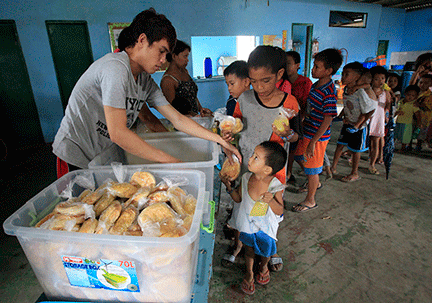
The following editorial first appeared in the Nov. 12 issue of The Compass, newspaper of the Diocese of Green Bay, Wisconsin. It was written by Sam Lucero, news and information manager, and is provided here through Catholic News Service.
In October, Oxfam America launched a global campaign to address extreme inequality. As part of this campaign, Oxfam, a nonprofit organization that works to find solutions to poverty, issued a report that highlights just how extreme global inequality has become. Titled “Even It Up: Time to End Extreme Inequality,” the report offers some troubling statistics on the growing gap between rich and poor.
The Oxfam report notes that the richest 85 people in the world own as much as the poorest half of the world. That’s an 85-to-3.5 billion contrast. “Between March 2013 and March 2014, these 85 people grew $668 million richer each day,” reported Oxfam.
“If Bill Gates were to cash in all of his wealth and spend $1 million every single day, it would take him 218 years to spend it all,” said the report. “In reality though, he would never run out of money” because he would continue to make $4.2 million in interest each day.
Oxfam reports that a “billionaire boom” has occurred since the world financial crisis, which began in 2007. Today there are 1,645 billionaires in the world, more than double the number in 2007.
“Extreme wealth is not just a rich-country story,” said Oxfam, noting that Mexico’s Carlos Slim Helu ousted Gates as the richest man in the world last July. There are 16 billionaires living in sub-Saharan Africa, home to 358 million living in extreme poverty.
“The aggregate wealth of today’s billionaires has increased by 124 percent in the last four years and is now approximately $5.4 trillion,” Oxfam noted. “This is twice the size of France’s GDP in 2012.”
In an effort to end extreme inequality, Oxfam is calling on governments, institutions and corporations to help build a fairer economic and political system. It proposes a nine-point plan including ways to make the world’s richest pay their share of taxes and close international tax loopholes that allow them to avoid fair taxation.
According to Oxfam, if the world’s billionaires were taxed 1.5 percent on their wealth directly after the financial crisis, “23 million lives across the world’s poorest 49 countries” could have been saved by providing them with funds to invest in health care.
With such a growing disparity between the excessively rich and extremely poor, it is no wonder Pope Francis called for an end to “an economy of exclusion and inequality” last November when he released “Evangelii Gaudium” (“The Joy of the Gospel”), his first apostolic exhortation.
Oxfam and Pope Francis share a belief that the world’s financial leaders have a duty and a moral obligation to make ethics a part of their business plan.
“Ethics -- a non-ideological ethics-- would make it possible to bring about balance and a more humane social order,” said Pope Francis. “Money must serve, not rule! The pope loves everyone, rich and poor alike, but he is obliged in the name of Christ to remind all that the rich must help, respect and promote the poor.”
Read the Oxfam report here: http://bit.ly/1ufun5D.
The views or positions presented in this or any guest editorial are those of the writer and/or the originating publication and do not necessarily represent the views of Catholic News Service, the U.S. Conference of Catholic Bishops, the Diocese of Trenton or The Monitor.
[[In-content Ad]]
Related Stories
Thursday, December 18, 2025


E-Editions
Events
The following editorial first appeared in the Nov. 12 issue of The Compass, newspaper of the Diocese of Green Bay, Wisconsin. It was written by Sam Lucero, news and information manager, and is provided here through Catholic News Service.
In October, Oxfam America launched a global campaign to address extreme inequality. As part of this campaign, Oxfam, a nonprofit organization that works to find solutions to poverty, issued a report that highlights just how extreme global inequality has become. Titled “Even It Up: Time to End Extreme Inequality,” the report offers some troubling statistics on the growing gap between rich and poor.
The Oxfam report notes that the richest 85 people in the world own as much as the poorest half of the world. That’s an 85-to-3.5 billion contrast. “Between March 2013 and March 2014, these 85 people grew $668 million richer each day,” reported Oxfam.
“If Bill Gates were to cash in all of his wealth and spend $1 million every single day, it would take him 218 years to spend it all,” said the report. “In reality though, he would never run out of money” because he would continue to make $4.2 million in interest each day.
Oxfam reports that a “billionaire boom” has occurred since the world financial crisis, which began in 2007. Today there are 1,645 billionaires in the world, more than double the number in 2007.
“Extreme wealth is not just a rich-country story,” said Oxfam, noting that Mexico’s Carlos Slim Helu ousted Gates as the richest man in the world last July. There are 16 billionaires living in sub-Saharan Africa, home to 358 million living in extreme poverty.
“The aggregate wealth of today’s billionaires has increased by 124 percent in the last four years and is now approximately $5.4 trillion,” Oxfam noted. “This is twice the size of France’s GDP in 2012.”
In an effort to end extreme inequality, Oxfam is calling on governments, institutions and corporations to help build a fairer economic and political system. It proposes a nine-point plan including ways to make the world’s richest pay their share of taxes and close international tax loopholes that allow them to avoid fair taxation.
According to Oxfam, if the world’s billionaires were taxed 1.5 percent on their wealth directly after the financial crisis, “23 million lives across the world’s poorest 49 countries” could have been saved by providing them with funds to invest in health care.
With such a growing disparity between the excessively rich and extremely poor, it is no wonder Pope Francis called for an end to “an economy of exclusion and inequality” last November when he released “Evangelii Gaudium” (“The Joy of the Gospel”), his first apostolic exhortation.
Oxfam and Pope Francis share a belief that the world’s financial leaders have a duty and a moral obligation to make ethics a part of their business plan.
“Ethics -- a non-ideological ethics-- would make it possible to bring about balance and a more humane social order,” said Pope Francis. “Money must serve, not rule! The pope loves everyone, rich and poor alike, but he is obliged in the name of Christ to remind all that the rich must help, respect and promote the poor.”
Read the Oxfam report here: http://bit.ly/1ufun5D.
The views or positions presented in this or any guest editorial are those of the writer and/or the originating publication and do not necessarily represent the views of Catholic News Service, the U.S. Conference of Catholic Bishops, the Diocese of Trenton or The Monitor.
[[In-content Ad]]