


Expert invites Hispanic community to take leadership roles in Church
July 29, 2019 at 12:37 p.m.
By Matt Greeley
Special Contributor
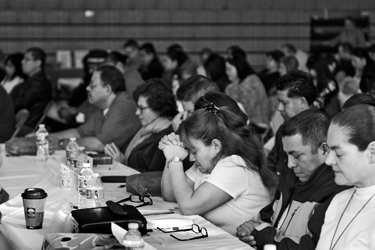
“Somos el cuerpo de Cristo. We are the Body of Christ,” was sung loud and proud as hundreds of Latino leaders representing parishes from across the Diocese of Trenton gathered in the gym of St. Rose of Lima School, Freehold, Nov. 21 for an Hispanic Ministry Study Day.
The workshop, which drew several hundred people, focused on finding ways for the Church to respond to the ministerial needs of the Diocese’s ever-growing Hispanic Catholic community.
Specifically, the goal of the day was to encourage more Hispanics to assume leadership in the life of the Church. The day also served to promote awareness among and challenge the greater Catholic community on how they can help to respond to the needs of their Latino Catholic brothers and sisters.
In a day-long program delivered in Spanish, presenter Dr. Hosffman Ospino gave an in-depth history lesson on the first Catholic Church that was founded in the New World in St. Augustine, Fla., by the Spanish. Dr. Ospino reflected on that founding as a way to generate conversation and conversion among the diocesan family of Trenton.
“El presente y el futuro [the present and the future],” are in your hands, said Dr. Ospino. “You are transforming the Church in the United States.”
While Dr. Ospino reflected on the need of current Church leadership around the country to more intentionally embrace and empower the Latino community, he directly called upon the Latino community to “invertir,” to invest, in their families, in their education, in their Church.
“I have heard people call the Hispanic community a problem for the Church, to which I respond that we are a blessing,” Ospino said, adding how it is the responsibility of the Latino community to take steps to build a more stable society. He spoke openly of the importance of education and that many families are allowing their sons and daughters to drop out of school or to stop studying after high school.
María Bravo, from St. Anthony Claret Parish, Lakewood, shared her personal story of how her daughter, now a university freshman, sought out scholarships and financial help to attend Georgian Court University, Lakewood.
“The university wanted her there and helped make it possible,” emphasized Bravo, expressing that there are ways to make higher education happen if people work for it. Her daughter, Ashley Rosales, is now excelling as an engineering major in GCU.
Dr. Ospino used the example to challenge parishes to more fully respond to the needs of the community, in particular those of the Hispanic community. He offered a list of potential ministries that would directly affect communities and help strengthen faith, family and society all at the same time. To accomplish that goal, he suggested that revolutionary parish ministries would need to be developed:
Do you know young people in gangs? Work on gang prevention.
Latinos are the second-largest group in prisons. Offer prison ministries.
The vast majority of Latinos in the United States were born here? Try to meet their needs, not just the needs of the immigrant.
Latinas have the highest teen pregnancy rates in the U.S.? We must respond.
Offer vocation preparation and support by looking for young people who may be discerning a call to the priesthood or religious life and truly encouraging and walking with them.
Accompany newly married couples through their first five years of marriage, given that half of them end in divorce these days.
Zeneida Limardo of Mother of Mercy Parish, Asbury Park, was impressed with all she learned at the workshop.
“Latinos make our faith known by how we live it, communicate it and how we ‘feel’ it,” she said. “ We need to help the other Church communities know us.”
Speaking of the larger Catholic community and Latinos’ relationship within it, Ospino said, “There are a lot of us and that can be something scary.”
To that point, Mercedes Hernández of St. Rose of Lima Parish reminded the gathering that, “We all serve God first. We need to look for opportunities to invite one another to get to know each other.”
“It would be good to have more events where we could be together as people of faith, to recognize one another and learn to accept one another,” shared Roberto Hernández of St. Joseph Parish in Trenton.
Greeley is associate director of the Office of Communications and coordinator of Spanish-language communications.
[[In-content Ad]]Related Stories
Monday, December 22, 2025




E-Editions
Events
By Matt Greeley
Special Contributor
“Somos el cuerpo de Cristo. We are the Body of Christ,” was sung loud and proud as hundreds of Latino leaders representing parishes from across the Diocese of Trenton gathered in the gym of St. Rose of Lima School, Freehold, Nov. 21 for an Hispanic Ministry Study Day.
The workshop, which drew several hundred people, focused on finding ways for the Church to respond to the ministerial needs of the Diocese’s ever-growing Hispanic Catholic community.
Specifically, the goal of the day was to encourage more Hispanics to assume leadership in the life of the Church. The day also served to promote awareness among and challenge the greater Catholic community on how they can help to respond to the needs of their Latino Catholic brothers and sisters.
In a day-long program delivered in Spanish, presenter Dr. Hosffman Ospino gave an in-depth history lesson on the first Catholic Church that was founded in the New World in St. Augustine, Fla., by the Spanish. Dr. Ospino reflected on that founding as a way to generate conversation and conversion among the diocesan family of Trenton.
“El presente y el futuro [the present and the future],” are in your hands, said Dr. Ospino. “You are transforming the Church in the United States.”
While Dr. Ospino reflected on the need of current Church leadership around the country to more intentionally embrace and empower the Latino community, he directly called upon the Latino community to “invertir,” to invest, in their families, in their education, in their Church.
“I have heard people call the Hispanic community a problem for the Church, to which I respond that we are a blessing,” Ospino said, adding how it is the responsibility of the Latino community to take steps to build a more stable society. He spoke openly of the importance of education and that many families are allowing their sons and daughters to drop out of school or to stop studying after high school.
María Bravo, from St. Anthony Claret Parish, Lakewood, shared her personal story of how her daughter, now a university freshman, sought out scholarships and financial help to attend Georgian Court University, Lakewood.
“The university wanted her there and helped make it possible,” emphasized Bravo, expressing that there are ways to make higher education happen if people work for it. Her daughter, Ashley Rosales, is now excelling as an engineering major in GCU.
Dr. Ospino used the example to challenge parishes to more fully respond to the needs of the community, in particular those of the Hispanic community. He offered a list of potential ministries that would directly affect communities and help strengthen faith, family and society all at the same time. To accomplish that goal, he suggested that revolutionary parish ministries would need to be developed:
Do you know young people in gangs? Work on gang prevention.
Latinos are the second-largest group in prisons. Offer prison ministries.
The vast majority of Latinos in the United States were born here? Try to meet their needs, not just the needs of the immigrant.
Latinas have the highest teen pregnancy rates in the U.S.? We must respond.
Offer vocation preparation and support by looking for young people who may be discerning a call to the priesthood or religious life and truly encouraging and walking with them.
Accompany newly married couples through their first five years of marriage, given that half of them end in divorce these days.
Zeneida Limardo of Mother of Mercy Parish, Asbury Park, was impressed with all she learned at the workshop.
“Latinos make our faith known by how we live it, communicate it and how we ‘feel’ it,” she said. “ We need to help the other Church communities know us.”
Speaking of the larger Catholic community and Latinos’ relationship within it, Ospino said, “There are a lot of us and that can be something scary.”
To that point, Mercedes Hernández of St. Rose of Lima Parish reminded the gathering that, “We all serve God first. We need to look for opportunities to invite one another to get to know each other.”
“It would be good to have more events where we could be together as people of faith, to recognize one another and learn to accept one another,” shared Roberto Hernández of St. Joseph Parish in Trenton.
Greeley is associate director of the Office of Communications and coordinator of Spanish-language communications.
[[In-content Ad]]