


Diocese issues library media curriculum guidelines
July 29, 2019 at 12:37 p.m.
By Christina Leslie | Staff Writer
Embracing the ideal that “the library is the heart of the education environment,” Dr. Margaret F. Boland addressed a group of 35 library and media specialists from around the Diocese in St. Dominic School, Brick, May 14, as the Diocese of Trenton released its first set of library curriculum guidelines.
Dr. Boland, who serves as diocesan associate superintendant of schools, explained that the all-volunteer committee had met for five years as they formulated the inaugural document for use in all diocesan schools. “This is a momentous occasion for the committee to provide a document the diocese has never had and surely needs,” she said of the guidelines which offer librarians the strategies necessary for Catholic school students to compete in the third millennium.
Dr. Boland noted the changes in both education and libraries over the decades, shifting towards a more intensive use of electronic media over the printed word. “Children’s brains are being rewired, look at the technology we have,” she urged. “They don’t like repetition, they are used to moving on. It is a very different environment as educators; we have to be open to that.
The Diocese, recognizing the need to standardize practices, formed a committee of 11 library and media specialists to devise a set of guidelines for the schools melding diocesan goals, the National Standards and Benchmarks for Catholic Elementary and Secondary Schools and Association of American School Libraries research. The result was a comprehensive document over 100 pages in length which covers educational strategies for students from pre-kindergarten through grade 12.
Dr. Boland noted the document would fulfill the 2005 guidelines issued by the U.S. Conference of Catholic Bishops: “Young people of the third millennium must be a source of energy and leadership in our Church... [and Catholic schools should offer] an academically rigorous and doctrinally sound program of education.”
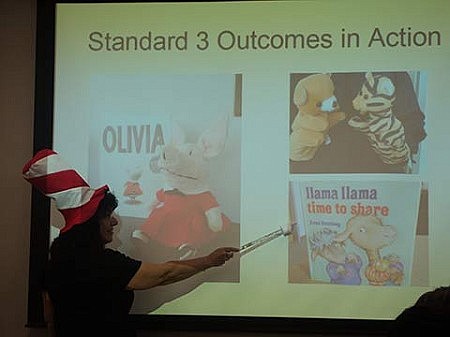
Committee members presented a light-hearted look at the guidelines, employing hand puppets, costumes, rhymes, videos and quizzes. One member, illustrating preparedness for natural and man-made disasters, donned a HAZMAT suit as she stressed the importance to preserve digital records of library contents. “We even have disaster planning in the guidelines,” Dr. Boland said. “Nobody else has that; we do now.”
Pauline Barber, librarian in All Saints Regional Catholic School, Manahawkin, noted the important place the guidelines had in diocesan schools. “It legitimizes the position of librarian when many of my friends and colleagues are losing their jobs and being replaced by Google and machines,” she asserted.
Joanne Smith, who served as the library/media specialist at St. Joan of Arc School, Marlton, for two decades, also was in favor of standardizing practices. “It is necessary to have a curriculum to follow,” she asserted. “We are the only person in the school who does what we do. It’s a great idea for the Diocese for us all to follow.”
[[In-content Ad]]
Related Stories
Friday, December 19, 2025



E-Editions
Events
By Christina Leslie | Staff Writer
Embracing the ideal that “the library is the heart of the education environment,” Dr. Margaret F. Boland addressed a group of 35 library and media specialists from around the Diocese in St. Dominic School, Brick, May 14, as the Diocese of Trenton released its first set of library curriculum guidelines.
Dr. Boland, who serves as diocesan associate superintendant of schools, explained that the all-volunteer committee had met for five years as they formulated the inaugural document for use in all diocesan schools. “This is a momentous occasion for the committee to provide a document the diocese has never had and surely needs,” she said of the guidelines which offer librarians the strategies necessary for Catholic school students to compete in the third millennium.
Dr. Boland noted the changes in both education and libraries over the decades, shifting towards a more intensive use of electronic media over the printed word. “Children’s brains are being rewired, look at the technology we have,” she urged. “They don’t like repetition, they are used to moving on. It is a very different environment as educators; we have to be open to that.
The Diocese, recognizing the need to standardize practices, formed a committee of 11 library and media specialists to devise a set of guidelines for the schools melding diocesan goals, the National Standards and Benchmarks for Catholic Elementary and Secondary Schools and Association of American School Libraries research. The result was a comprehensive document over 100 pages in length which covers educational strategies for students from pre-kindergarten through grade 12.
Dr. Boland noted the document would fulfill the 2005 guidelines issued by the U.S. Conference of Catholic Bishops: “Young people of the third millennium must be a source of energy and leadership in our Church... [and Catholic schools should offer] an academically rigorous and doctrinally sound program of education.”
Committee members presented a light-hearted look at the guidelines, employing hand puppets, costumes, rhymes, videos and quizzes. One member, illustrating preparedness for natural and man-made disasters, donned a HAZMAT suit as she stressed the importance to preserve digital records of library contents. “We even have disaster planning in the guidelines,” Dr. Boland said. “Nobody else has that; we do now.”
Pauline Barber, librarian in All Saints Regional Catholic School, Manahawkin, noted the important place the guidelines had in diocesan schools. “It legitimizes the position of librarian when many of my friends and colleagues are losing their jobs and being replaced by Google and machines,” she asserted.
Joanne Smith, who served as the library/media specialist at St. Joan of Arc School, Marlton, for two decades, also was in favor of standardizing practices. “It is necessary to have a curriculum to follow,” she asserted. “We are the only person in the school who does what we do. It’s a great idea for the Diocese for us all to follow.”
[[In-content Ad]]