


Catechetical convocation focuses on teaching role of the family
July 29, 2019 at 12:37 p.m.
By Mary Stadnyk | Associate Editor
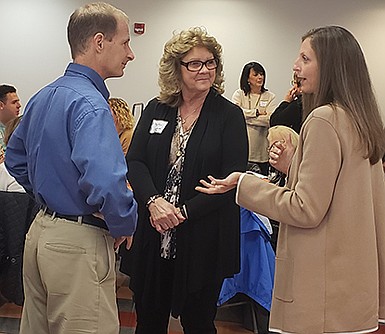
The ways in which the Church can assist parents in their role as primary educators of the faith was a focus of the 2018 Parish Catechetical Leader Convocation held Oct. 18 in St. Isaac Jogues Parish, Marlton.
The formation day, which drew 70 parish catechetical leaders from around the Diocese, featured presentations on Models of Catechesis by Sister of St. Joseph Kathy Burton and Mary Lou Hughes, co-directors of the Office of Faith, Family Life and Lay Formation in the Camden Diocese, and on Online Resources For Parents by Jessica Donohue, parish catechetical leader in Sacred Heart Parish, Mount Holly. The day also included a Mass celebrated by Franciscan Father Gabriel Zeis, diocesan vicar for Catholic education, and the presentation of the Chick McGinty Award for Excellence in Catechetical Ministry. This year’s recipient was Dominica Vullo, coordinator of religious education in St. Benedict Parish, Holmdel.
Denise Contino, director of the diocesan Department of Catechesis, which hosted the day, said she hoped the convocation would help the leaders “to think differently [and] really take a look at their parish community and carefully reflect on the entire faith formation process in their parish.
“Family catechesis can be implemented, and the hope is to help families grow in the ‘domestic Church’ within their homes,” Contino said. “Family catechesis can provide parents the catechetical tools to pass on the faith.”
Sister Kathy and Hughes offered a number of concepts to help parish catechetical leaders enhance their skills and responsibilities. As teachers of the faith, they must strive to: be aware of their families and their situations; work with and support parents; offer quality faith forming opportunities in the parish for families to come together; offer families the tools that can help them build and strengthen their homes as domestic churches; redirect their energies from primarily focusing on children to coaching parents. Lastly, they must work toward being more intentional about formation instead of information.
“Parents and families must be actively involved,” said Sister Kathy.
In her presentation “Technology and Family Catechesis: Learning About Our Faith Online, Living Our Faith ‘IRL,’” Donohue conveyed how technology is really just a means of meeting people where they are.
“We are called to use those resources that will help us to best meet the needs of the people to whom we are ministering and in ways that resonate with them,” Donohue said. “Technology is just one modern way to do that but it is also very important that technology is the medium and not the message.”
Donohue described an online course for parents she created to help them discover the importance of the domestic Church. The course was designed so that parents can follow it on their own time. She also spoke about using social media to enhance catechetical ministries.
“I don’t think social media creates community as far as parishes go, but it does reflect and can enhance the community that already exists,” she said. She added that social media needs to be used wisely, with purpose, and is best employed “when we know who our people are and what they need.”
The emphasis on family catechesis and making it available in the parishes was not lost on the parish catechetical leaders in attendance.
“The Church tends to lose many families once the students receive Confirmation,” said Celeste Grant, PCL for the St. Andrew campus of St. Isidore the Farmer Parish, New Egypt. “My hope is to catechize the parents as well as their children so that parents realize Confirmation is not an end goal but that it is a new beginning for the family, a beginning of a faith journey in their Church.”
Regarding the use of technology in faith formation, Rich Scanlon, director of evangelization and discipleship mentor in Resurrection Parish, Delran, remarked on having a better understanding on how Generation X and millennials are immersed in technology as a way of life.
“If parents are hoping that their kids learn the faith, develop a relationship with Jesus and ultimately, become saints, then dropping their kids off for religious education once a week for an hour-and-a-half over the course of a 30-plus week won’t accomplish those goals,” he said. “There is still about 167 hours in the week that they are not at religious education.”
[[In-content Ad]]
Related Stories
Saturday, December 27, 2025



E-Editions
Events
By Mary Stadnyk | Associate Editor
The ways in which the Church can assist parents in their role as primary educators of the faith was a focus of the 2018 Parish Catechetical Leader Convocation held Oct. 18 in St. Isaac Jogues Parish, Marlton.
The formation day, which drew 70 parish catechetical leaders from around the Diocese, featured presentations on Models of Catechesis by Sister of St. Joseph Kathy Burton and Mary Lou Hughes, co-directors of the Office of Faith, Family Life and Lay Formation in the Camden Diocese, and on Online Resources For Parents by Jessica Donohue, parish catechetical leader in Sacred Heart Parish, Mount Holly. The day also included a Mass celebrated by Franciscan Father Gabriel Zeis, diocesan vicar for Catholic education, and the presentation of the Chick McGinty Award for Excellence in Catechetical Ministry. This year’s recipient was Dominica Vullo, coordinator of religious education in St. Benedict Parish, Holmdel.
Denise Contino, director of the diocesan Department of Catechesis, which hosted the day, said she hoped the convocation would help the leaders “to think differently [and] really take a look at their parish community and carefully reflect on the entire faith formation process in their parish.
“Family catechesis can be implemented, and the hope is to help families grow in the ‘domestic Church’ within their homes,” Contino said. “Family catechesis can provide parents the catechetical tools to pass on the faith.”
Sister Kathy and Hughes offered a number of concepts to help parish catechetical leaders enhance their skills and responsibilities. As teachers of the faith, they must strive to: be aware of their families and their situations; work with and support parents; offer quality faith forming opportunities in the parish for families to come together; offer families the tools that can help them build and strengthen their homes as domestic churches; redirect their energies from primarily focusing on children to coaching parents. Lastly, they must work toward being more intentional about formation instead of information.
“Parents and families must be actively involved,” said Sister Kathy.
In her presentation “Technology and Family Catechesis: Learning About Our Faith Online, Living Our Faith ‘IRL,’” Donohue conveyed how technology is really just a means of meeting people where they are.
“We are called to use those resources that will help us to best meet the needs of the people to whom we are ministering and in ways that resonate with them,” Donohue said. “Technology is just one modern way to do that but it is also very important that technology is the medium and not the message.”
Donohue described an online course for parents she created to help them discover the importance of the domestic Church. The course was designed so that parents can follow it on their own time. She also spoke about using social media to enhance catechetical ministries.
“I don’t think social media creates community as far as parishes go, but it does reflect and can enhance the community that already exists,” she said. She added that social media needs to be used wisely, with purpose, and is best employed “when we know who our people are and what they need.”
The emphasis on family catechesis and making it available in the parishes was not lost on the parish catechetical leaders in attendance.
“The Church tends to lose many families once the students receive Confirmation,” said Celeste Grant, PCL for the St. Andrew campus of St. Isidore the Farmer Parish, New Egypt. “My hope is to catechize the parents as well as their children so that parents realize Confirmation is not an end goal but that it is a new beginning for the family, a beginning of a faith journey in their Church.”
Regarding the use of technology in faith formation, Rich Scanlon, director of evangelization and discipleship mentor in Resurrection Parish, Delran, remarked on having a better understanding on how Generation X and millennials are immersed in technology as a way of life.
“If parents are hoping that their kids learn the faith, develop a relationship with Jesus and ultimately, become saints, then dropping their kids off for religious education once a week for an hour-and-a-half over the course of a 30-plus week won’t accomplish those goals,” he said. “There is still about 167 hours in the week that they are not at religious education.”
[[In-content Ad]]