


Bringing Christ's light into the darkest of times
July 29, 2019 at 12:37 p.m.
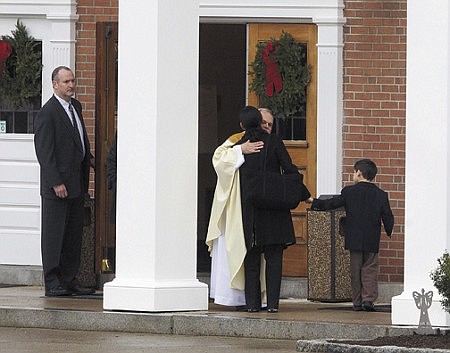
He was there.
Msgr. Robert Weiss, pastor of St. Rose of Lima Parish in Newtown, Connecticut, went quickly to the scene of the Dec. 14 school massacre. There were the bodies of 20 little children, six staff and the 20-year-old perpetrator who killed them and then himself.
And from that moment on and for days to come, Msgr. Weiss became the face of compassion to victims’ families, to parishioners, townspeople, and, through the media, the entire world. He and other clergy said nothing had prepared them to deal with such a situation, but they may be wrong.
Msgr. Weiss knew that by right of Baptism and later ordination, he must bring Christ’s presence to the world, especially in troubled times. He had to eschew anger for caring, point to hope amidst near despair, and give a reason to live to some who felt their reason for living lay dead. Often he had to do so without words.
As God’s representative, Msgr. Weiss came from the only world that offered consolation. People attended Mass in search of comfort. For memorial and funeral Masses, Scripture guided him.
When it comes to the human encountering the divine, nothing matches a Catholic funeral. It stands out at the final commendation of the deceased. “May the angels lead you into Paradise,” the Church prays. “May the martyrs greet you at your arrival and lead you into the holy city, Jerusalem….” The teaching that “life is not ended but changed” lets children, parents, brothers, sisters and friends know they will see their loved one again.
Msgr. Weiss became psychologist and counselor. Leave the Christmas lights on, he advised families who asked what to do. “I saw 20 new stars in the sky tonight,” he said evoking a human image at an overflow Mass the night of the crime.
The grace of the moment, that special gift of God, was with Msgr. Weiss. And so was six-to eight years of training before ordination. Early in his priesthood he likely labored beside seasoned priests, learning the trade and crafting his own distinctive pastoral style.
Seminaries are intense, a fish bowl-like experience in a close-knit community, where praying, studying and eating together taught him about the human condition. Spiritual directors and formation directors pushed and pulled him to articulate his inner life, called him to greater accountability and comforted him when he struggled.
Seminary and the first years of priestly ministry are a steep immersion into the depths of one’s own humanity followed by an immersion into the depths of others.’ And it is always filtered through the lens of faith. Seminarians face queries about how they feel at the death of someone dear? How has the grieving process been? How do they feel when a friend leaves the seminary? How do they deal with the loss? And how do Christ and the seminarian’s faith help him with each of those? This is the undertow of seminary life, where academic training is but a part.
And then it happens, an unconscionable act of violence. Perhaps he remembered from his training in visiting hospitals and nursing homes: the ministry of presence, where sometimes the most soothing ministry is just being there. Sometimes words can get in the way and people just need to know that everything has not evaporated, that there is still someone to lean on, that even if they don’t see the working of faith in this moment, then perhaps another does.
Sometimes a priest can draw on the words of Christ and sometimes he simply stands as a presence to show God is not absent.
Msgr. Weiss, whatever his previousl experience with grief and struggle, and whether or not he had been tested in the fire of faith, at Newtown stood as a presence and image of that faith for others.
Perhaps it was grace, or training, or both that let Msgr. Weiss touch souls across the nation this week. For right from the start, like Jesus, he was there.
Sister Mary Ann is director of media relations for the United States Conference of Catholic Bishops. Contributing to this was Father Daniel Merz, associate director of the U.S. Conference of Catholic Bishops Secretariat for Divine Worship.
[[In-content Ad]]Related Stories
Thursday, December 18, 2025



E-Editions
Events
He was there.
Msgr. Robert Weiss, pastor of St. Rose of Lima Parish in Newtown, Connecticut, went quickly to the scene of the Dec. 14 school massacre. There were the bodies of 20 little children, six staff and the 20-year-old perpetrator who killed them and then himself.
And from that moment on and for days to come, Msgr. Weiss became the face of compassion to victims’ families, to parishioners, townspeople, and, through the media, the entire world. He and other clergy said nothing had prepared them to deal with such a situation, but they may be wrong.
Msgr. Weiss knew that by right of Baptism and later ordination, he must bring Christ’s presence to the world, especially in troubled times. He had to eschew anger for caring, point to hope amidst near despair, and give a reason to live to some who felt their reason for living lay dead. Often he had to do so without words.
As God’s representative, Msgr. Weiss came from the only world that offered consolation. People attended Mass in search of comfort. For memorial and funeral Masses, Scripture guided him.
When it comes to the human encountering the divine, nothing matches a Catholic funeral. It stands out at the final commendation of the deceased. “May the angels lead you into Paradise,” the Church prays. “May the martyrs greet you at your arrival and lead you into the holy city, Jerusalem….” The teaching that “life is not ended but changed” lets children, parents, brothers, sisters and friends know they will see their loved one again.
Msgr. Weiss became psychologist and counselor. Leave the Christmas lights on, he advised families who asked what to do. “I saw 20 new stars in the sky tonight,” he said evoking a human image at an overflow Mass the night of the crime.
The grace of the moment, that special gift of God, was with Msgr. Weiss. And so was six-to eight years of training before ordination. Early in his priesthood he likely labored beside seasoned priests, learning the trade and crafting his own distinctive pastoral style.
Seminaries are intense, a fish bowl-like experience in a close-knit community, where praying, studying and eating together taught him about the human condition. Spiritual directors and formation directors pushed and pulled him to articulate his inner life, called him to greater accountability and comforted him when he struggled.
Seminary and the first years of priestly ministry are a steep immersion into the depths of one’s own humanity followed by an immersion into the depths of others.’ And it is always filtered through the lens of faith. Seminarians face queries about how they feel at the death of someone dear? How has the grieving process been? How do they feel when a friend leaves the seminary? How do they deal with the loss? And how do Christ and the seminarian’s faith help him with each of those? This is the undertow of seminary life, where academic training is but a part.
And then it happens, an unconscionable act of violence. Perhaps he remembered from his training in visiting hospitals and nursing homes: the ministry of presence, where sometimes the most soothing ministry is just being there. Sometimes words can get in the way and people just need to know that everything has not evaporated, that there is still someone to lean on, that even if they don’t see the working of faith in this moment, then perhaps another does.
Sometimes a priest can draw on the words of Christ and sometimes he simply stands as a presence to show God is not absent.
Msgr. Weiss, whatever his previousl experience with grief and struggle, and whether or not he had been tested in the fire of faith, at Newtown stood as a presence and image of that faith for others.
Perhaps it was grace, or training, or both that let Msgr. Weiss touch souls across the nation this week. For right from the start, like Jesus, he was there.
Sister Mary Ann is director of media relations for the United States Conference of Catholic Bishops. Contributing to this was Father Daniel Merz, associate director of the U.S. Conference of Catholic Bishops Secretariat for Divine Worship.
[[In-content Ad]]