


Bishop promulgates revised Statutes of Fourth Synod
July 29, 2019 at 12:37 p.m.
By EmmaLee Italia | Correspondent
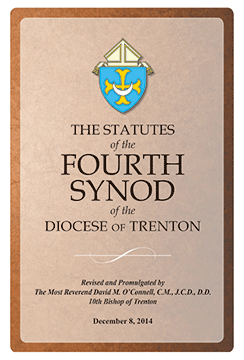
The set of laws that govern the Church of Trenton have just been put through an overhaul, an exhaustive process led by Bishop David M. O’Connell, C.M., in consultation with clergy, diocesan staff and other representatives of the Diocese.
The work to update the Statutes of the Fourth Synod, which stretched over the better part of three years, drew to a close with the promulgation of the comprehensive document by Bishop O’Connell Dec. 8, 2014.
“The statutes – or diocesan policies – themselves require review and revision every five years,” said Bishop O’Connell. “Since their original promulgation following the Fourth Diocesan Synod in 1991, they had never been updated.”
The statutes shape the law of the universal Catholic Church to the specific needs of the Diocese. Examples of statutes include those dealing with parish governance, financial obligations of individual parishes and the Diocese as a whole, and practices and responsibilities of diocesan clergy and employees. There are instructions, as well, for the laity of the Diocese in respect to their responsibility as baptized Catholics.
As explained by the statutes booklet, the statutes “are taken from the 1983 Code of Canon Law or other universal legislative documents; particular law, whether national, regional, or diocesan or pertaining to particular institutions or organizations; authoritative teachings of the Church’s magisterium, and other narrative elements included to contextualize or explain these statutes.”
“Since becoming diocesan Bishop, I have been studying all our diocesan policies to ensure coherence and consistency,” the Bishop explained. “Laws and policies are designed for the common good. It was time to ensure that our revised policies incorporated changes that have transpired, eliminated things that no longer existed and introduced innovations and clarification regarding the ways we serve God’s people in the Diocese.”
Bishop O’Connell established a review committee chaired by Msgr. Leonard Troiano, chairman of the diocesan Expansion and Restructuring Commission and pastor of St. Pio of Pietrelcina Parish, Lavallette, who was very involved in the Fourth Synod.
While the committee met several times for initial review, Hurricane Sandy destroyed materials that were stored in a parish, Bishop O’Connell explained. He added, “I took whatever could be salvaged, consulted with members of the committee and then spent the summer incorporating all the recommended revision(s).”
Bishop O’Connell, who holds a doctorate in canon law and has worked as a canon lawyer since 1987, serves as the chief legislator of the Diocese and holds the responsibility to issue revised statutes. He composed multiple drafts and circulated them several times to members of the diocesan staff for their edits and suggestions.
The Fourth Synod, opened by Bishop John C. Reiss in January 1991, produced the statutes in use by the Diocese of Trenton before the most current promulgation. According to the Code of Canon Law, a diocesan synod is “an assembly of selected priests and other members of Christ’s faithful of a particular church, who offer assistance to the Bishop for the good of the whole diocesan community according to the norm of canon law (canon 460).”
Bishop Reiss began the synod to review and revise the statutes from the Third Synod, which was held in 1931. Between the two synods, “many ecclesial events have transpired to change the functioning of the Church universal,” Bishop Reiss had said during his homily for the opening of the Fourth Synod. “In addition to the upheavals in society, there has been held the Second Vatican Council, which issued various fundamental documents in its own name and commissioned revisions of the Liturgy and of the Code of Canon Law.”
The synod came to a close Dec. 8, 1991, with a Mass in St. Mary of the Assumption Cathedral in Trenton. Bishop Reiss announced, during his homily, the compilation of 350 statutes, emphasizing that they “are tailored for the Diocese as a means to promote the Gospel.”
The current revised statutes will have a similar effect of promoting uniformity, as well as clarifying the practices of the Diocese and its departments.
“Confusion enters the picture when policies are not current or, worse, ignored,” Bishop O’Connell said. “Every community needs laws and policies. The Church is a community of faith, worship and law. A Diocese applies all these things to its unique situation. Hence it is called ‘particular law’ in Church vocabulary… We’re not simply making things up arbitrarily as we go along, but serving [the faithful] by serving the common good.”
It will be the responsibility of the parishes, diocesan offices and other institutions to implement the revised statutes. The statutes will be up again for review and updating in 2019.
While there no plans for a Fifth Synod in the immediate future, Bishop O’Connell remarked, “I hope to do other things that will yield similar effects,” the Bishop said.
Statute booklets will be distributed to: members of the diocesan curia; diocesan directors; all diocesan chancery offices; each parish, priest and deacon of the diocese, and all diocesan schools.
To view a copy of the statutes online, visit www.dioceseoftrenton.org.
[[In-content Ad]]Related Stories
Sunday, December 21, 2025



E-Editions
Events
By EmmaLee Italia | Correspondent
The set of laws that govern the Church of Trenton have just been put through an overhaul, an exhaustive process led by Bishop David M. O’Connell, C.M., in consultation with clergy, diocesan staff and other representatives of the Diocese.
The work to update the Statutes of the Fourth Synod, which stretched over the better part of three years, drew to a close with the promulgation of the comprehensive document by Bishop O’Connell Dec. 8, 2014.
“The statutes – or diocesan policies – themselves require review and revision every five years,” said Bishop O’Connell. “Since their original promulgation following the Fourth Diocesan Synod in 1991, they had never been updated.”
The statutes shape the law of the universal Catholic Church to the specific needs of the Diocese. Examples of statutes include those dealing with parish governance, financial obligations of individual parishes and the Diocese as a whole, and practices and responsibilities of diocesan clergy and employees. There are instructions, as well, for the laity of the Diocese in respect to their responsibility as baptized Catholics.
As explained by the statutes booklet, the statutes “are taken from the 1983 Code of Canon Law or other universal legislative documents; particular law, whether national, regional, or diocesan or pertaining to particular institutions or organizations; authoritative teachings of the Church’s magisterium, and other narrative elements included to contextualize or explain these statutes.”
“Since becoming diocesan Bishop, I have been studying all our diocesan policies to ensure coherence and consistency,” the Bishop explained. “Laws and policies are designed for the common good. It was time to ensure that our revised policies incorporated changes that have transpired, eliminated things that no longer existed and introduced innovations and clarification regarding the ways we serve God’s people in the Diocese.”
Bishop O’Connell established a review committee chaired by Msgr. Leonard Troiano, chairman of the diocesan Expansion and Restructuring Commission and pastor of St. Pio of Pietrelcina Parish, Lavallette, who was very involved in the Fourth Synod.
While the committee met several times for initial review, Hurricane Sandy destroyed materials that were stored in a parish, Bishop O’Connell explained. He added, “I took whatever could be salvaged, consulted with members of the committee and then spent the summer incorporating all the recommended revision(s).”
Bishop O’Connell, who holds a doctorate in canon law and has worked as a canon lawyer since 1987, serves as the chief legislator of the Diocese and holds the responsibility to issue revised statutes. He composed multiple drafts and circulated them several times to members of the diocesan staff for their edits and suggestions.
The Fourth Synod, opened by Bishop John C. Reiss in January 1991, produced the statutes in use by the Diocese of Trenton before the most current promulgation. According to the Code of Canon Law, a diocesan synod is “an assembly of selected priests and other members of Christ’s faithful of a particular church, who offer assistance to the Bishop for the good of the whole diocesan community according to the norm of canon law (canon 460).”
Bishop Reiss began the synod to review and revise the statutes from the Third Synod, which was held in 1931. Between the two synods, “many ecclesial events have transpired to change the functioning of the Church universal,” Bishop Reiss had said during his homily for the opening of the Fourth Synod. “In addition to the upheavals in society, there has been held the Second Vatican Council, which issued various fundamental documents in its own name and commissioned revisions of the Liturgy and of the Code of Canon Law.”
The synod came to a close Dec. 8, 1991, with a Mass in St. Mary of the Assumption Cathedral in Trenton. Bishop Reiss announced, during his homily, the compilation of 350 statutes, emphasizing that they “are tailored for the Diocese as a means to promote the Gospel.”
The current revised statutes will have a similar effect of promoting uniformity, as well as clarifying the practices of the Diocese and its departments.
“Confusion enters the picture when policies are not current or, worse, ignored,” Bishop O’Connell said. “Every community needs laws and policies. The Church is a community of faith, worship and law. A Diocese applies all these things to its unique situation. Hence it is called ‘particular law’ in Church vocabulary… We’re not simply making things up arbitrarily as we go along, but serving [the faithful] by serving the common good.”
It will be the responsibility of the parishes, diocesan offices and other institutions to implement the revised statutes. The statutes will be up again for review and updating in 2019.
While there no plans for a Fifth Synod in the immediate future, Bishop O’Connell remarked, “I hope to do other things that will yield similar effects,” the Bishop said.
Statute booklets will be distributed to: members of the diocesan curia; diocesan directors; all diocesan chancery offices; each parish, priest and deacon of the diocese, and all diocesan schools.
To view a copy of the statutes online, visit www.dioceseoftrenton.org.
[[In-content Ad]]