


Bishop celebrates Mass with seminarians
July 29, 2019 at 12:37 p.m.
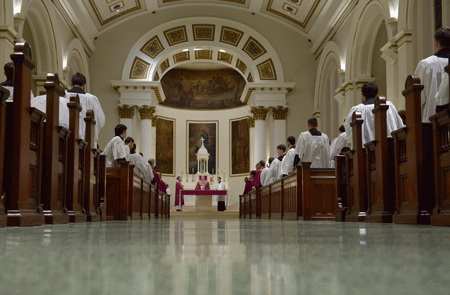
Just a few days before the start of the extraordinary jubilee year of mercy, Bishop David M. O’Connell joined the seminarians in formation at Saint Charles Borromeo Seminary for Mass.
The seminarians, clad in surplices, lined the aisles of the chapel for Mass for the Wednesday of the First Week of Advent. Bishop O’Connell, who was the main celebrant, was joined on the altar by a number of priests from the Diocese.
“This Advent…Pray for the abundance of grace in your own lives and then offer it generously to others, more than they deserve,” the Bishop said in his homily.
“We all hunger for the bread of life. Take and eat. Give it away and gather what is left and then give more.”
While visiting the Seminary, Bishop O’Connell, who sits on the Board of Trustees, visited with Seminary rector Bishop Timothy C. Senior, as well as the seminarians from the Diocese currently at St. Charles Borromeo. The Bishop also made time in his schedule to visit with future fellow Vincentians studying for the priesthood in Wynnewood.
The following is the text, as prepared for delivery, of the homily delivered by Bishop David M. O’Connell, C.M., at Saint Charles Borromeo Seminary, Wynnewood, Pa., Dec. 2:
The Lord Jesus always made an impression on people in the Gospel. Either they were drawn to him by his mercy and love or they rejected him because he allowed himself to be portrayed as the messiah and savior. People were intrigued by his mystery and wanted to know more or they condemned him as a fraud. In today's Gospel passage from St. Matthew, the Lord offers a demonstration of his mercy and mystery. He performs a miracle before their very eyes.
It begins with human need – "my heart is moved with pity for the crowd. They have been with me three days with nothing to eat" – and it ends with an abundance of grace – "they all ate and were satisfied. They picked up the fragments leftover, seven baskets full." For the second time in St. Matthew's Gospel – and only a chapter apart – the Lord multiples a few loaves and fishes to feed those who followed him.
This miracle is the only one repeated in all four Gospels, so it obviously has profound significance, some say as a prefigurement of the Eucharist, others as pointing to the heavenly banquet table. In the first multiplication story – St. Matthew 14 – it was the apostles who took the initiative with Jesus but in today's multiplication narrative – St. Matthew 15 – Jesus made the first move. Details and numbers differ, but the Gospel point behind them is the same: his heart is moved with "pity for the crowd." Where at first there was little, there became enough to go around, more than enough. But nothing was wasted.
God's feeding his people was not unique to the New Testament Gospels. In our first reading from the book of the prophet Isaiah, God provided a feast for his people, "rich foods and choice wines." The Old Testament attests that God chose and formed a people for himself in order to reveal himself and carry out his loving plan of salvation.
In the New Testament Gospels, the Lord Jesus continues that process and same purpose but with a new people. In the Old Testament, God lifts the veil and wipes away tears. In the New Testament, the Lord looks with pity on the crowd. In both testaments, whether on the mountain of the Lord or the mountain near the Sea of Galilee, God shows mercy on his people, more than they deserve, an "abundance," even more than they need.
We find ourselves, once again, in the Season of Advent. This year, the word and the idea of "mercy" is very much in our thoughts and prayers as we prepare to respond to the Holy Year announced by Pope Francis. He calls us to reach out to the "lame, the blind, the deformed, the mute," indeed, to the poor and those on the "peripheries" – not unlike that hungering crowd for whom Jesus multiplied the loaves and the fishes – to "wipe away tears" and "to look with pity and mercy" the way he did.
This Advent, look in the mirror first, "lift the veil" and seek after God's mercy. You and I need it, more than we deserve. Pray for the abundance of grace in your own lives and then offer it generously to others, more than they deserve, enough to go around and more. Sometimes the lame do walk; the blind do see; the deformed are not disabled and the mute sometimes speak. The peripheries may be closer than you realize.
But, ultimately, it should not matter. Near and far, we all need the mercy of God. We all hunger for the bread of life. Take and eat. Give it away and gather what is left and then give more. That is how we are to "live in the house of the Lord" this Advent until we dwell there forever.
[[In-content Ad]]
Related Stories
Monday, December 22, 2025





E-Editions
Events
Just a few days before the start of the extraordinary jubilee year of mercy, Bishop David M. O’Connell joined the seminarians in formation at Saint Charles Borromeo Seminary for Mass.
The seminarians, clad in surplices, lined the aisles of the chapel for Mass for the Wednesday of the First Week of Advent. Bishop O’Connell, who was the main celebrant, was joined on the altar by a number of priests from the Diocese.
“This Advent…Pray for the abundance of grace in your own lives and then offer it generously to others, more than they deserve,” the Bishop said in his homily.
“We all hunger for the bread of life. Take and eat. Give it away and gather what is left and then give more.”
While visiting the Seminary, Bishop O’Connell, who sits on the Board of Trustees, visited with Seminary rector Bishop Timothy C. Senior, as well as the seminarians from the Diocese currently at St. Charles Borromeo. The Bishop also made time in his schedule to visit with future fellow Vincentians studying for the priesthood in Wynnewood.
The following is the text, as prepared for delivery, of the homily delivered by Bishop David M. O’Connell, C.M., at Saint Charles Borromeo Seminary, Wynnewood, Pa., Dec. 2:
The Lord Jesus always made an impression on people in the Gospel. Either they were drawn to him by his mercy and love or they rejected him because he allowed himself to be portrayed as the messiah and savior. People were intrigued by his mystery and wanted to know more or they condemned him as a fraud. In today's Gospel passage from St. Matthew, the Lord offers a demonstration of his mercy and mystery. He performs a miracle before their very eyes.
It begins with human need – "my heart is moved with pity for the crowd. They have been with me three days with nothing to eat" – and it ends with an abundance of grace – "they all ate and were satisfied. They picked up the fragments leftover, seven baskets full." For the second time in St. Matthew's Gospel – and only a chapter apart – the Lord multiples a few loaves and fishes to feed those who followed him.
This miracle is the only one repeated in all four Gospels, so it obviously has profound significance, some say as a prefigurement of the Eucharist, others as pointing to the heavenly banquet table. In the first multiplication story – St. Matthew 14 – it was the apostles who took the initiative with Jesus but in today's multiplication narrative – St. Matthew 15 – Jesus made the first move. Details and numbers differ, but the Gospel point behind them is the same: his heart is moved with "pity for the crowd." Where at first there was little, there became enough to go around, more than enough. But nothing was wasted.
God's feeding his people was not unique to the New Testament Gospels. In our first reading from the book of the prophet Isaiah, God provided a feast for his people, "rich foods and choice wines." The Old Testament attests that God chose and formed a people for himself in order to reveal himself and carry out his loving plan of salvation.
In the New Testament Gospels, the Lord Jesus continues that process and same purpose but with a new people. In the Old Testament, God lifts the veil and wipes away tears. In the New Testament, the Lord looks with pity on the crowd. In both testaments, whether on the mountain of the Lord or the mountain near the Sea of Galilee, God shows mercy on his people, more than they deserve, an "abundance," even more than they need.
We find ourselves, once again, in the Season of Advent. This year, the word and the idea of "mercy" is very much in our thoughts and prayers as we prepare to respond to the Holy Year announced by Pope Francis. He calls us to reach out to the "lame, the blind, the deformed, the mute," indeed, to the poor and those on the "peripheries" – not unlike that hungering crowd for whom Jesus multiplied the loaves and the fishes – to "wipe away tears" and "to look with pity and mercy" the way he did.
This Advent, look in the mirror first, "lift the veil" and seek after God's mercy. You and I need it, more than we deserve. Pray for the abundance of grace in your own lives and then offer it generously to others, more than they deserve, enough to go around and more. Sometimes the lame do walk; the blind do see; the deformed are not disabled and the mute sometimes speak. The peripheries may be closer than you realize.
But, ultimately, it should not matter. Near and far, we all need the mercy of God. We all hunger for the bread of life. Take and eat. Give it away and gather what is left and then give more. That is how we are to "live in the house of the Lord" this Advent until we dwell there forever.
[[In-content Ad]]