


Bill Gates and the Island of Love
July 29, 2019 at 12:37 p.m.
By Father Peter James R. Alindogan | Special Contributor
The island of Kiriwina has been the subject of cultural and religious studies since the early 1900s. Among the islands I visited in Papua New Guinea, it was the most unique and eccentric. It is the largest of the Trobriand Islands and part of the Diocese of Alotau-Sideia.
Kiriwina Island is very tribal in organization and structure. The people follow a paramount chief, who is elected among his clansmen and serves for life. He has the ultimate say in matters of law and governance far and above his subordinates, the other chiefs from various clans. The present chief has five wives and countless children.
Two things stand out among the villagers: the sexual mores of their culture and their belief in magic and witchcraft. Couples change partners often. There is no traditional marriage ceremony in the island. Once a man and a woman eat together for about a year, the marriage is officially recognized. If after a year, they are not happy with each other, then they divorce. The island is teeming with children.
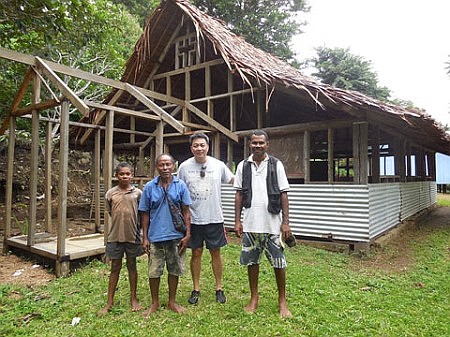
Two girls in traditional costumes welcomed me with a lei of flowers and a crown on my head when I visited Father Nicky’s parish in Buya. They addressed me as “Fadduh Peeta” while scores of people, including their tribal leaders and chiefs dressed up in their long sleeves and pants, lined up to shake hands. Most of them wore shoes that morning, though it is ordinary and customary for them to walk barefoot.
Ironically, I was in my khaki shorts and white shirt because of the sweltering heat. I shared my embarrassment with the two missionary priests assigned there. They said to me that in some way, it was not a sign of disrespect for the community, but a way of showing them that the Church can also be informal at times to encounter people in their own faith culture. Somehow I thought, the spirit of Pope Francis has filtered in this missionary island.
The pastor, Father Nicky, then led me inside the chapel to offer a prayer. He had a kneeler prepared in front of the altar. After this I spoke for a short time to the people waiting for me outside. There was no sound system, so I had to speak louder for them. They were all warm and welcoming.
The village chief, elders and church leaders met with me afterwards. They expressed their needs. They wanted a health center, faster telecommunication system for their island and better transportation. Now, I am beginning to think that they mistook me for someone else.
I told them that I was not Santa Claus. See, no white beard. My joke fell flat. Most of them have no idea about Santa Claus. Then I said to them that I was not Bill Gates. No idea of Bill Gates, either.
Kiriwina, known as the Island of Love, can be independent in its cultural traditions and social mores. But it is dependent on the mission of the Church. I expressed to them my willingness to share with the outside world their needs. Their needs may be endless, but our connection with them as part of the Church knows no bounds. They all nodded their heads in agreement.
When I left Kiriwina Island the next day, I did not just find it to be an island of love. It is also an island where faith is actively professed, even with the abject poverty they had passively embraced. It is also an island of missionary hope and a developing cradle of New Evangelization.
Father Alindogan is diocesan director of the Pontifical Mission Societies and pastor of St. Charles Borromeo Parish, Cinnaminson.
[[In-content Ad]]Related Stories
Friday, December 19, 2025





E-Editions
Events
By Father Peter James R. Alindogan | Special Contributor
The island of Kiriwina has been the subject of cultural and religious studies since the early 1900s. Among the islands I visited in Papua New Guinea, it was the most unique and eccentric. It is the largest of the Trobriand Islands and part of the Diocese of Alotau-Sideia.
Kiriwina Island is very tribal in organization and structure. The people follow a paramount chief, who is elected among his clansmen and serves for life. He has the ultimate say in matters of law and governance far and above his subordinates, the other chiefs from various clans. The present chief has five wives and countless children.
Two things stand out among the villagers: the sexual mores of their culture and their belief in magic and witchcraft. Couples change partners often. There is no traditional marriage ceremony in the island. Once a man and a woman eat together for about a year, the marriage is officially recognized. If after a year, they are not happy with each other, then they divorce. The island is teeming with children.
Two girls in traditional costumes welcomed me with a lei of flowers and a crown on my head when I visited Father Nicky’s parish in Buya. They addressed me as “Fadduh Peeta” while scores of people, including their tribal leaders and chiefs dressed up in their long sleeves and pants, lined up to shake hands. Most of them wore shoes that morning, though it is ordinary and customary for them to walk barefoot.
Ironically, I was in my khaki shorts and white shirt because of the sweltering heat. I shared my embarrassment with the two missionary priests assigned there. They said to me that in some way, it was not a sign of disrespect for the community, but a way of showing them that the Church can also be informal at times to encounter people in their own faith culture. Somehow I thought, the spirit of Pope Francis has filtered in this missionary island.
The pastor, Father Nicky, then led me inside the chapel to offer a prayer. He had a kneeler prepared in front of the altar. After this I spoke for a short time to the people waiting for me outside. There was no sound system, so I had to speak louder for them. They were all warm and welcoming.
The village chief, elders and church leaders met with me afterwards. They expressed their needs. They wanted a health center, faster telecommunication system for their island and better transportation. Now, I am beginning to think that they mistook me for someone else.
I told them that I was not Santa Claus. See, no white beard. My joke fell flat. Most of them have no idea about Santa Claus. Then I said to them that I was not Bill Gates. No idea of Bill Gates, either.
Kiriwina, known as the Island of Love, can be independent in its cultural traditions and social mores. But it is dependent on the mission of the Church. I expressed to them my willingness to share with the outside world their needs. Their needs may be endless, but our connection with them as part of the Church knows no bounds. They all nodded their heads in agreement.
When I left Kiriwina Island the next day, I did not just find it to be an island of love. It is also an island where faith is actively professed, even with the abject poverty they had passively embraced. It is also an island of missionary hope and a developing cradle of New Evangelization.
Father Alindogan is diocesan director of the Pontifical Mission Societies and pastor of St. Charles Borromeo Parish, Cinnaminson.
[[In-content Ad]]