


At convocation, priests reminded of their call to be of service to others
July 29, 2019 at 12:37 p.m.
By Mary Stadnyk | Associate Editor
In the Parable of the Lost Sheep, the shepherd leaves behind his flock of 99 and goes out in search of the one who is lost.
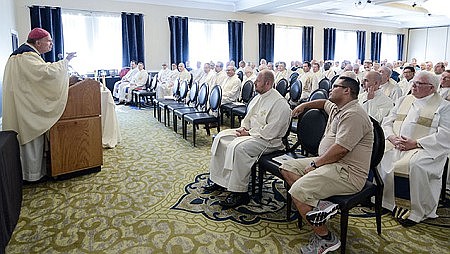
Speaking to some 140 priests at the 2017 Convocation of Priests, Vincentian Father Martin McGeough urged them to consider the parable as a mission – to go out and find the lost sheep in their communities and bring them back into the fold.
“Reach out to them as the gaood shepherd and let them know their pastor is going to walk with them,” said Father McGeough, diocesan coordinator of jail and prison ministry, and presenter for the three-day retreat held Sept. 12 to 14 in Galloway.
Photo Gallery: 2017 Convocation of Priests
Hosted by the diocesan Office of Clergy and Consecrated Life, the convocation was an opportunity for prayer, worship and fellowship.
In a message sent to the priests following the convocation, Bishop David M. O’Connell, C.M., who attended the annual gathering, expressed appreciation to his priests. He wrote, “I was delighted to be with you this year. Thanks so much for making the time to be together.”
“Father Marty gave some inspiring talks and the spirit was really very happy and positive. It was good to be with you, as always,” he said.
The Bishop extended appreciation to Msgr. Thomas Mullelly, episcopal vicar for the Office of Clergy and Consecrated Life and director of seminarians, Father Michael Hall, diocesan director of the Office of Worship, and their staffs “for making things go smoothly.”
Called to Mission
Focusing on the theme “Whatsoever You Do to the Least of My Sisters and Brothers You Do to Me,” Father McGeough cited Scripture and the life experiences of St. Vincent de Paul. He also shared his own life experiences to reveal ways in which priests can serve the poor and marginalized.
“Unless we can be like the poor and develop a total sense of dependence on God ... we will not be able to move forward,” said Father McGeough, describing the poor as those who are downtrodden and have lost hope.
Father McGeough noted that St. Vincent de Paul, founder of the Congregation of the Mission, the religious community to which he and Bishop O’Connell belong, had been a diocesan priest looking to serve in a wealthy parish when he experienced a conversion of heart to wanting to serve the poor.
“We can’t meet the poor with a sense of arrogance. We need to meet them as meek people and see them as God sees them,” said Father McGeough, encouraging priests to reach out the poor in spirit through the Sacrament of Reconciliation, as well as through preaching.
Citing the practice of St. Vincent de Paul to preach on the needs of the people as a way to bring about change, Father McGeough said, “We have that same power of the Word. We need to listen to the needs in our communities and then use the power of the pulpit to let people know about [those] that they can address. We need to be present [to the people] in our communities and in doing so that leads us to be people of action.”
Father McGeough also shared insights from his ministry to inmates in state and county jails, youth detention centers and correctional facilities, saying not only did he come to see the face of Christ in the inmates, but he also became inspired to “see Christ as an inmate.”
“Jesus was arrested and abandoned. He knew what it was to be an inmate,” Father McGeough said.
Father McGeough advised the priests that he has been reassigned to serve as pastor in a parish in Emmitsburg, Md., and will be leaving the Diocese in October. He urged his brothers to consider prison ministry in some capacity and to encourage their parishioners to become involved, as well.
Prison ministry, he said, does not necessarily mean having to go to a facility such as a jail or prison; it could mean providing outreach to parishioners who may have family members serving time in prison or form a parish-based re-entry program to provide outreach to inmates once they are released.
“You can do such good prison ministry without stepping through the gates,” said Father McGeough.
Growing as Brothers
Priests agreed they enjoy attending the annual convocation, especially having quality time to spend together.
Referring to the convocation as a “wonderful moment in the annual life of the Diocese,” Msgr. Mullelly said it is a time when the priests can come together, share fellowship, get away from their pastoral tasks for a short period of time and be nurtured by a series of talks.
“We’re all brothers in the priesthood and a highpoint of the convocation is for all of us to get together and enjoy camaraderie,” said Father Daniel Cahill, pastor of St. Ann Parish, Keansburg.
For Father Stanley P. Lukaszewski, episcopal vicar of Ocean County and pastor of St. Barnabas Parish, Bayville, the convocation is a “great opportunity to come together in prayer, to learn and enhance the quality of our ministry, and spend time with one another in a spirit of fraternalism.”
“The Priest Convocation is about renewal,” said Father Jeffrey E. Lee, pastor of St. Mary Parish, Colts Neck, noting that while some years the event has more of a spiritual focus and other years it is more ministerial in focus, the bottom line is that it is “always about strengthening the bonds of the presbyterate – that is priest to priest.”
The priests concurred there were many messages to be gleaned from Father McGeough’s presentations.
“The talks made us aware that we all have people who are poor in our parishes, no matter how rich some of them may be,” said Father Cahill.
Father John Testa, pastor of Corpus Christi Parish, Willingboro, added, “We must never forget the poor in spirit. We must always strive to meet those people who are right before us.”
Father Lee noted the images of mercy presented by Father McGeough could be applied in every ministerial assignment. “Even though he referenced jail and prison ministry, the focus of Father McGeough’s presentations were applicable to us as we serve the people of God.”
Msgr. Mullelly described Father McGeough’s presentations as “outstanding,” enriched by the insights he shared from his understanding of Sacred Scripture, knowledge of the life of St. Vincent de Paul, his pastoral experiences and the message he conveyed on what it means to develop a spirit of the poor.
Msgr. Mullelly added that he was particularly heartened to hear Father McGeough reflect on how St. Vincent de Paul was a man open to change and growth in his spiritual life and ministry. For priests, he said, it can “give us hope that while we may not be perfect, we can earnestly strive to respond to the Holy Spirit in our lives.”
“That is what happened in the life of St. Vincent de Paul,” he said. “He was a man who grew in cooperation with the Spirit and by the grace of God. He was a hero of the faith.”
[[In-content Ad]]
Related Stories
Sunday, December 28, 2025


E-Editions
Events
By Mary Stadnyk | Associate Editor
In the Parable of the Lost Sheep, the shepherd leaves behind his flock of 99 and goes out in search of the one who is lost.
Speaking to some 140 priests at the 2017 Convocation of Priests, Vincentian Father Martin McGeough urged them to consider the parable as a mission – to go out and find the lost sheep in their communities and bring them back into the fold.
“Reach out to them as the gaood shepherd and let them know their pastor is going to walk with them,” said Father McGeough, diocesan coordinator of jail and prison ministry, and presenter for the three-day retreat held Sept. 12 to 14 in Galloway.
Photo Gallery: 2017 Convocation of Priests
Hosted by the diocesan Office of Clergy and Consecrated Life, the convocation was an opportunity for prayer, worship and fellowship.
In a message sent to the priests following the convocation, Bishop David M. O’Connell, C.M., who attended the annual gathering, expressed appreciation to his priests. He wrote, “I was delighted to be with you this year. Thanks so much for making the time to be together.”
“Father Marty gave some inspiring talks and the spirit was really very happy and positive. It was good to be with you, as always,” he said.
The Bishop extended appreciation to Msgr. Thomas Mullelly, episcopal vicar for the Office of Clergy and Consecrated Life and director of seminarians, Father Michael Hall, diocesan director of the Office of Worship, and their staffs “for making things go smoothly.”
Called to Mission
Focusing on the theme “Whatsoever You Do to the Least of My Sisters and Brothers You Do to Me,” Father McGeough cited Scripture and the life experiences of St. Vincent de Paul. He also shared his own life experiences to reveal ways in which priests can serve the poor and marginalized.
“Unless we can be like the poor and develop a total sense of dependence on God ... we will not be able to move forward,” said Father McGeough, describing the poor as those who are downtrodden and have lost hope.
Father McGeough noted that St. Vincent de Paul, founder of the Congregation of the Mission, the religious community to which he and Bishop O’Connell belong, had been a diocesan priest looking to serve in a wealthy parish when he experienced a conversion of heart to wanting to serve the poor.
“We can’t meet the poor with a sense of arrogance. We need to meet them as meek people and see them as God sees them,” said Father McGeough, encouraging priests to reach out the poor in spirit through the Sacrament of Reconciliation, as well as through preaching.
Citing the practice of St. Vincent de Paul to preach on the needs of the people as a way to bring about change, Father McGeough said, “We have that same power of the Word. We need to listen to the needs in our communities and then use the power of the pulpit to let people know about [those] that they can address. We need to be present [to the people] in our communities and in doing so that leads us to be people of action.”
Father McGeough also shared insights from his ministry to inmates in state and county jails, youth detention centers and correctional facilities, saying not only did he come to see the face of Christ in the inmates, but he also became inspired to “see Christ as an inmate.”
“Jesus was arrested and abandoned. He knew what it was to be an inmate,” Father McGeough said.
Father McGeough advised the priests that he has been reassigned to serve as pastor in a parish in Emmitsburg, Md., and will be leaving the Diocese in October. He urged his brothers to consider prison ministry in some capacity and to encourage their parishioners to become involved, as well.
Prison ministry, he said, does not necessarily mean having to go to a facility such as a jail or prison; it could mean providing outreach to parishioners who may have family members serving time in prison or form a parish-based re-entry program to provide outreach to inmates once they are released.
“You can do such good prison ministry without stepping through the gates,” said Father McGeough.
Growing as Brothers
Priests agreed they enjoy attending the annual convocation, especially having quality time to spend together.
Referring to the convocation as a “wonderful moment in the annual life of the Diocese,” Msgr. Mullelly said it is a time when the priests can come together, share fellowship, get away from their pastoral tasks for a short period of time and be nurtured by a series of talks.
“We’re all brothers in the priesthood and a highpoint of the convocation is for all of us to get together and enjoy camaraderie,” said Father Daniel Cahill, pastor of St. Ann Parish, Keansburg.
For Father Stanley P. Lukaszewski, episcopal vicar of Ocean County and pastor of St. Barnabas Parish, Bayville, the convocation is a “great opportunity to come together in prayer, to learn and enhance the quality of our ministry, and spend time with one another in a spirit of fraternalism.”
“The Priest Convocation is about renewal,” said Father Jeffrey E. Lee, pastor of St. Mary Parish, Colts Neck, noting that while some years the event has more of a spiritual focus and other years it is more ministerial in focus, the bottom line is that it is “always about strengthening the bonds of the presbyterate – that is priest to priest.”
The priests concurred there were many messages to be gleaned from Father McGeough’s presentations.
“The talks made us aware that we all have people who are poor in our parishes, no matter how rich some of them may be,” said Father Cahill.
Father John Testa, pastor of Corpus Christi Parish, Willingboro, added, “We must never forget the poor in spirit. We must always strive to meet those people who are right before us.”
Father Lee noted the images of mercy presented by Father McGeough could be applied in every ministerial assignment. “Even though he referenced jail and prison ministry, the focus of Father McGeough’s presentations were applicable to us as we serve the people of God.”
Msgr. Mullelly described Father McGeough’s presentations as “outstanding,” enriched by the insights he shared from his understanding of Sacred Scripture, knowledge of the life of St. Vincent de Paul, his pastoral experiences and the message he conveyed on what it means to develop a spirit of the poor.
Msgr. Mullelly added that he was particularly heartened to hear Father McGeough reflect on how St. Vincent de Paul was a man open to change and growth in his spiritual life and ministry. For priests, he said, it can “give us hope that while we may not be perfect, we can earnestly strive to respond to the Holy Spirit in our lives.”
“That is what happened in the life of St. Vincent de Paul,” he said. “He was a man who grew in cooperation with the Spirit and by the grace of God. He was a hero of the faith.”
[[In-content Ad]]