
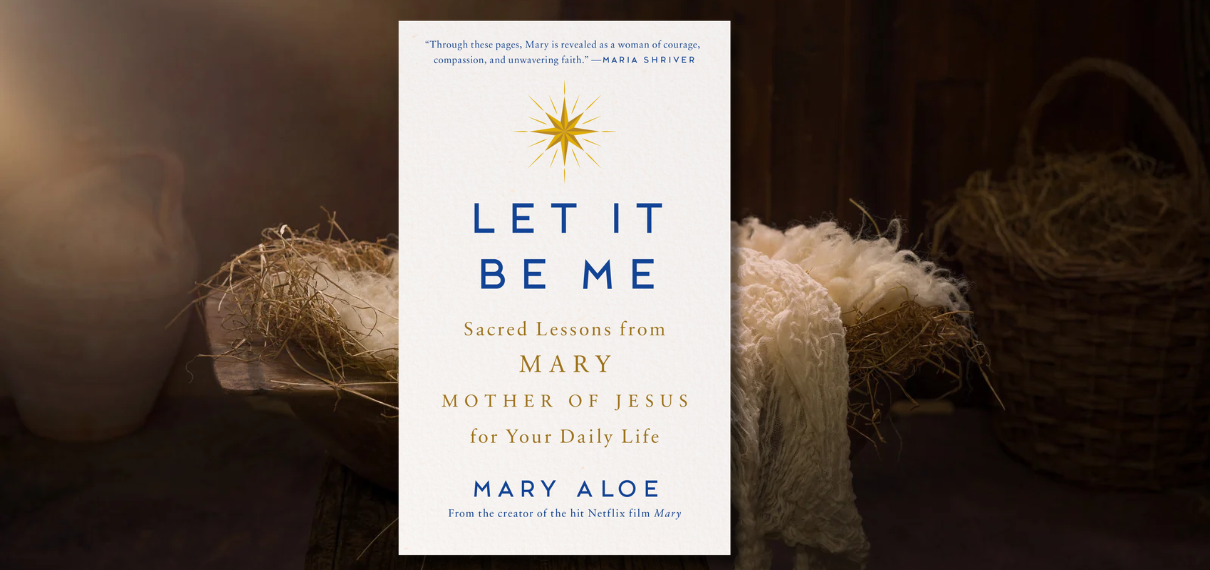
Top photo caption: This is the cover of “Let it Be Me” by Mary Aloe. OSV News photo/Penguin Random House, Canva background
By Michael Mastromatteo, OSV News
“Let It Be Me: Sacred Lessons from Mary Mother of Jesus for Your Daily Life”
Mary Aloe, The Open Field (2026)
368 pages, $27
“Let It Be Me” by Mary Aloe draws parallels from biblical accounts of the Annunciation, the birth of Christ, his ministry, and the Passion and Crucifixion to offer “sacred lessons” for a re-ordered life.
Author Mary Aloe, producer of the 2024 Netflix film “Mary,” cobbled the book together after researching the life and significance of the Blessed Virgin in preparation for the film.
The book is divided into 10 sections, each with commentary and observations from the life of Mary from the Annunciation (and Mary’s fiat), all the way to Christ’s resurrection and the foundation of a new Church.
This book however, is more than a superficial biography or prayer guide. Instead, it presents a whole new way of pondering Mary’s life as worthy of emulation. In some ways, “Let It Be Me” reads like the Stations of the Cross from Our Lady’s point of view. Moreover, each entry in the book includes a “Your Turn” passage wherein the author invites readers to incorporate elements of Mary’s commitment, steadfast devotion, patience and wisdom into their own lives.
The author’s insights and reflections in the book stem from the intensive research and study of Our Lady’s life and role in the production of the Netflix film. It’s a period Aloe refers to as “Marynating” – an intentional process of immersing oneself in Mary’s virtues, compassion and wisdom, allowing her example to infuse and transform our own journey.
“Let It Be Me” makes much of Our Lady’s initial uncertainty about the task she would be taking on after saying “yes” to the angel Gabriel.
Mary accepted the request even though she didn’t understand at the time all it would entail. She was quick to ask questions and seek answers as part of her ultimate formation and as the mother of the Church and an eternal intercessor for humanity.
Although Marian books might naturally appeal more directly to Catholics, Aloe is optimistic that readers of all faiths – or no faith – might find inspiration in the book.
“I wrote this book for women and for men, for the young and the seasoned, for Catholics, Protestants and people who are still considering a life of faith,” Aloe told me. “Mary’s example is for everyone. This book is like a beautiful cathedral whose doors are open wide to each person who passes by – a blend of awe and comfort for all who enter.”
“Let it Be Me” lauds Our Lady as one of the earliest of the Church’s evangelizers and disciples. “What role does Mary play in the church her Son founded?” Aloe asks rhetorically. “No leadership in the formal sense, but a weighty presence nonetheless. She is living memory, first-hand testimony, the woman who has carried hope for Jesus’ kingdom longer than anyone else alive.”
Aloe also draws attention to Mary’s evolution from someone simply saying “yes” to the Lord to becoming a key figure in the eventual establishment of a Christ-centered faith. Mary’s own discernment culminates in the Magnificat, as recorded by Luke: “My soul magnifies the Lord, and my spirit rejoices in God my Savior, for God has looked with favor on the lowliness of the Almighty’s servant. … Surely, from now on all generations will call me blessed” (Lk 1:46-55).
Aloe invites readers to consider how Mary’s experience can be worthy of emulation today.
Her Magnificat, Aloe says, can become an invitation to readers to “recognize the holy breaking and remaking of your own magnificent ordinary life.”
Aloe reiterated that the Mary film and the new book in particular just might fulfill a growing hunger in the minds of many new readers. “What I’m seeing is that Mary is resonating beyond Catholic circles in a new way. People are hungry for models of how to live faithful lives even when under pressure. I pray readers from every background will find themselves drawn to her example.”
Mike Mastromatteo is a writer, editor and book reviewer from Toronto.
Catholic journalism is needed now more than ever. Please consider supporting this work by signing up for a SUBSCRIPTION (click HERE) or making a DONATION to The Monitor (click HERE). Thank you for your contribution.
Is the idea of people being resurrected at the end times symbolic or literal?
Top photo caption: A crucifix hangs before a mural depicting the Resurrection in the sanctuary at St. Timothy Parish in Mesa, Ariz., in this undated file photo. OSV News photo/J.D. Long-Garcia, Catholic Sun
By Jenna Marie Cooper, OSV News
Q: At a recent family gathering the subject of “end-times resurrection” came up. Some people present said they expect to one day come out of their grave and stand on the Earth again as themselves, but brand new. Others present said much of the Church’s “resurrection” talk is symbolic, meant only to indicate a generic message of hope for the future. Could you comment? Indiana
A: The short answer is that Catholics understand the resurrection of the dead at the end of the world to be much more than merely symbolic.
As the Catechism of the Catholic Church tells us, “Belief in the resurrection of the dead has been an essential element of the Christian faith from its beginnings” (CCC 991). To that end, our belief in the resurrection of the dead is enshrined in both of our major creeds.
In the ancient Apostles’ Creed, we pray explicitly: “I believe in … the resurrection of the body and life everlasting.” And in the Nicene Creed, which we recite together at Mass every Sunday, we state our belief that Jesus “will come again in glory to judge the living and the dead and his kingdom will have no end” and state that we “look forward to the resurrection of the dead and the life of the world to come.”
Paragraph 997 of the Catechism spells out exactly what we mean by “resurrection” or “rising” from the dead. As we read: “In death, the separation of the soul from the body, the human body decays and the soul goes to meet God, while awaiting its reunion with its glorified body. God, in his almighty power, will definitively grant incorruptible life to our bodies by reuniting them with our souls, through the power of Jesus’ Resurrection.
Or in other words, at the time of our death our souls, though not our bodies, will encounter God. In this encounter, we will face the ultimate consequences of the choices we made in our earthly life. If we sought to know, love and serve God, our souls will be destined for perfect joy in heaven with him forever. But on the other hand, if we have made the choice to reject God through a life of unrepented sin, our souls will be condemned to the eternal suffering of separation from God in hell. Traditionally, this immediate postmortem spiritual “sorting” is called our “particular judgment,” since God is judging each of us one at a time as specific individuals.
We also believe that Jesus will visibly return to the world at the end of time, at which point Jesus will publicly judge all of humanity at once. At this point, our souls will be reunited with our physical bodies. Generally, we understand this to mean that those in heaven will experience a more complete happiness, and those in hell will undergo a more profound suffering.
Understandably, it can be tempting to speculate on the exact practicalities of how this bodily resurrection will “work.” For instance, one might wonder how a body that was, for whatever reason, reduced to ashes might reintegrate and come alive again. Or one might – as your relatives seem to – suppose that they will literally need to crawl up and out of the graves that had been dug for them.
But with respect to the question of how this will all work, the catechism states that “this ‘how’ exceeds our imagination and understanding; it is accessible only to faith” (CCC 1000). So for now, we have to be content with letting the specifics remain a mysterious part of God’s providence.
In the meantime, we can fruitfully reflect on some relevant passages of sacred Scripture. For just a few examples, Chapter 37 of the book of Ezekiel employs the striking imagery of God bringing dry bones back to life; and in St. Paul’s letter to the Philippians, we are told that Christ “will change our lowly body to conform with his glorified body” (Phil 3:21).
Jenna Marie Cooper, who holds a licentiate in canon law, is a consecrated virgin and a canonist whose column appears weekly at OSV News. Send your questions to CatholicQA@osv.com.
Catholic journalism is needed now more than ever. Please consider supporting this work by signing up for a SUBSCRIPTION (click HERE) or making a DONATION to The Monitor (click HERE). Thank you for your contribution.
aith