
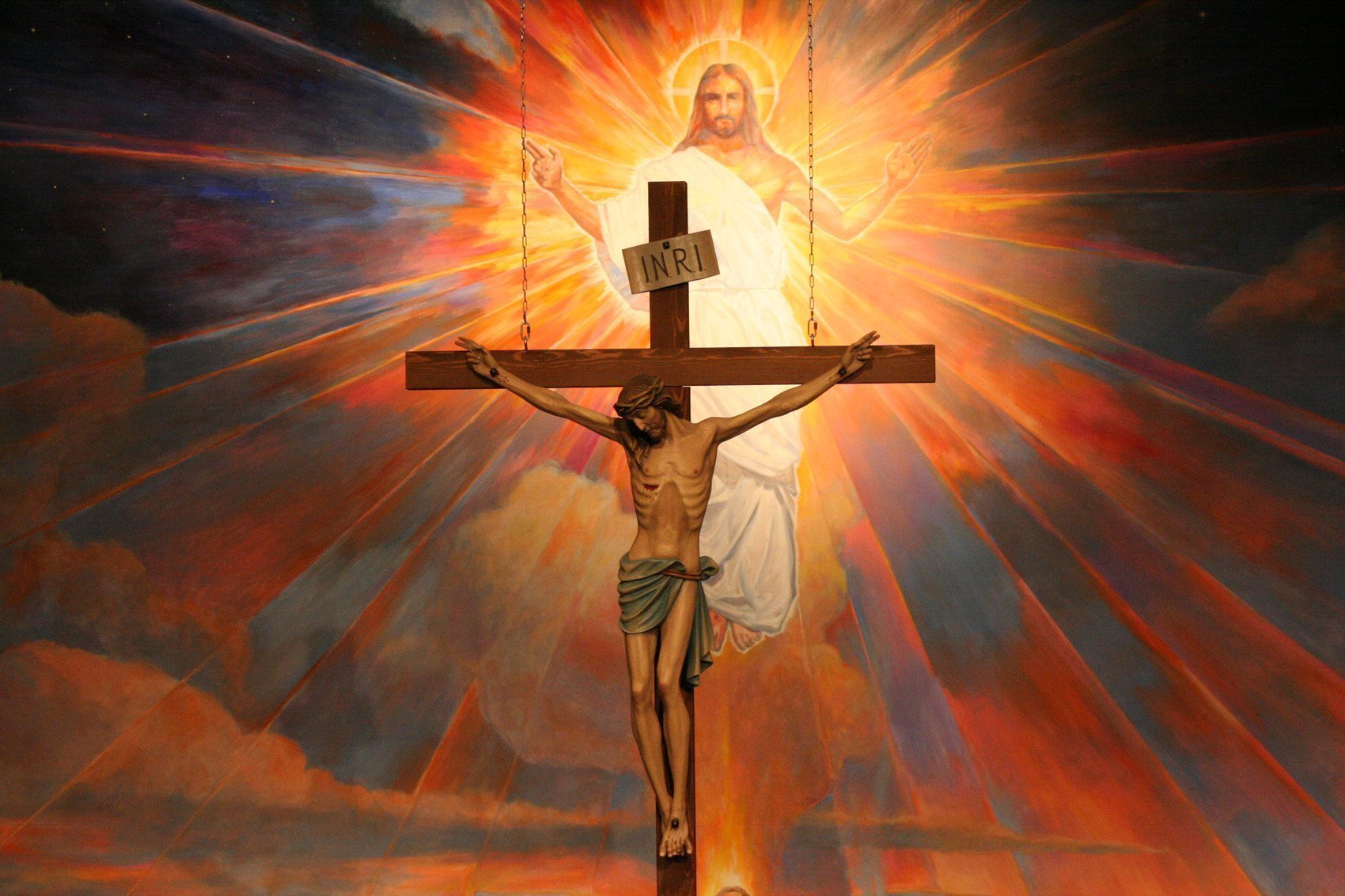
Top photo caption: A crucifix hangs before a mural depicting the Resurrection in the sanctuary at St. Timothy Parish in Mesa, Ariz., in this undated file photo. OSV News photo/J.D. Long-Garcia, Catholic Sun
By Jenna Marie Cooper, OSV News
Q: At a recent family gathering the subject of “end-times resurrection” came up. Some people present said they expect to one day come out of their grave and stand on the Earth again as themselves, but brand new. Others present said much of the Church’s “resurrection” talk is symbolic, meant only to indicate a generic message of hope for the future. Could you comment? Indiana
A: The short answer is that Catholics understand the resurrection of the dead at the end of the world to be much more than merely symbolic.
As the Catechism of the Catholic Church tells us, “Belief in the resurrection of the dead has been an essential element of the Christian faith from its beginnings” (CCC 991). To that end, our belief in the resurrection of the dead is enshrined in both of our major creeds.
In the ancient Apostles’ Creed, we pray explicitly: “I believe in … the resurrection of the body and life everlasting.” And in the Nicene Creed, which we recite together at Mass every Sunday, we state our belief that Jesus “will come again in glory to judge the living and the dead and his kingdom will have no end” and state that we “look forward to the resurrection of the dead and the life of the world to come.”
Paragraph 997 of the Catechism spells out exactly what we mean by “resurrection” or “rising” from the dead. As we read: “In death, the separation of the soul from the body, the human body decays and the soul goes to meet God, while awaiting its reunion with its glorified body. God, in his almighty power, will definitively grant incorruptible life to our bodies by reuniting them with our souls, through the power of Jesus’ Resurrection.
Or in other words, at the time of our death our souls, though not our bodies, will encounter God. In this encounter, we will face the ultimate consequences of the choices we made in our earthly life. If we sought to know, love and serve God, our souls will be destined for perfect joy in heaven with him forever. But on the other hand, if we have made the choice to reject God through a life of unrepented sin, our souls will be condemned to the eternal suffering of separation from God in hell. Traditionally, this immediate postmortem spiritual “sorting” is called our “particular judgment,” since God is judging each of us one at a time as specific individuals.
We also believe that Jesus will visibly return to the world at the end of time, at which point Jesus will publicly judge all of humanity at once. At this point, our souls will be reunited with our physical bodies. Generally, we understand this to mean that those in heaven will experience a more complete happiness, and those in hell will undergo a more profound suffering.
Understandably, it can be tempting to speculate on the exact practicalities of how this bodily resurrection will “work.” For instance, one might wonder how a body that was, for whatever reason, reduced to ashes might reintegrate and come alive again. Or one might – as your relatives seem to – suppose that they will literally need to crawl up and out of the graves that had been dug for them.
But with respect to the question of how this will all work, the catechism states that “this ‘how’ exceeds our imagination and understanding; it is accessible only to faith” (CCC 1000). So for now, we have to be content with letting the specifics remain a mysterious part of God’s providence.
In the meantime, we can fruitfully reflect on some relevant passages of sacred Scripture. For just a few examples, Chapter 37 of the book of Ezekiel employs the striking imagery of God bringing dry bones back to life; and in St. Paul’s letter to the Philippians, we are told that Christ “will change our lowly body to conform with his glorified body” (Phil 3:21).
Jenna Marie Cooper, who holds a licentiate in canon law, is a consecrated virgin and a canonist whose column appears weekly at OSV News. Send your questions to CatholicQA@osv.com.
Catholic journalism is needed now more than ever. Please consider supporting this work by signing up for a SUBSCRIPTION (click HERE) or making a DONATION to The Monitor (click HERE). Thank you for your contribution.