
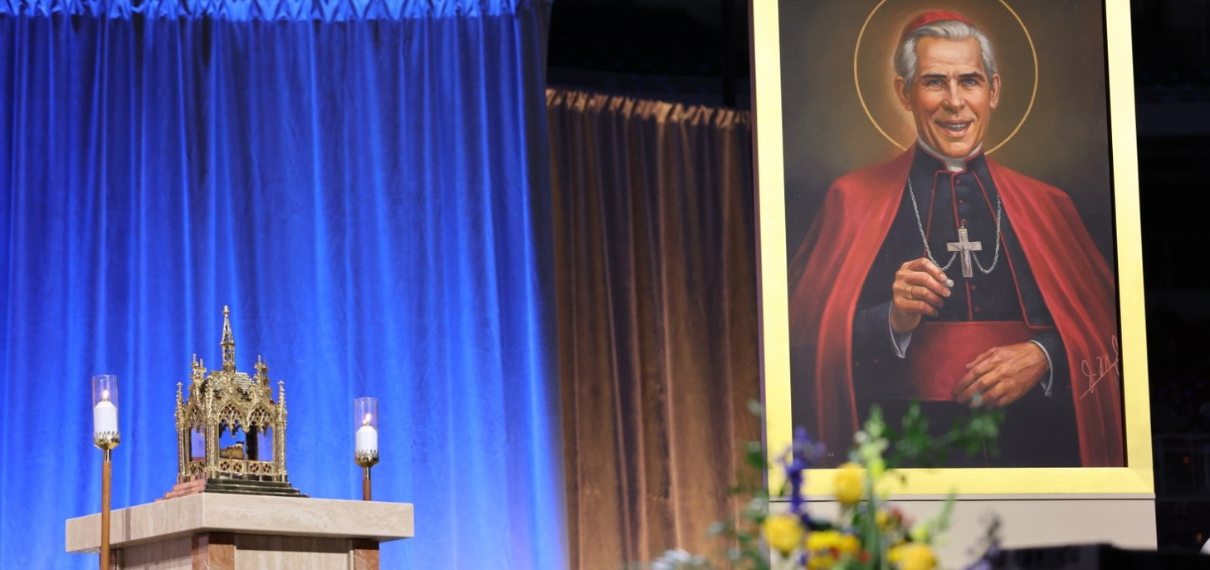
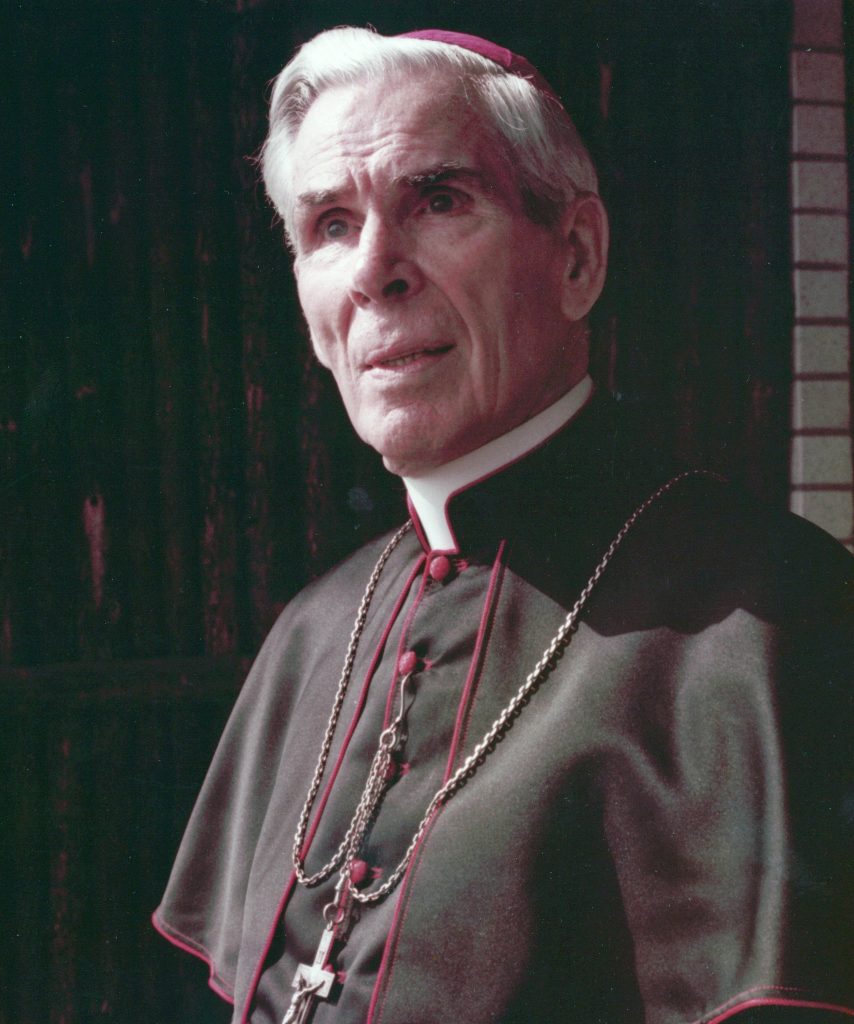
Top photo caption: A major relic of Blessed Fulton J. Sheen is displayed next to his official portrait at his beatification Mass Sept. 24, 2026, at The Dome at America’s Center in St. Louis. OSV News photo/Margaret Murray
By Gina Christian, OSV News
ST. LOUIS OSV News — Archbishop Fulton J. Sheen — the 20th-century theologian, evangelizer, Catholic communications pioneer, teacher and preacher — is now Blessed Fulton J. Sheen.
Cardinal Luis Antonio Tagle, a pro-prefect for the Holy See’s Dicastery for Evangelization and papal delegate, pronounced the Church’s declaration on Archbishop Sheen’s holiness of life and witness to Jesus Christ at a Sept. 24 Mass celebrated in The Dome at America’s Center in St. Louis.
To the applause of pilgrims, Cardinal Tagle described Archbishop Sheen as a “son of Illinois, son of the United States of America” and “indeed, son of the world.”
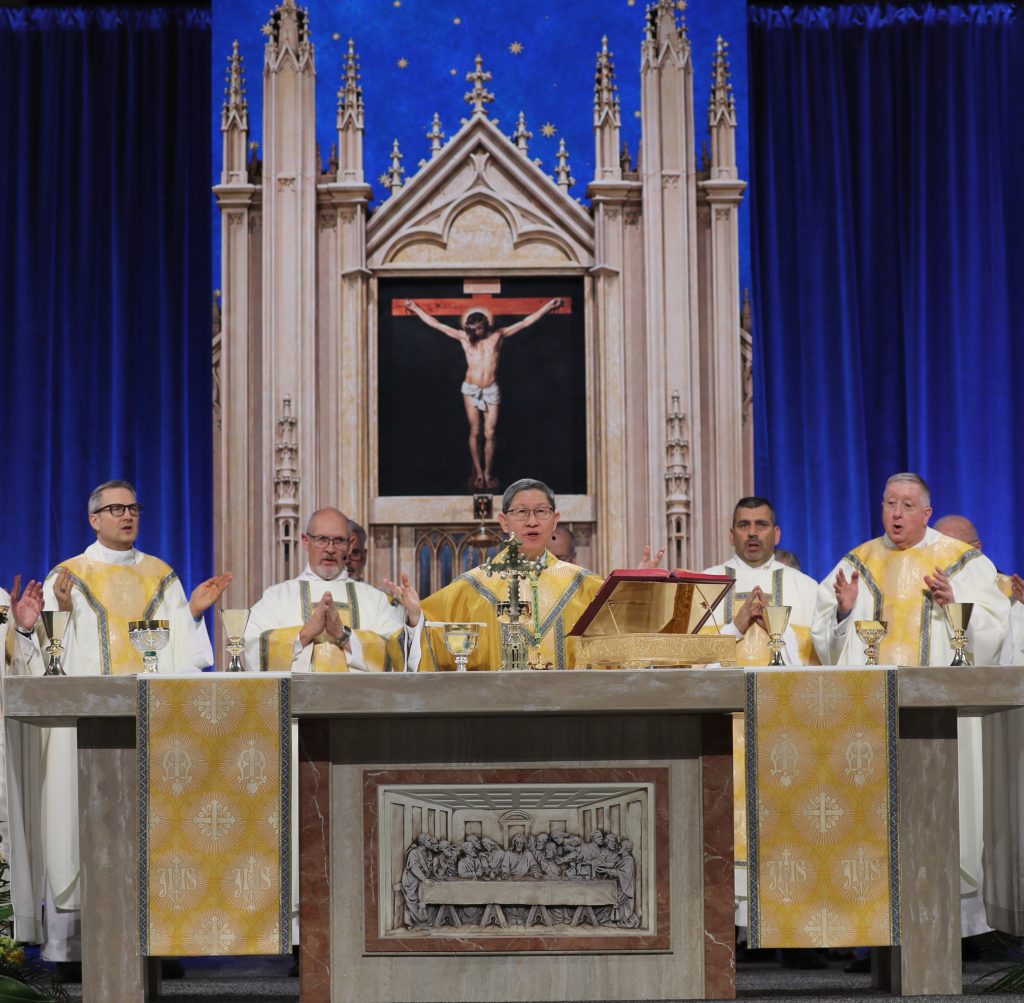
Hundreds of clergy, including dozens of bishops and cardinals, had processed into the arena for the Mass as choirs, accompanied by an orchestra, performed a succession of hymns. The priests’ vestments were embroidered with “JMJ,” Archbishop Sheen’s signature dedication to Jesus, Mary and Joseph.
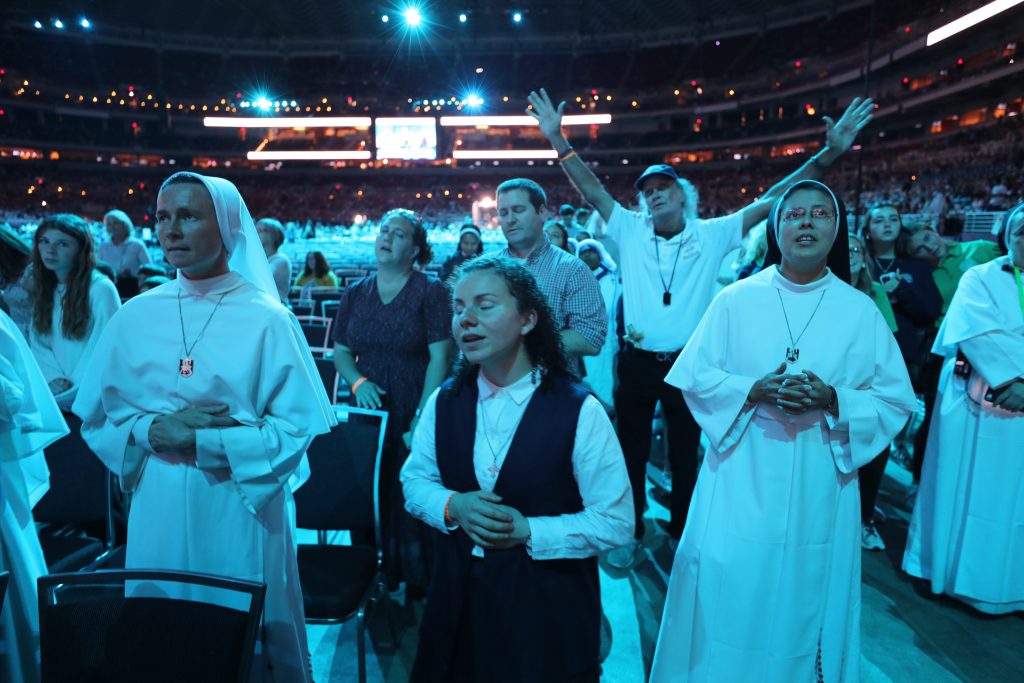
The location had been selected by Archbishop Sheen’s home Diocese of Peoria, Illinois, to accommodate the number of pilgrims who arrived for the beatification and its surrounding events. Around 50,000 people were in attendance, according to organizers.
During a press conference a few hours prior to the Mass, Bishop Louis Tylka of Peoria said that almost every U.S. state and several additional nations were represented by pilgrims. A number of the faithful hailed from Italy, Poland and Brazil, he said.
Close to 90 bishops, some 1,000 priests, an estimated 1,600 men and women religious, and almost 250 deacons were present, added Bishop Tylka, who wore Archbishop Sheen’s pectoral cross. Among the concelebrating prelates was Archbishop Gabriele G. Caccia, apostolic nuncio to the United States.
The beatification — a papal act affirming an individual’s presence in heaven is worthy of belief — officially occurred between the liturgy’s Penitential Rite and the Gloria. Bishop Tylka made a formal request for Archbishop Sheen’s beatification to Cardinal Tagle.
A short biography of Archbishop Sheen, who was born in El Paso, Illinois, in 1895 and died in New York in 1979, was read by Archbishop Sheen’s great-nephew, Paul Cunningham, after which Cardinal Tagle proclaimed the apostolic letter from Pope Leo XIV declaring the beatification in Latin. Bishop Tylka then read the letter in English, as applause followed both.
With the papal decree’s public proclamation, Archbishop Sheen became formally counted among the Church’s “beati,” from the Latin word for “blessed.”
James Fulton Engstrom — whose revival from stillbirth in 2010, attributed to Archbishop Sheen’s intercession, was formally declared the miracle that moved Archbishop Sheen to beatification — processed with his parents and siblings to present a major relic of Archbishop Sheen during the liturgy.
Enclosed in a special case called a reliquary, the relic is Archbishop Sheen’s mandible, or jawbone, chosen because it represents the archbishop’s tremendous gifts as an orator, teacher and evangelist.
As part of the beatification, a portrait of a haloed Blessed Fulton Sheen was also unveiled. In the image, he is notably holding a piece of chalk, which he famously used — along with a blackboard — during his Emmy-winning television show, “Life Is Worth Living.”
The image was also simultaneously unveiled in the Diocese of Peoria at the Cathedral of St. Mary of the Immaculate Conception.
The first reading from the beatification Mass, Isaiah 52:7-10, was delivered in Spanish, with the second reading, 2 Corinthians 4:1-2, 5-7, proclaimed in Portuguese, while the Gospel taken from Mark 16:15-20 was proclaimed in English. The prayers of the faithful were offered in a variety of other languages, illustrating both the universal character of the Church and also the missionary mindset of Blessed Fulton J. Sheen, who served as the U.S. director for the Society for the Propagation of the Faith.
In his homily, Cardinal Tagle praised Archbishop Sheen as a “storyteller of Jesus” and “a “missionary who digs deep into the heart of the poor to meet Jesus there.”
The cardinal noted then-Bishop Sheen’s passionate advocacy for the poor during the Second Vatican Council. During the 1964 discussions on the document “Ad Gentes,” on the missionary activity of the Church, then-Bishop Sheen asked his brother bishops to “affirm” the notion of poverty and the bishops who came from poor and suffering parts of the Church.
“As only a wounded Christ could convert a doubting Thomas, so only a Church wounded by poverty can convert a doubting world,” he said.
Cardinal Tagle commended Archbishop Sheen for making genuine connections with the people he met and to whom he preached and ministered.
“The missionary evangelizer is blessed by the communion with persons and peoples, especially the poor and vulnerable, and this is communion in the name of Jesus Christ,” he said.
Cardinal Tagle shared how Archbishop Sheen told a friend, who asked why he became a priest, that he was called to share the Gospel and tell the story of Jesus.
“I never tire of telling it; I never tire of improving my telling of it. I love my calling,” Archbishop Sheen said, as Cardinal Tagle recounted.
In remarks after Communion, Bishop Tylka urged all attendees to pray for Archbishop Sheen’s canonization, leading them together in a prayer for that intention.
“It is God who has given the Church the extraordinary witness of the man we may now call Blessed Fulton J. Sheen,” he said.
Thanking the many prelates involved in the Mass, including Archbishop Mitchell T. Rozanski, whose archdiocese hosted the beatification, and representatives from the Archdiocese of New York, Diocese of Rochester and the Pontifical Mission Societies, Bishop Tylka noted, “Your presence today is a beautiful reminder that while Peoria is incredibly proud to call Fulton Sheen one of our own, he is a gift to the whole Church.”
Bishop Tylka also expressed his gratitude to Archbishop Sheen’s family, individuals and benefactors involved in preparations and liturgy, and the faithful who made the pilgrimage to attend the beatification.
“Fulton Sheen has left us a great legacy,” he said. “He fearlessly proclaimed the Gospel in challenging cultural times. He supported the Church’s missions throughout the world. He won tens of thousands of converts and preached to millions. His time of prayer before the Blessed Sacrament was the source of his insight into the Son of God. He used every gift God gave him for one purpose: to bring people to Christ. And his legacy is now ours.”
Following the Mass, attendees were invited to remain in prayer to venerate Archbishop Sheen’s relics.
Gina Christian is a multimedia reporter for OSV News. Follow her on X @GinaJesseReina. Maria Wiering, senior managing editor of OSV News, contributed to this article.
SIDEBAR: A short biography of Blessed Fulton J. Sheen
By Gina Christian, OSV News
OSV News — Born Peter John Sheen in 1895 in El Paso, Illinois, while later adopting his mother’s maiden name “Fulton” as his own in his youth, the future Blessed Fulton J. Sheen was ordained a priest of the Diocese of Peoria, Illinois, in 1919.
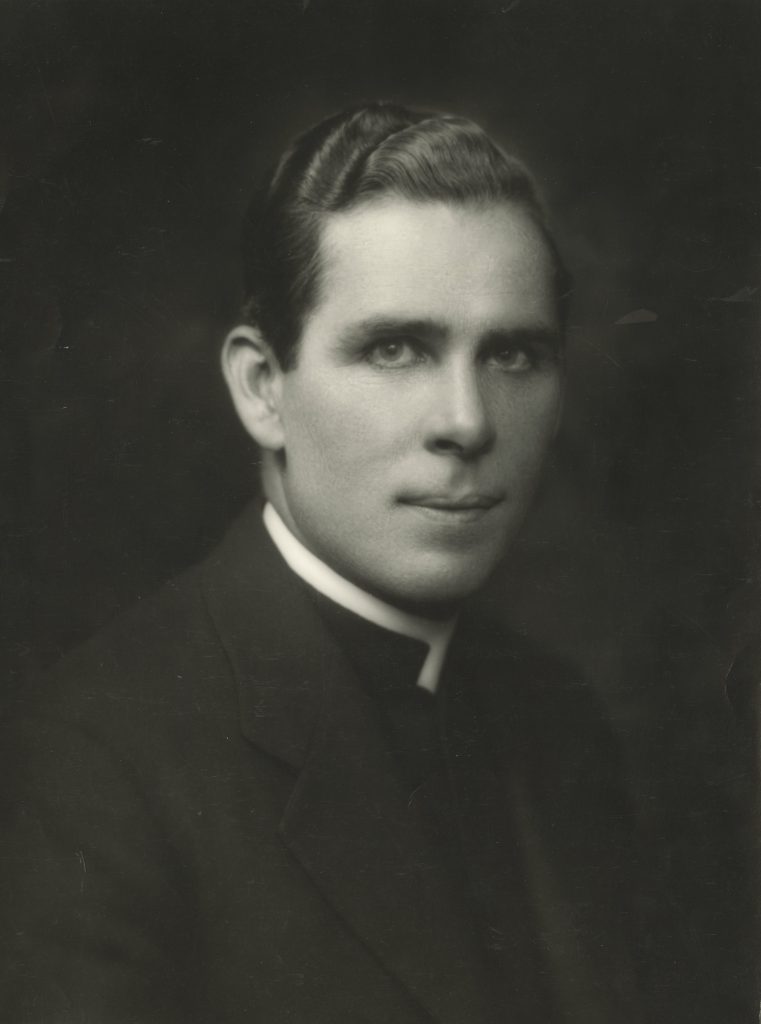
He studied at both The Catholic University of America and at the Catholic University of Louvain in Belgium, one of Europe’s oldest universities, before returning to the former to teach religion and philosophy for more than 20 years.
While at Catholic University, then-Father Sheen’s ability to engage with modern society on any number of issues and bring the light of the Gospel to them, quickly gained attention. He soon showed he was just as much at home before a radio mic and television camera as he was in the pulpit or the classroom.
Blessed Fulton Sheen rose to fame first through his radio show “The Catholic Hour” and then the Emmy-winning television program “Life is Worth Living.”
Drawing on his scholarship, pastoral insight and a keen sense of humor, he shared with millions his love for Jesus Christ and his devotion to the Blessed Mother, while warning of the dangers of communism and the emptiness of a worldview that exalted man while excluding God.
With priestly faculties in both the Roman and Byzantine rites, Blessed Fulton J. Sheen was known for his closeness to Eastern Catholics.
Amid his broadcasts, his appearances, and the hundreds of letters a week he received, Archbishop Sheen wrote more than 60 books, not counting various reprints and collections of his works.
In 1950, he was appointed the national director of the Society for the Propagation of the Faith, now known as The Pontifical Mission Societies USA, and spent 16 years at the helm, reaching millions and modernizing missionary outreach.
He was ordained and named an auxiliary bishop of the Archdiocese of New York in 1951 before being appointed bishop of Rochester, New York, in 1966. Upon his retirement in 1969, he received the title “archbishop” from St. Paul VI. He continued to preach and give retreats, and died at age 84 in 1979, while in prayer before the Blessed Sacrament in his private chapel.
The Diocese of Peoria opened Archbishop Sheen’s cause for canonization in 2002, and in 2012, Pope Benedict XVI recognized the archbishop’s heroic virtue, declaring him “venerable.”
Catholic journalism is needed now more than ever. Please consider supporting this work by signing up for a SUBSCRIPTION (click HERE) or making a DONATION to The Monitor (click HERE). Thank you for your contribution.