
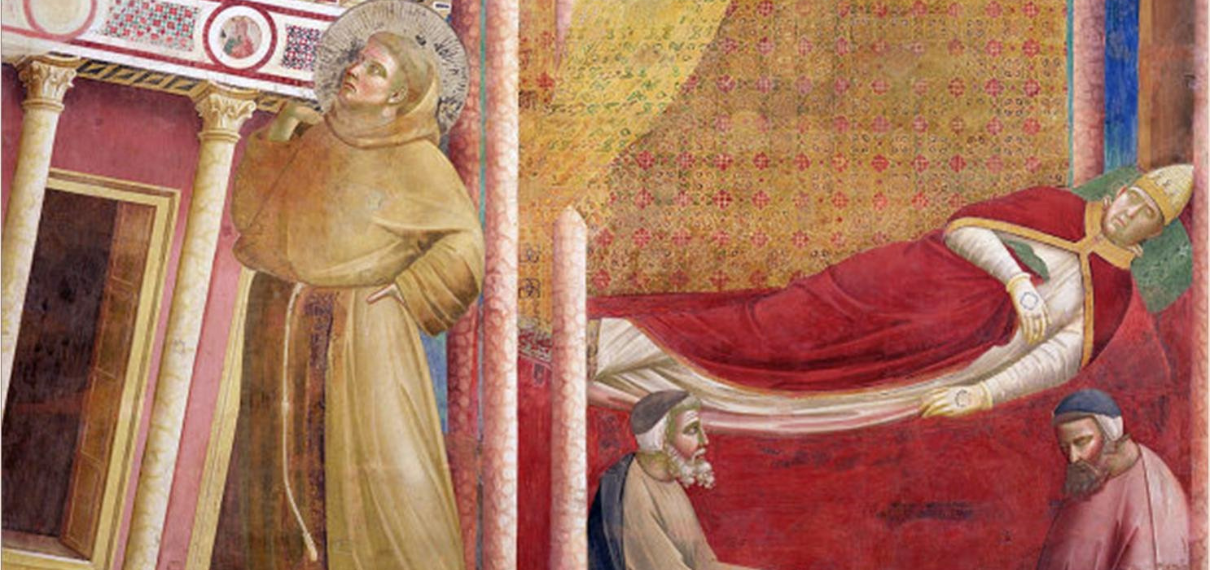
Top photo caption: This fresco “Dream of Innocent III” by artist Giotto di Bondone (1267-1337) is in the Basilica of St. Francis in Assisi, Italy. OSV News photo/Wikipedia Commons, Public Domain
By Nora Hamerman, OSV News
OSV News — One of the 28 colorful scenes from the life of St. Francis on the walls of the Upper Church the Basilica of St. Francis in Assisi depicts the “Dream of Innocent III.” Of all the panels telling the story of the friar’s journey from conversion to canonization, this picture packs some of the richest meaning for St. Francis’ historical role in the 1200s and merits a look today during the jubilee year marking the 800th anniversary of his death.
The fresco records an event in 1208, when Francis was on his way to Rome with a dozen followers to seek papal approval for his way of life. Ragged, unwashed, renouncing earthly goods and committed to a radical imitation of Christ, the band stood no chance of a welcome at the papal court.
On the right half of the panel, Pope Innocent III sleeps in a bedchamber hung with exquisite textiles, perhaps alluding to the luxury that Francis, the son of a prosperous draper and quite the fancy dresser in youth, had famously renounced. On the le?, the Lateran Basilica in Rome — seat of the bishop of Rome — teeters dangerously. A humble man dressed in a robe holds it up with his right arm.
Interpreting the dream to mean that St. Francis would be instrumental in reforming and strengthening the Church, Pope Innocent not only received him but also gave the ?rst papal approval of his order.
The “Dream of Innocent III” juxtaposes two men whose historic roles seem opposites. Innocent was a mighty leader regarded by many as the acme of the medieval papacy. He fought heresy, reformed the clergy and convened the Fourth Lateran Council.
In his devotion to society’s lowliest, St. Francis (1181-1226) was revered as a “Second Christ.” Shortly before death he received the wounds of Christ, known as the stigmata. In 1228
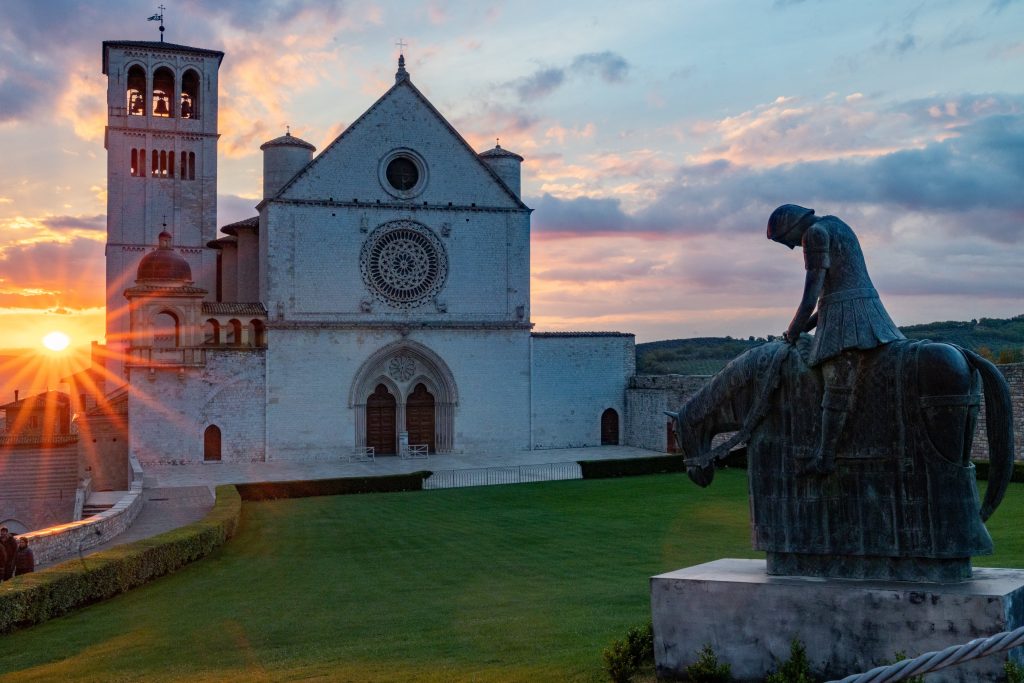
in Assisi, Pope Gregory IX solemnly proclaimed him a saint and laid the ?rst stone of the basilica where his body would rest. Over the saint’s tomb two buildings were built, one atop the other: the Lower Church and the Upper Church.
Within a generation a ?rst cycle of frescoes in the Lower Church depicted parallel scenes from the life of Christ and the life of Francis facing each other across the nave. Then in the late 1280s, the best artists from Tuscany and Rome painted the Upper Church. Of all the splendid paintings, the most admired is the frieze of life-size narratives many scholars believe were painted by Giotto.
During the 13th century, the representation of St. Francis in art had evolved into a radically new way of representing saints.
Posthumous miracles still counted, as they proved that the saint could intercede for the faithful in heaven, but more and more, artists emphasized that Francis was a “role model” in his earthly life.
The change in theme ushered in a revolution in style. Before the Franciscans, Italian religious art followed the icon tradition of Constantinople. Sacred figures usually stood stock still against a gold background, with large staring eyes and a weightless, disembodied look that emphasized their presence outside ?nite time and space.
Giotto changed all of that.
His brush creates credible physical settings in perspective frames. The figures have volume. In the “Dream of Innocent III” we are aware of Francis’ body beneath his brown habit, as shown by the highlight on his projecting knee. We may see the settings today as dollhouse-like, too small for the figures. But in the 1280s, they seemed as palpably real as 3-D color movies laden with special effects would have seemed to filmgoers in the 1920s.
The “Dream of Innocent” also reminds us of how closely tied Francis of Assisi was to the papacy, during and after his life. Since the Franciscan rule of poverty prohibited the ownership of property, the splendid basilica at Assisi officially was owned by the Popes and the Friars Minor were merely its guardians.
Nora Hamerman writes from Virginia.
Catholic journalism is needed now more than ever. Please consider supporting this work by signing up for a SUBSCRIPTION (click HERE) or making a DONATION to The Monitor (click HERE). Thank you for your contribution.