
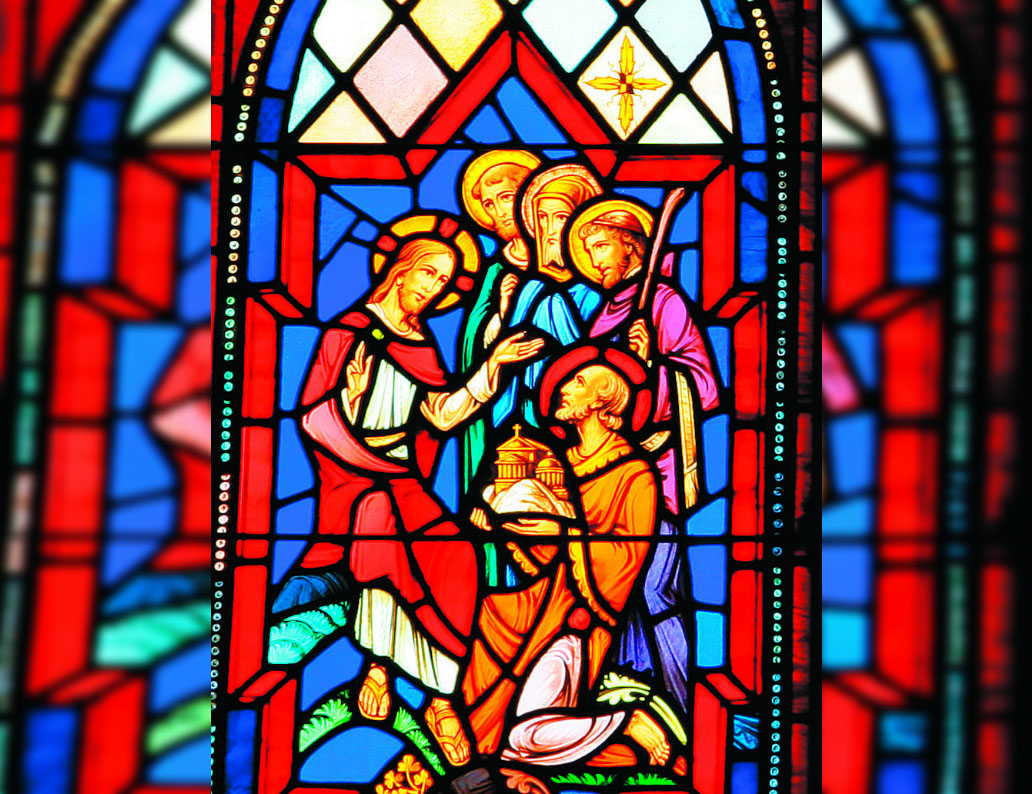
In photo above is a stained glass window in St. Bonaventure Church, part of St. Pio of Pietrelcina Parish, Lavallette, showing Jesus presenting St. Peter with keys to the Church. Monitor file photo
By Father Garry Koch
Gospel reflection for Aug. 23, 2026, 21st Sunday in Ordinary Time
On May 8, 2025, when Cardinal Robert Prevost appeared on the loggia of St. Peter’s Basilica as Pope Leo XIV, the keys which were given to St. Peter at Caesarea Philippi, passed into his care. This stands as a sign of the apostolic continuity of the Church serving as the guardianship of the teaching, mission and ministry of Jesus. This is not insignificant. The Church has struggled for two millennia to maintain the faith handed down to us and the authority vested, not in an individual person per se, but in the office held by that person. We are assured by Jesus that he is ever-present with his Church through his vicar, maintaining the faith until he comes again.
While the presentation of the keys is a symbolic gesture – there were no physical keys handed to him – the designation of authority to Peter comes with a name change. Known by his given name of Simon, Jesus bestows a new name, “Peter,” which equivocates to “rock” or “rocky.”
While only Matthew records this event in the Gospels, each of the Gospels, the Acts of the Apostles and the Letters of St. Paul, all bear witness to the fact of the name change by their use of the name Peter, while acknowledging that his given name was Simon.
The two are not separate; the handing of the keys and the changing of the name each inform each other and are truly inseparable events.
In the course of his ministry, Jesus developed a reputation as one “who spoke with authority” unlike the Rabbis and Scribes of the time. Jesus hands this same authority on to his disciples, and especially to Simon Peter as a sign of unity and the on-going need to remain authentic to the teaching of Jesus.
From the very beginning of the Church this was no easy task. As the Church struggled with how to include the Gentiles into the community, the apostles were charged with making a decision upon which they would all agree. This occurred at Jerusalem around the year 50 as recorded in the Acts of the Apostles, chapter 15.
Peter’s martyrdom leaves a breach with the direct connection to Jesus, yet it is repaired as the church in Rome understood the necessity of continuity, choosing Linus to lead the community there. St. Irenaeus records this in his writing, and Linus is known to us in the Second Letter of Paul to Timothy. The Church then continued to hand-on this through the office which we now call the papacy (Father) expressed today in Pope Leo XIV.
Some people make much of the fact that the Greek word petros, the name that Jesus calls Peter, refers to a small stone, while the term petra, which refers to the great cliff at Caesarea Philippi, means just that: a large boulder, building block or cliff. In keeping with the common usage of juxtaposing images in the Scriptures, Jesus is not diminishing Peter personally, or his successors. He is, instead, pointing out that from what seems small or insignificant comes that which is made great or significant because God has named it and designated it. Peter, a simple man who is also fraught with his own weakness, uncertainties and fears, gains the respect of the other apostles and then of the entire Church, even after he denies three times that he even knows who Jesus is.
From this moment at Caesarea Philippi, Simon called Peter, becomes the foundational disciple who will lead the Church until the end of time.
While over the course of the history of the Church there have been exceptional popes, holy popes, scholarly popes and men filled with spiritual zeal, there have also been popes who were none of the above, yet they have always handed on faithfully the teaching of Jesus and the traditions of the Church.
The Pope stands as the guardian of the faith. He is also tasked with leading the Church forward, requiring new modes of thinking and presenting the truths of the faith to a world which continues to evolve philosophically, in its understanding of the human person, and in the development of technologies which both enhance and threaten the dignity of the human person.
Charged with the care of more than one billion souls and called to evangelize the billions of others which fervently seek God, we extend our prayers for Pope Leo XIV, praising God for all of the successors of St. Peter, and praying that the Church will continue to lead all souls to eternal life.
Father Garry Koch is pastor of St. Benedict Parish, Holmdel.