
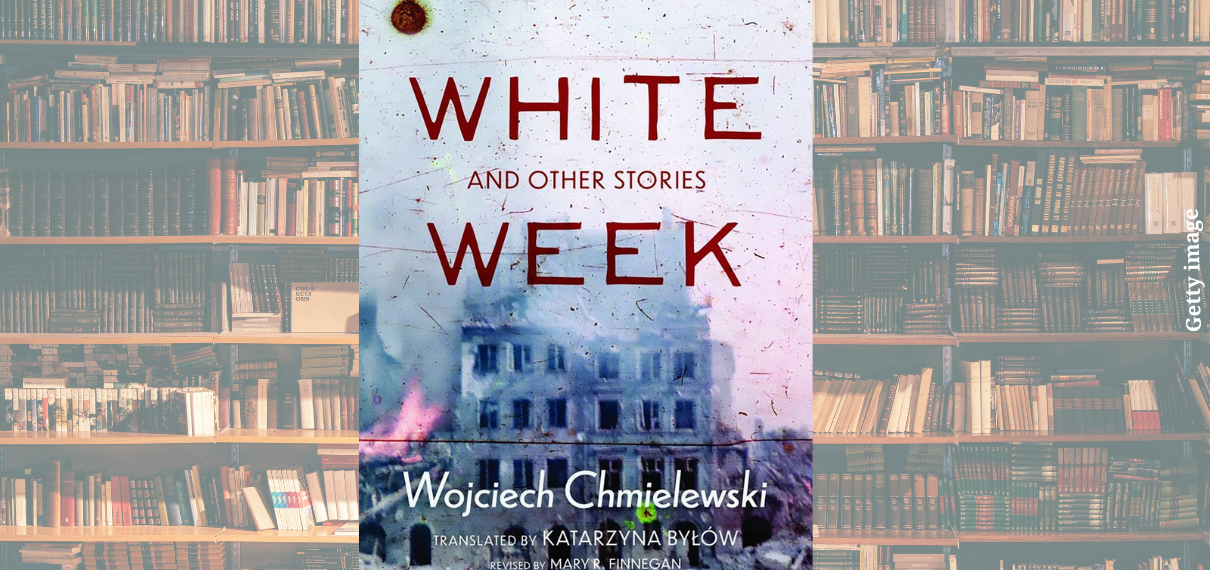
Top photo caption: Cover of “White Week and Other Stories” by Wojciech Chmielewski, Wiseblood Books. A new English translation of Polish short stories offers an interesting look at Catholicism in Poland. OSV News photo/Wiseblood Books
By Madelyn Reichert, OSV News
“White Week and Other Stories”
Wojciech Chmielewski, Wiseblood Books (2025)
180 pages, $18.00.
Ordinarily in this column, this reviewer opines on works of contemporary Catholic fiction — the ways in which a current novel or a collection of short stories attempts to tell us something true, good or beautiful about the world through the lens of the Catholic faith.
For that reason, after reading Wiseblood Books’ English translation of Wojciech Chmielewski’s “White Week and Other Stories,” this reviewer was left a bit stumped. This is not an anthology of short stories written through a contemporary Catholic lens, but rather from a contemporary Polish perspective, in which Catholicism heavily figures.
Perhaps for that reason it would be best to examine the ways in which Catholicism works through the stories, rather than examining the collection as a Catholic work per se.
“White Week and Other Stories” is about many things, but perhaps most clearly about the experience of living in a country where the past extends into the present, and history is layered just under modernity like sedimentary deposits.
This is best exemplified by “The Chlodna Street Fantasy,” in which a child’s daydream during a religious procession is inextricably intertwined with the cultural memory of Nazi violence. This is very different from the experience of most Americans, given the relative youth of our nation and the ways in which the long history of this land prior to the 17th century has been largely erased from our national consciousness.
It could therefore be tempting to reduce the Catholicism in “White Week and Other Stories” to the detritus of Catholic history scattered across the Polish landscape — Churches, monasteries, graveyards left like ruins in the sand. But the Catholic institutions in these stories are living giants, both historical and contemporaneous; the characters move through Catholic settings whose significance extends far back into the past, as well as actively serving the spiritual needs of those in the present.
“All Saints’ Church is still and silent. Two massive towers, blackened at the top and capped with green spires, have always been here in this square, witnesses to a world which the people who rush past the wire fences know nothing about,” Chmielewski writes in the first story of the volume, “A Prayer.” The Church in “White Week and Other Stories” is tangibly ever ancient and ever new, and the stories in general are written with great care for the physical experience of places made heavy with history. The prose is so vivid that many scenes feel almost like paintings or snapshots of a moment captured on film.
This overall positive review does come with some caveats. This reviewer personally thinks the female characters in many of the stories could have done with a little more agency and interiority ascribed to them; furthermore, several characters handle the topic of human sexuality rather crassly, sometimes to the point of immodesty. The individuals in question aren’t depicted as aspirational, so it doesn’t detract from the work as a whole, but the book is not appropriate reading for younger audiences.
Overall, however, this collection is well worth the read for American Catholics interested in how our religion is experienced in a culture quite different from our own, and Wiseblood Books has my thanks for making this English translation available to us.
Madelyn Reichert is publications administrative coordinator at The Catholic Spirit, the official publication of the Archdiocese of St. Paul and Minneapolis.
Catholic journalism is needed now more than ever. Please consider supporting this work by signing up for a SUBSCRIPTION (click HERE) or making a DONATION to The Monitor (click HERE). Thank you for your contribution.