
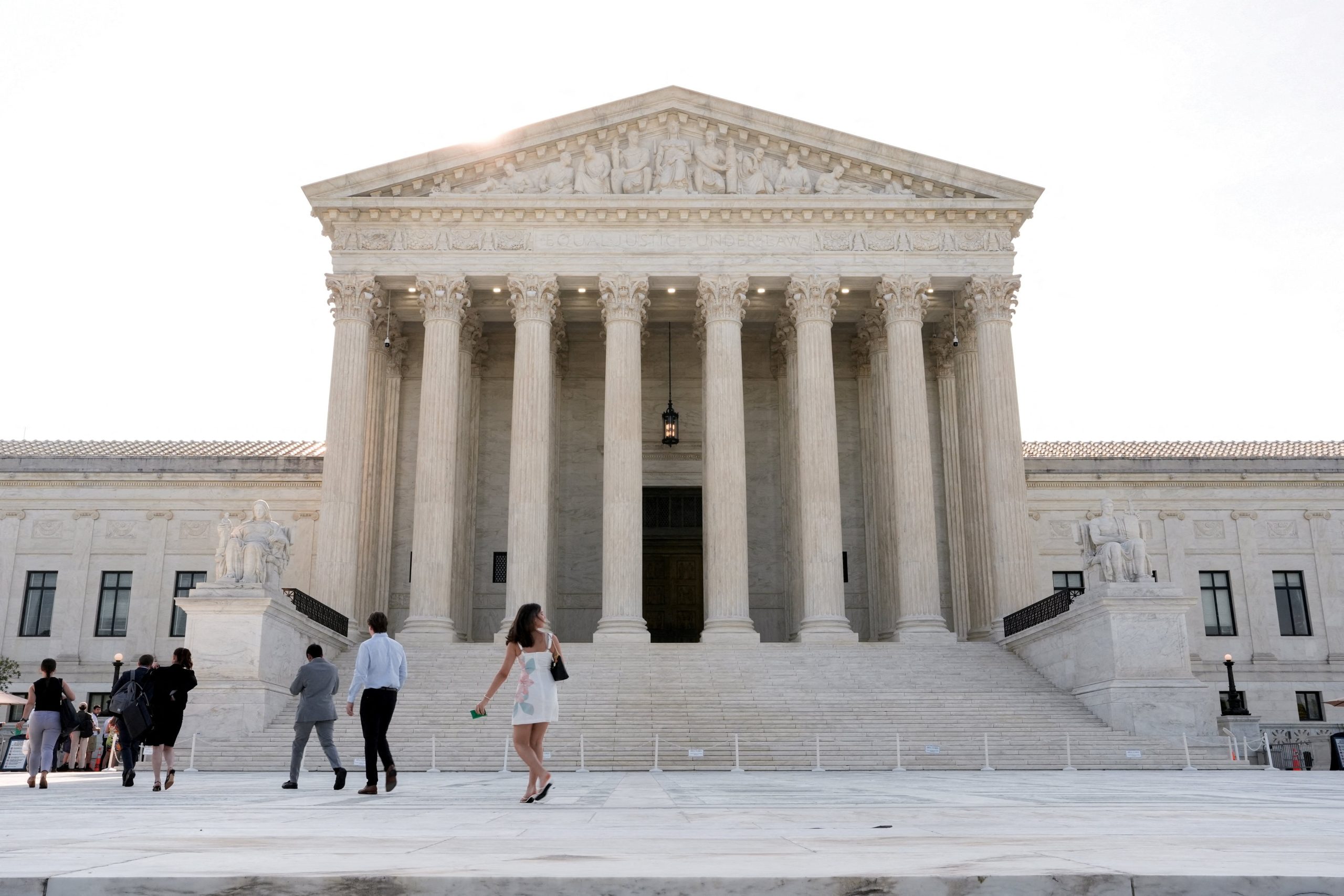
Top photo credit: The U.S. Supreme Court is seen on June 30, 2026. OSV News photo/Cheney Orr, Reuters
By Kate Scanlon, OSV News
WASHINGTON OSV News – The U.S. Supreme Court struck down President Donald Trump’s executive order limiting birthright citizenship on June 30, finding the order violated the 14th Amendment.
The U.S. Conference of Catholic Bishops and Catholic Legal Immigration Network (CLINIC) previously submitted a friend-of-the-court brief in the case, arguing that ending the practice of birthright citizenship would weaken families and risk leaving children stateless, thereby making them targets for violence, trafficking and exploitation.
“The principle of citizenship by birth is firmly rooted in Western legal tradition, enshrined in the Fourteenth Amendment, and reaffirmed by this Court’s precedent,” it said. “It is equally grounded in Church teachings, which affirms the inherent dignity of every human person, especially the innocent child.”
Writing for the majority, Chief Justice John Roberts wrote, “Citizenship, then and now, was the right to have rights – to freely participate in our political community.”
Citing comments made by Sen. Lyman Trumbull, a proponent of the Civil Rights Act of 1866, which led to the 14th Amendment, Roberts wrote, “The Framers of the Fourteenth Amendment extended that promise to ‘every free-born person in this land.’ We keep that promise today.”
The case concerned an executive order signed by Trump within hours of returning to the Oval Office on Jan. 20, 2025, that sought to change the longstanding legal interpretation of the 14th Amendment, which states, “All persons born or naturalized in the United States, and subject to the jurisdiction thereof, are citizens of the United States and of the State wherein they reside.”
But Roberts wrote, “The word ‘jurisdiction’ was hardly unknown to the drafters and ratifiers of the Fourteenth Amendment. Congress chose to use an established legal term, and the Clause must be interpreted in that light.”
Roberts was joined in his opinion by Justices Amy Coney Barrett, Sonia Sotomayor, Elena Kagan and Ketanji Brown Jackson. Justice Brett Kavanaugh filed an opinion that concurred in the judgment but dissented in part. Justices Samuel Alito, Clarence Thomas and Neil Gorsuch dissented.
Ashley Feasley, the legal expert in residence at the Immigration Law and Policy Initiative at The Catholic University of America Columbus School of Law, told OSV News, “Today’s opinion is a victory for immigrant children born in the United States.”
Roberts’ opinion, she said, “while focused on Constitutional analysis and history and tradition, aligns with the bishops, who noted in their amicus brief on the case, the alignment of birthright citizenship with Church teaching as it treats ‘birth within a community as a sufficient and objective basis for political belonging.'”
J. Kevin Appleby, senior fellow for policy and communications at the Center for Migration Studies of New York and the former director of migration policy for the U.S. Conference of Catholic Bishops, told OSV News, “This decision shows that … the Constitution retains its authority and still guides our 250-year-old republic. It also sends a message to the administration that to change the Constitution you must go through a constitutional amendment process, not just use a pen.”
Catholic social teaching on immigration involves three interrelated principles: the right of persons to migrate in order to sustain their lives and those of their families, the right of a country to regulate its borders and control immigration, and a nation’s duty to regulate its borders with justice and mercy.
Anna Gallagher, executive director of CLINIC, said in a statement, “We are relieved and grateful that the Supreme Court has upheld this right that is so important for our identity as a nation and for safeguarding justice and human dignity.”
“In our amicus brief, we explained how the values of Catholic social teaching, the particular realities of undocumented immigration in the United States, and our nation’s legal history make upholding the tradition of birthright citizenship the most just outcome of this case,” she said. “We are glad to receive a decision that will bring relief to immigrant families and our network. This is a win for immigrants, and a win for justice.”
Appleby told OSV News, “I think the Church’s voice made a difference here.”
“This is a victory for human dignity and for human life,” he said, adding the ruling is one that could be celebrated by “Catholics of all political views.”
Kate Scanlon is a national reporter for OSV News covering Washington. Follow her on X @kgscanlon.