
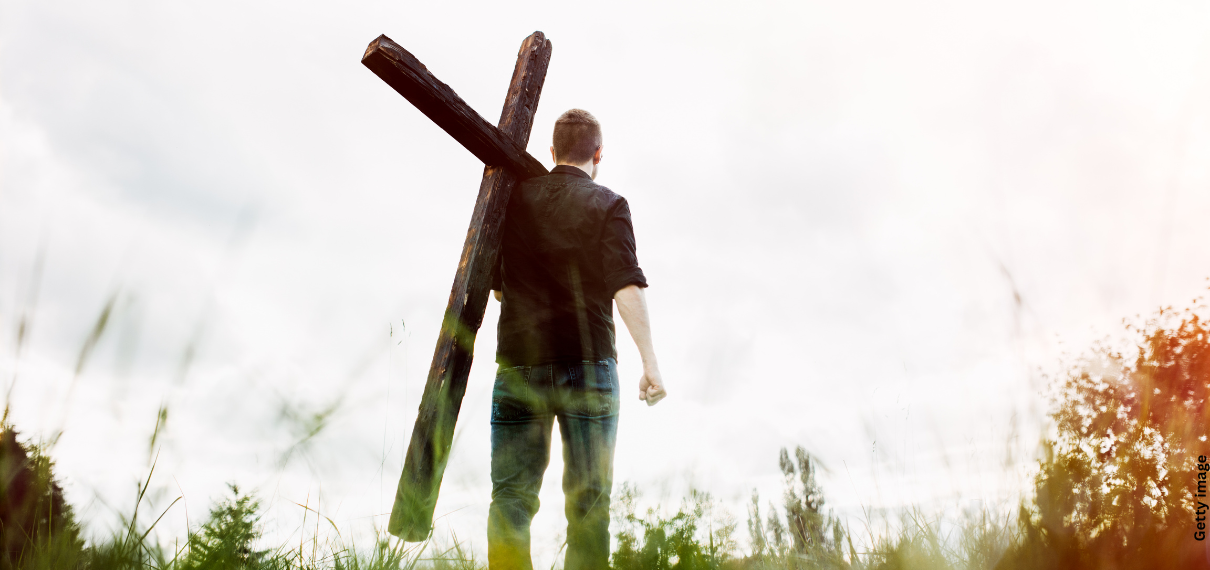
Top photo caption: Getty image
Gospel reflection for June 28, 2026, 13th Sunday in Ordinary Time
There is a certain familiarity, especially among Catholics, of the call of Jesus to “take up our cross.” The cross indeed stands at the forefront of our lives even on the most unconscious level of our existence. Most of us have multiple presentations of the cross – a Crucifix – in our homes. Our churches have crosses outside and on top of them, and generally a large Crucifix dominates the sanctuary. Many people carry crosses in their pockets or purses, often attached to a Rosary, which is another ubiquitous symbol of our Catholic faith. Many of our cars have crosses and other religious medals displayed as well.
These are not used for superstitious purposes but as a reminder of our faith and an expression of the desire for protection and grace during the movements of our lives. So, we are really proficient in carrying crosses, but we can easily overlook the call to take-up our cross each day.
For some, the idea of taking-up a cross is equivalent to carrying a burden. They take consolation in sharing in the suffering of Jesus through the endurance of the challenges of their lives. Often this involves health and wellness issues, either for themselves or as a caregiver. This notion also provides some comfort in the face of tragedy and loss. Others see their cross in the difficulties of their lives: financial stress, family conflicts, or their own sense of loneliness or despair.
Each of these experiences allows us to share in the Passion of Jesus Christ, with the hope that somehow we are able to make some atonement for our sins, or to offer that suffering vicariously for the sake of someone else.
All of these are noble ways to think of suffering, and certainly are ways in which we find hope and peace in the midst of the struggles of life. Thinking of life this way helps to offer meaning in the midst of what at times seems to be random and senseless suffering.
However, the call to take-up our cross runs deeper than the moments of suffering. The invitation from Jesus is to all of his disciples, regardless of their state in life.
Taking-up the cross demands that we put something down. We cannot hold the cross and our own attachments to this world at the same time.
The essence of what Jesus demands of us is to put aside our own desires, personal goals, and financial concerns and in their place, to take up our cross. As we take up the cross, we welcome the stranger, the orphan, the widow. In welcoming them, we welcome Christ.
To carry the cross of Jesus in our daily lives can have some awkward repercussions for us. We can carry the cross to Mass on Sunday and within our families and amongst most of our friends, but we can very easily leave that cross at the church altar or the front door of the house as we enter the workplace, only to take it up again when we return.
Discipleship is not just a part of our life, it defines our life. Our religious faith is not a matter of personal convenience but a testimony to the passion, death, and resurrection of Jesus Christ. We bear witness to our faith with our very lives. This is the essence of martyrdom.
We are then called and challenged even further in our acts of charity and service to the least and to the poorest, yes, but also to be open to the charity and service of others. We enter into a dialogue with the world that recognizes and honors the individual human dignity and of each person whom we encounter along the way.
Sometimes, in our compartmentalizing of our faith, and given the polarized climate of our society, we can see those who do not follow our own religious path with suspicion and even hostility. We can fail to see and experience the genuine goodness of each person, and even to reject their kindness and hospitality. While less true in our country, it is nonetheless an increasing issue here as well.
Our call to evangelize the world is both an active and a passive experience. We speak about Jesus and the promise of salvation to others, yes; but we also treat others with compassion, generosity, and kindness, and accept the compassion, generosity, and kindness of others with grace and dignity.
Being a disciple of Jesus Christ, being a faithful Catholic, calls us to let go of our prejudices, preconceptions, and our attachments to the familiar, so that we can truly take up our cross, and bring Jesus to the world.
Father Garry Koch is pastor of St. Benedict Parish, Holmdel.