
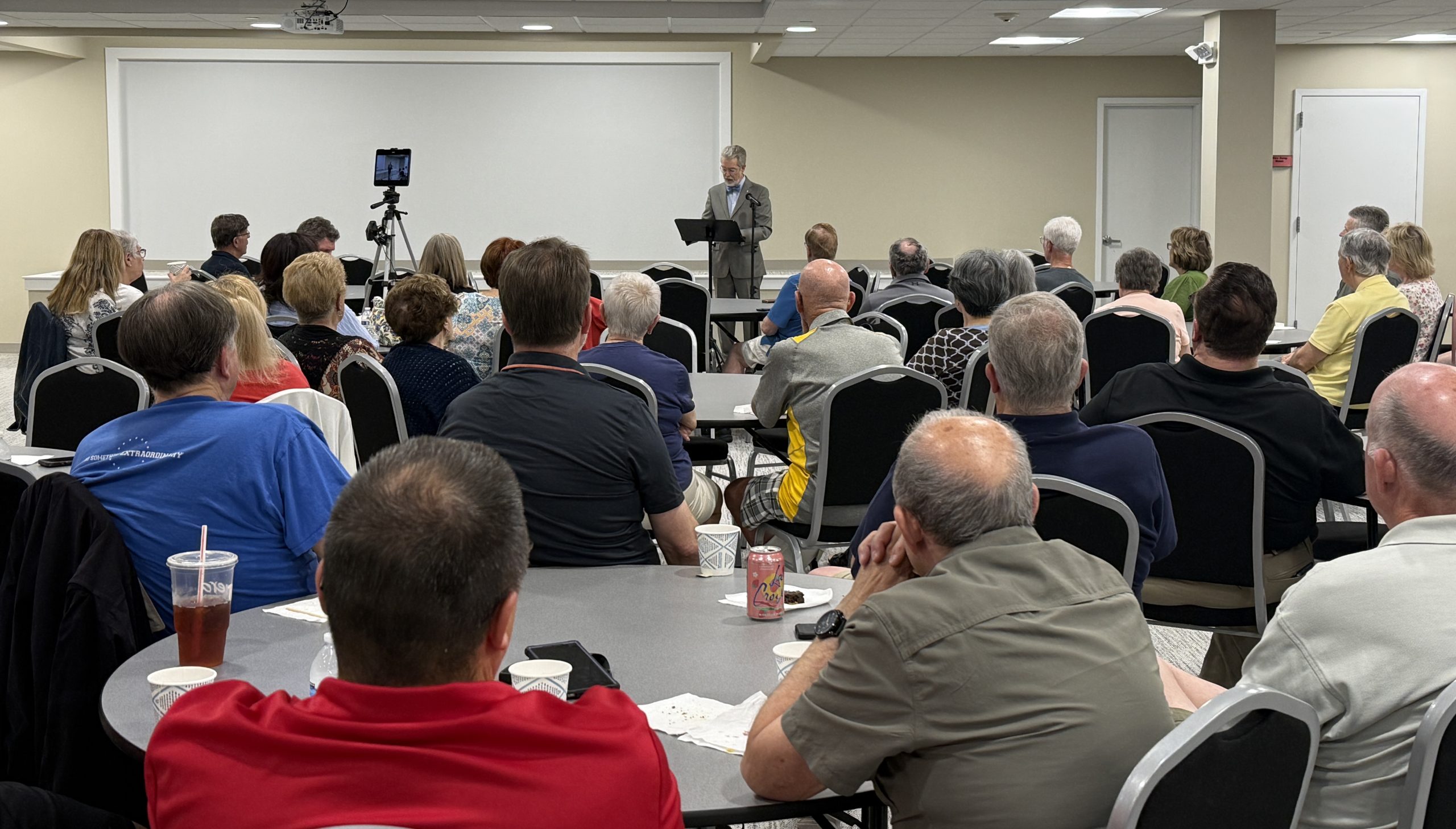
In top photo, Attendees hear the reasoning behind why it’s important for Catholics to observe America’s 250th anniversary. EmmaLee Italia photo
By EmmaLee Italia, Contributing Editor
The foundational document that defined a rising new nation 250 years ago declared that “all men are created equal.”
But as a Princeton University academic and nationally-renowned expert recently told a parish gathering in Hamilton Square, that “self-evident truth” most importantly means that “the equal dignity of all human beings as creatures of one creator is the foundation of all our political principles.”
Speaking May 19 in St. Gregory the Great Parish Center on America’s impending anniversary, Matthew Franck argued that Catholics have strong historical and philosophical reasons to celebrate the nation’s founding, rejecting claims from both the political left and right that Catholicism and America’s origins are fundamentally at odds.
Franck, a visiting lecturer in politics at Princeton University and senior fellow at the Witherspoon Institute, delivered a sweeping historical lecture tracing the relationship between Christianity, religious liberty and the founding principles of the United States.
Addressing skepticism surrounding patriotism and faith, Franck said some secular progressives view the American founding as rooted solely in Enlightenment rationalism, while some traditionalist Catholics see the nation’s founding principles as hostile to Christianity.
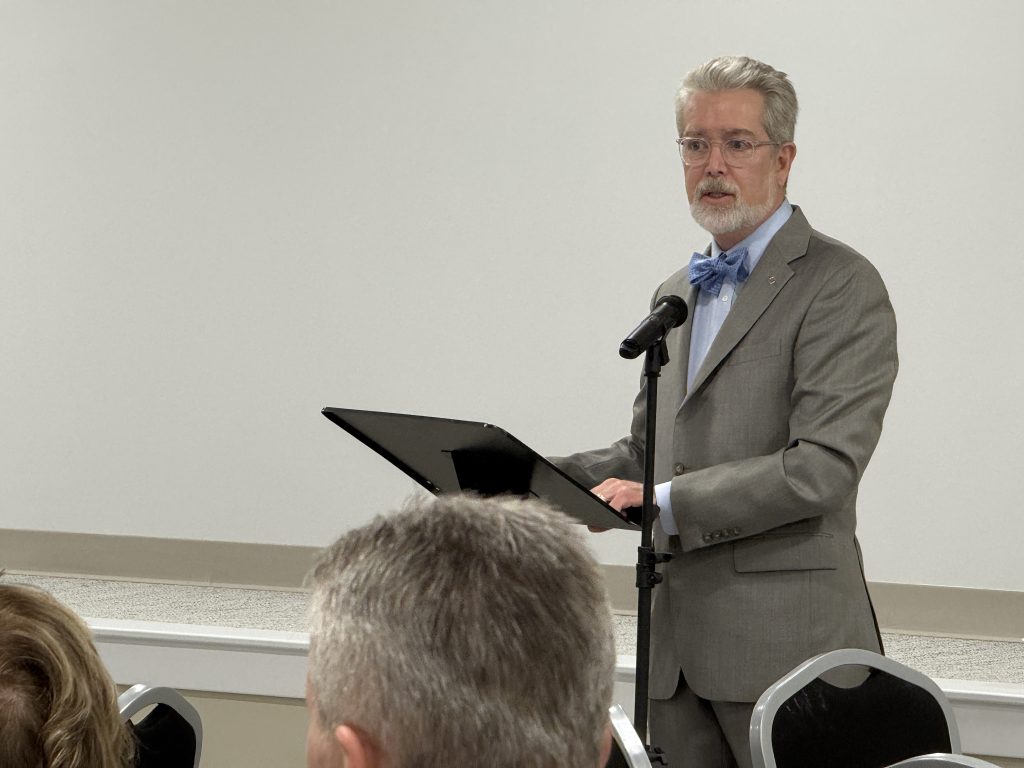
On Catholic faith and American patriotism’s discordance, “Secularists of the left … and traditionalists of the right … are both wrong. There is no fundamental incompatibility,” he said. “The founders of our country saw none, and they are correct; neither should we.”
Liberty Rooted in God
The Declaration of Independence, Franck noted, was a group product, “a statement of the Continental Congress of 1776 whose members included Anglicans, Unitarians, Quakers, Baptists, Presbyterians, including the lone ordained minister at the Congress, John Witherspoon of Princeton – and one Catholic, Charles Carroll of Maryland.”
Central to his presentation was the argument that the American Revolution and the Declaration of Independence were deeply influenced by biblical and Christian concepts.
Referring to the Declaration’s references to “nature’s God,” a Creator, divine providence and a “Supreme Judge of the world,” Franck said the document reflected an active understanding of God, who is “not a mere watchmaker who wound up the world and let it go. This is the God who reveals himself in Scripture.”
Franck emphasized that the idea that “all men are created equal” emerged from Christian teaching on the dignity of the human person.
“America and the West in general owe this idea to the Church – that man is imago dei, made in the image of God,” he said.
Without Christianity, Franck argued, many concepts now associated with modern democracy and human rights would not have developed.
“No Christianity, then no dignity for women or for children or for the unborn, no abolition of slavery, no moral crusade against racial bigotry, no universal human rights transcending race and culture,” he said.
Catholics in American Formation
A history of Catholics in colonial Maryland and their contributions to religious liberty in America shed light on the role of Catholics in America’s founding. Franck highlighted the 1649 Maryland Act Concerning Religion, calling it “the first community in America to enact a law protecting freedom of conscience for every sect of Christianity.”
He also pointed to the role of prominent Catholic patriots in shaping the early republic, such as brothers John and Daniel Carroll and their cousin Charles Carroll. John Carroll became the first U.S. bishop, while Charles signed the Declaration and Daniel signed the Constitution.
Quoting George Washington’s 1790 letter to American Catholics, Franck noted Washington’s praise for Catholics’ role in the Revolution and his belief that liberty and religion reinforced one another.
“We can hear the unselfconscious belief on the part of our founders that what Alexis de Tocqueville would later call ‘the spirit of liberty and the spirit of religion,’ were not just fully compatible, but mutually reinforcing and indispensable to one another.”
Franck urged Catholics to embrace the nation’s semi-quincentennial celebration with confidence, pointing to the United States Conference of Catholic Bishops’ series of online essays “We Hold These Truths.” (usccb.org/weholdthesetruths)
“Our bishops know that no one has better cause than America’s Catholics to say again, ‘We hold these truths to be self-evident,’” he said. “Freedom and faith are interdependent, each supports the other, and each is harmed by the other’s absence.”