
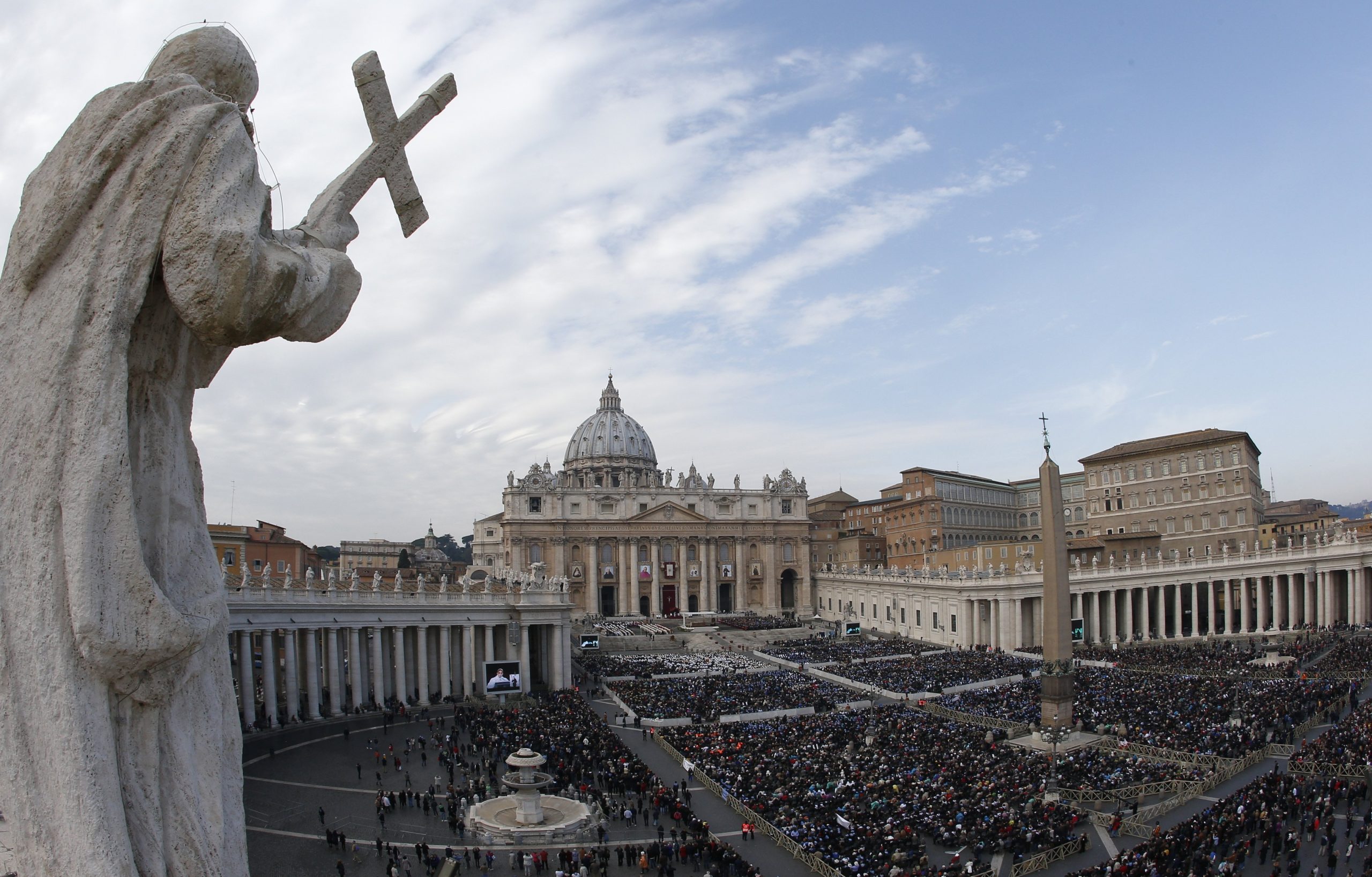
Top photo caption: This is a file photo showing as rooftop view as people gather in St. Peter’s Square at the Vatican. CNS photo/Paul Haring
By Jenna Marie Cooper, OSV News
Q: I have a question about appeals to Rome of the declaration of nullity process. The metropolitan tribunal of my local archdiocese has completed their review of the case and stated that it has been proved that there is sufficient ground to find the marriage invalid (“decision in the affirmative”). However, my former spouse has appealed the decision to the Roman Rota. I imagine that the Roman Rota is very busy and might not get around to reviewing this appeal. Is there a time limit on this? If we never hear from them, does that mean that my marriage is invalid? Also, theologically, what is the purpose of an appeal? It is my understanding that the Church does not actually make the marriage valid/invalid, it either is or isn’t valid. So if the tribunal has found that it is invalid, how can an appeal change how God sees this?
A: Your question actually contains several questions, which I’ll try to answer one by one.
But to start out for those who are not familiar with the marriage nullity process in general, if a person thinks their marriage might be invalid and they have a reason for wanting the status of their union to be formally clarified by the Catholic Church, they can bring their case to a local diocesan marriage tribunal. This becomes what is called the court of “first instance,” since this is the first time any Catholic tribunal is investigating the case.
If both the petitioner and the respondent accept the decision the first instance tribunal issues, then that decision stands as it is written. However, both parties have the right to challenge or appeal the first instance decision within a certain time frame. If an appeal is launched, this is heard by the appeals court, also called the tribunal of “second instance.” Ordinarily the court of second instance is the local metropolitan archdiocese, although in some places an ecclesiastical province (the group of local dioceses surrounding an archdiocese) might have a round-robin system where each diocese functions as their own first instance tribunal while taking on second instance cases from one of their neighboring dioceses.
If the second instance tribunal accepts the case, it will begin what is essentially a new nullity trial and will issue its own decision, which may or may not be in agreement with the one rendered in the court of first instance. If one or both of the parties object to the decision that the second instance tribunal comes to, the Roman Rota is the “third instance” and the final possible court of appeal.
Like you, I would assume the Roman Rota is busy, and for obvious reasons sending a case to Rome comes with its own set of inconveniences, like dealing with international postal services and occasional language barriers. But diocesan marriage tribunals are accustomed to sending cases to Rome, and often communication is routed through the local tribunal.
Speaking from personal experience as a diocesan tribunal judge, it’s not usually possible to predict how long a case sent to Rome will take. I have seen some third instance cases resolved in a matter of months, and others that took years. Still, the Roman Rota will never simply ignore or “not get around to” an appeal. The Rota may reject a case at the outset, but if this happens the interested parties will be informed.
In terms of the theological purpose of the appeals process, you are correct that a tribunal does not actively nullify a valid marriage, but only potentially recognizes that a marriage was always invalid from the beginning, in actual fact.
The reason why the canon law allows for appeals is because, even while tribunal judges prayerfully seek to arrive at the most accurate decision possible with moral certainty, at the end of the day we are merely human and not infallible. Unlike sacred Scripture, a tribunal decision is not the inspired word of God, but is rather the Church’s leadership making a prudential judgement.
Jenna Marie Cooper, who holds a licentiate in canon law, is a consecrated virgin and a canonist whose column appears weekly at OSV News. Send your questions to CatholicQA@osv.com.Catholic journalism is needed now more than ever. Please consider supporting this work by signing up for a SUBSCRIPTION (click HERE) or making a DONATION to The Monitor (click HERE). Thank you for your contribution.