
Reflection on recent public criticism of the Holy Father, tragedy of war
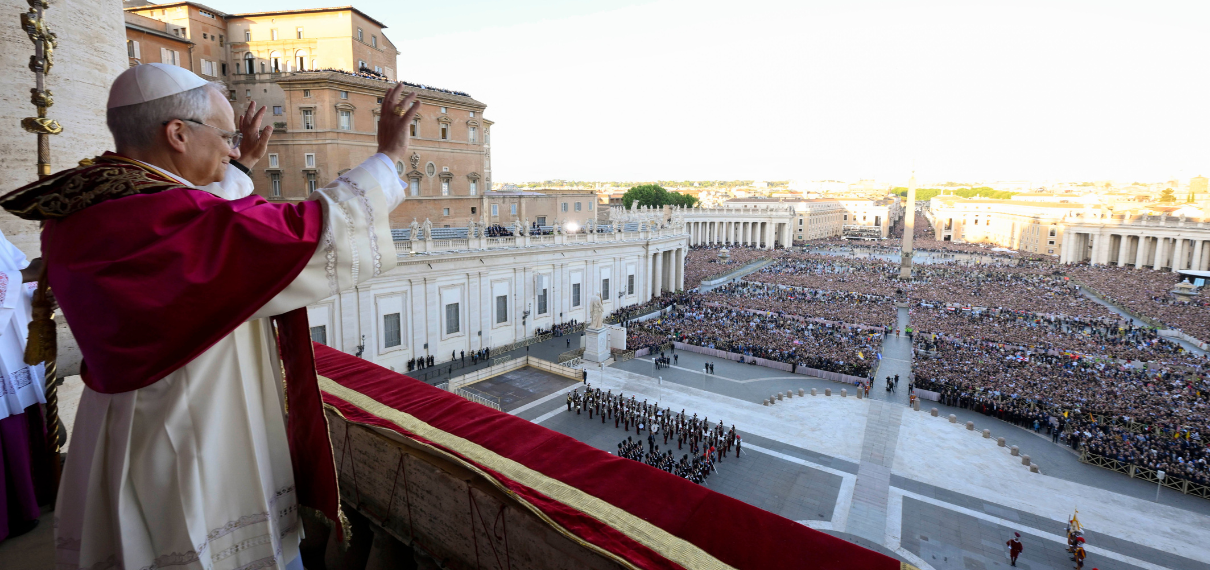
Top photo caption: Pope Leo XIV, the former Cardinal Robert F. Prevost, waves to the crowds in St. Peter’s Square at the Vatican after his election as pope May 8, 2025. The new pope was born in Chicago. CNS photo/Vatican Media
A message from Bishop David M. O’Connell, C.M.
In recent days, many of the faithful in the Diocese have reached out to me as Bishop and Shepherd of the local Church with concern, confusion, sorrow, and, in some cases, even anger regarding public comments made by President Donald Trump about our Holy Father, Pope Leo XIV, as well as the Holy Father’s measured response. Moments like these can unsettle hearts, especially when the unity of the Church and the dignity of her mission appear to be drawn into the turbulence of political discourse.
At the same time, our world is shaken by the ongoing war in Iran — an urgent conflict that has already claimed human lives and threatens to destabilize an entire region. In the midst of such suffering, the Church’s mission remains clear: to proclaim peace, to defend human dignity and to guide the faithful with confidence in times of uncertainty.
As your Bishop and Shepherd, I offer clarity, reassurance and a call to deeper Christian witness.
The Church’s mission is not dependent on political approval
The Catholic Church’s mission does not depend on political approval or cultural consensus. She has lived through emperors, kings, presidents, revolutions, persecutions, and cultural upheavals — and she endures both praise and scorn. Through it all, her mission remains the same: to proclaim Jesus Christ, to defend the dignity of every human person, and to guide souls toward salvation. This is precisely why the Church is not identified with any political community or bound to any political system; rather, she remains a sign and safeguard of the transcendent dignity of the human person.
So, when any public figure — regardless of office or influence — speaks critically of the Holy Father, it does not diminish the authority entrusted to the Successor of Peter, nor does it remove the Church’s responsibility to speak the truth in charity, especially when truth challenges powerful interests. Moreover, the Church herself has a true freedom to preach the faith, teach her social doctrine, and pass moral judgment when fundamental rights of the person or the salvation of souls require it.
The Holy Father’s response: humility, clarity, and pastoral concern
The Holy Father’s response to recent criticism has reflected qualities that have marked his pontificate: humility, clarity, and genuine pastoral concern. He did not return insult for insult, nor did he allow himself to be drawn into the combative tone so often present in public life.
Instead, he reaffirmed the Church’s teaching, emphasized the need for moral leadership rooted in the Gospel, and invited all people — including leaders of nations — to a renewed commitment to peace, justice, compassion and the common good. This is the way of Christ: correcting without humiliating, challenging without condemning, and calling every person to conversion.
War is never morally neutral: dignity, just war, and the pursuit of peace
The war in Iran weighs heavily on the conscience of the global Church. Catholic moral teaching offers principles that help us understand how to respond with truth and charity:
- The dignity of every human life. Every person — pope or president, soldier or civilian, American, Israeli, Iranian, and all peoples — is created in the image of God. The loss of life and the suffering of the innocent are tragedies that call for prayer, solidarity, and moral clarity.
- The Church’s “just war” teaching. The Church does not promote war; rather, legitimate defense requires strict moral conditions. Even in war, the moral law remains binding: “The mere fact that war has regrettably broken out does not mean that everything becomes licit between the warring parties.” Legitimate defense also requires rigorous moral evaluation of the damage caused, the impracticality of other means, serious prospects of success, and the requirement that the use of arms not produce evils and disorders graver than the evil to be eliminated — judgments entrusted to those responsible for the common good.
- Peace is more than the absence of violence. True peace is not merely “the absence of war,” but a tireless commitment to recognize, protect, and restore the dignity of those who are vulnerable and overlooked. Peace must therefore be pursued through justice, dialogue, and concrete efforts to protect the dignity of the person.
- Solidarity and prayer. Catholics are called to stand with those who suffer: to support humanitarian efforts, advocate for peace and pray for those caught in violence.
In all of this, the Church does not take sides in partisan political struggles. She takes the side of the humans, especially the vulnerable, and seeks the good of all.
Speaking truth with respect — and rejecting partisan temptations
As Catholics, we must resist the temptation to view the Church through the lens of partisan politics. The Pope is not a political rival; he is the spiritual father of the universal Church. Harsh or dismissive criticism wounds not only the person of the Pope but also the unity of believers and obscures the Church’s witness.
At the same time, our unity as Catholics does not mean silence in the face of moral truth. The Church calls us to speak truth with knowledge of what she teaches and why — and always with respect, especially when defending the Holy Father and the faith.
Every public official has a responsibility to lead with integrity, prudence, and respect for institutions that serve the common good. When disagreements arise between civil leaders and the Church, they should be addressed with seriousness and mutual respect rather than inflammatory language.
The Church prays for those who govern, including the leaders of all countries, and she will also continue to speak boldly and courageously when moral truth is at stake. These two responsibilities are not opposed; they belong together, because charity does not mean compromising justice and fidelity to prayer does not mean abandoning the duty to speak truth.
Pastoral invitation
In the present moment of world-wide concern, I invite every Catholic in our Diocese to pray for:
- Our Holy Father, Pope Leo XIV, that the Holy Spirit may strengthen him with wisdom and courage;
- President Donald Trump, that he may be guided by truth, wisdom, justice, and a genuine commitment to the common good;
- All those suffering because of war, especially the innocent, that God will protect them and provide relief;
- World leaders, that they may pursue peace with sincerity and resolve;
- Our nation, that we may resist division and rediscover the dignity of respectful dialogue;
- The Church, that we may remain united in faith, hope, and charity.
Remember: our unity as a Church and as a Diocese is not founded on political alignment, but on our shared identity as disciples of Jesus Christ.
I share the concern about what was said about Pope Leo XIV by President Trump and the manner in which it was said. I do not like it nor do I believe it to be true. Those comments remind us that the Church’s voice is not always welcomed — but it must always remain faithful. Pope Leo XIV has offered us an example of calm, principled leadership. We should follow that example by responding not with anger or fear, but with steadfast faith and renewed commitment to the Gospel.
May the Lord grant us peace, wisdom and unity in the days ahead.