
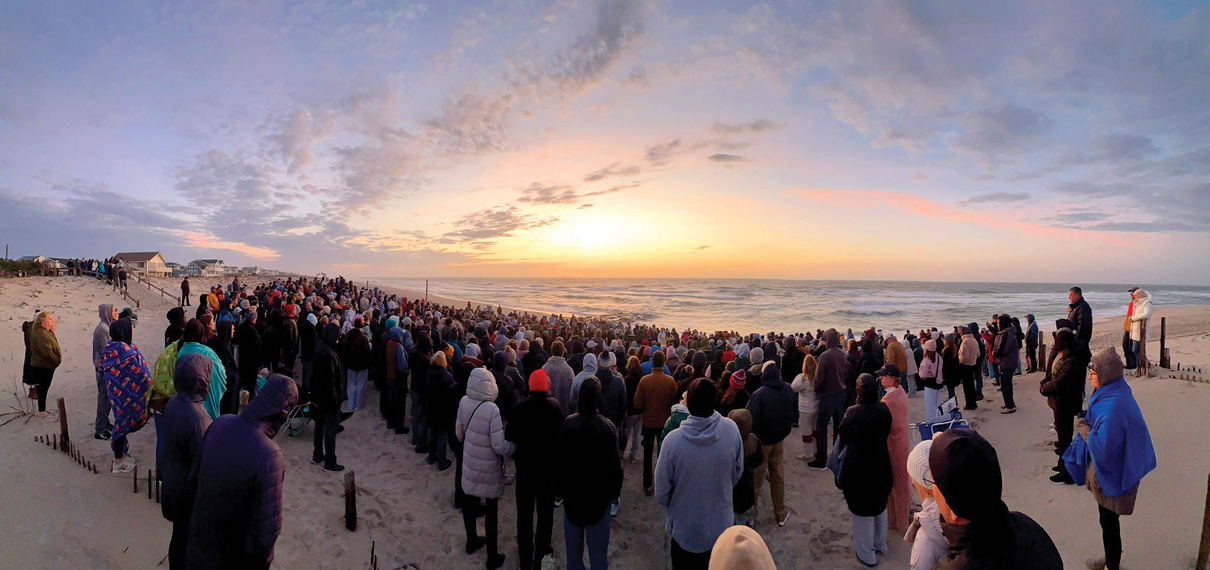
ABOVE PHOTO: A shot from Easter Sunday Sunrise Mass celebrated by the commuinity of St. Francis of Assisi, Long Beach Island. Facebook photo
By EmmaLee Italia, Contributing Editor
Holy Week recalls the final days of Jesus Christ’s life, unfolding through ritual, symbol and communal prayer. From the joyful procession of Palm Sunday to the radiant celebration of Easter Sunday, the week invites believers to move through shifting emotional and spiritual landscapes – what Bishop David M. O’Connell, C.M., described as a “week of crowds.”
“The crowds welcome Jesus with great enthusiasm,” he reflected in his Palm Sunday homily in St. Anthony of Padua Parish, Hightstown, recalling Christ’s entrance into Jerusalem. Yet that same crowd changes as the week progresses: “By Holy Thursday, the town seems eerily quiet . . . the crowd becomes ugly on Good Friday . . . and the crowd is reduced.”
His observation highlights one of Holy Week’s essential movements – not only the physical journey of Christ, but the interior journey of the faithful. “Holy Week invites us – not to remain in the shifting crowds – but to draw closer to Christ himself . . . To walk with him. To stay with him. To trust him.”
Holy Week was commemorated across the Diocese with both traditional and special devotions, such as Living Stations of the Cross. This physical reenactment of Christ’s path to Calvary draws participants into the suffering and sacrifice of the Passion, as experienced in St. Charles Borromeo Parish on Good Friday.
Another powerful observance is Tenebrae, a service marked by the gradual extinguishing of candles, celebrated this year on Palm Sunday in St. Catherine Laboure Parish, Middletown. As light fades into darkness, it symbolizes the abandonment of Christ and the apparent triumph of death, often ending with a sudden noise evoking the chaos of the crucifixion. Cultural traditions, such as the blessing of Easter foods – typically on Holy Saturday morning – also form part of the broader Holy Week experience, linking faith with daily life and anticipation of celebration.
The Sacred Triduum – three evenings but one continuous liturgy – begins with Holy Thursday, commemorating the Last Supper and the institution of the Eucharist. The celebration includes the washing of feet, an act rich in meaning.
“Jesus used what was common to create . . . a symbolic moment intended to make the point that we owe each other great respect and care,” Bishop O’Connell explained in his homily in St. Rose Church, Belmar. The gesture of humility is inseparable from the institution of the Eucharist, where “the bread became his Body, the wine, his Blood.”
These actions together reveal what he called “the essence of what we celebrate … humble and loving service” rooted in Christ’s total self-gift.
On Good Friday, the tone shifts to solemn reflection on the Passion. The Veneration of the Cross becomes a central act, inviting the faithful to encounter both suffering and redemption.
“Good Friday is not merely a day of sorrow,” Bishop O’Connell emphasizes, “it is a day to meditate on the incredible depth of love that led Jesus to the Cross.” In Christ’s final words – “It is finished” – he sees not defeat, but victory: “the power of sin and death was conquered … not with armies … but with humility and love.”
Holy Week reaches its climax in the Easter Vigil, which begins in darkness and moves toward light. Through Scripture, the liturgy traces salvation history, culminating in the proclamation of the Resurrection.
“The tomb is empty,” Bishop O’Connell proclaimed in his Easter Vigil homily in St. Ann Church, Lawrenceville. “This is about glory and triumph … a completely different order of existence.” The lighting of the Paschal candle, Baptisms and Confirmations all point to new life in Christ.
Finally, Easter Sunday bursts forth in joy, marking what Bishop O’Connell called a moment that “changed the world forever.” The journey from palm branches to the empty tomb reveals a unified story of transformation – one that calls believers not only to remember, but to enter fully into its meaning.
The Church needs quality Catholic journalism now more than ever. Please consider supporting this work by signing up for a SUBSCRIPTION (click HERE) or making a DONATION to The Monitor (click HERE). Thank you for your support.