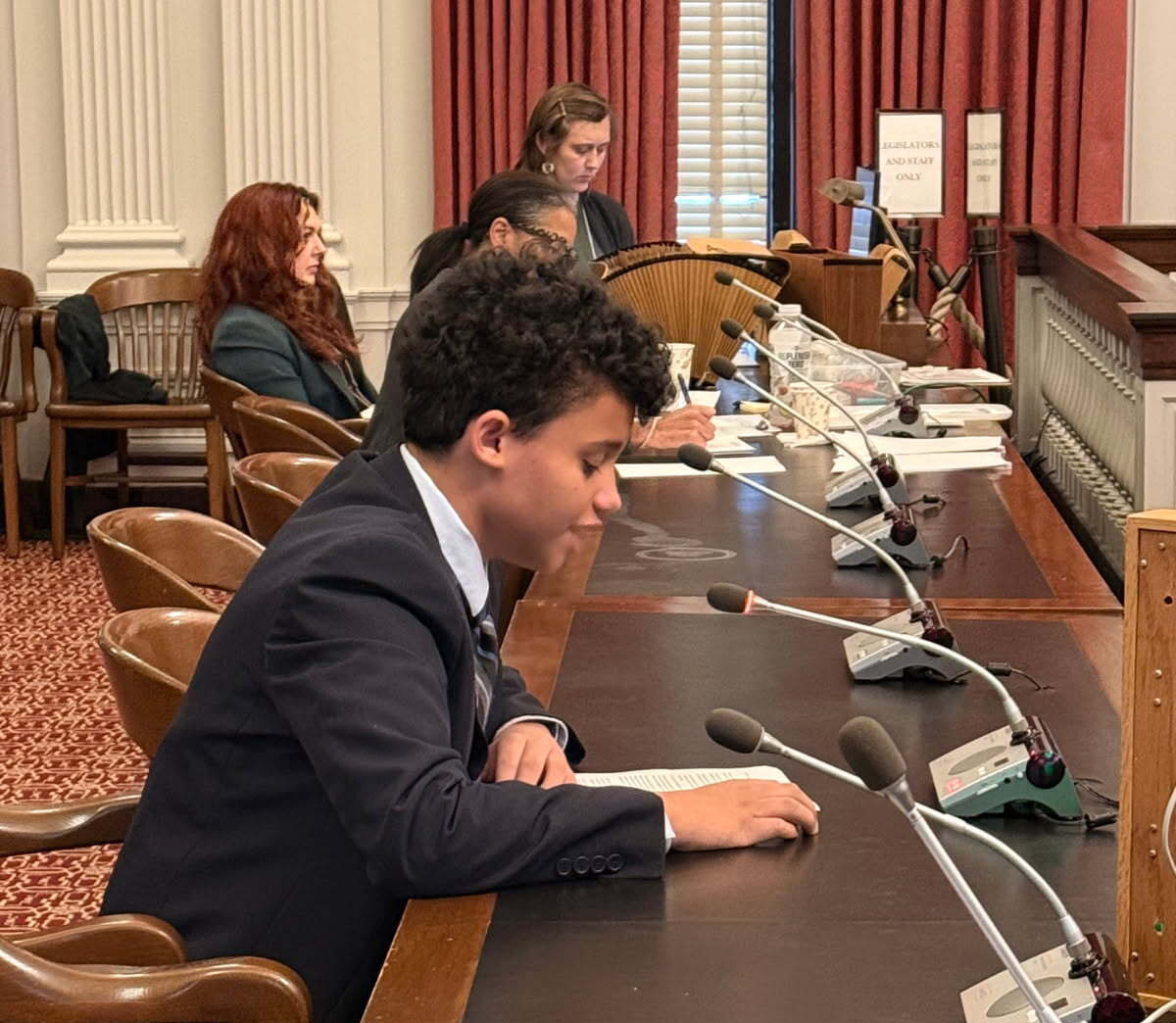
Top photo caption: St. Ann School student Marc Muir testifies before the NJ Assembly Budget Committee March 17. Courtesy photo
By Mary Stadnyk | Associate Editor
Testifying before the N.J. Assembly Budget Committee March 18, two Catholic school representatives who hail from the Diocese of Trenton reinforced why nonpublic schools need an increase in state funding for security.
“Families choose these schools because they want their children educated in an environment that reflects their values and beliefs,” said Bonnie Milecki , who testified in her role as president of the New Jersey Council for American Private Education, which represents more than 600 nonpublic and faith-based schools across New Jersey.
Milecki, who is also assistant superintendent of Catholic schools for the Diocese added, “Our state has long recognized the importance of allowing families to pursue that choice safely.” She noted that New Jersey’s nonpublic schools educate nearly 160,000 students from all backgrounds and faith traditions – including, but not limited to Catholic, Jewish, Muslim and Christian.
Ripple effect
As reported in The Monitor in March, the impetus for seeking increased security funding for nonpublic schools resulted from the Aug. 27, 2025, mass shooting at Annunciation Catholic Church and School in Minneapolis. Two students died and more than two dozen people were injured.
The New Jersey Catholic Conference, the public policy arm for the bishops of New Jersey, urged New Jersey residents to contact Gov. Mikie Sherrill and support increasing funds for student security from $205 to $260 per student in nonpublic schools. New Jersey’s fiscal year begins each July 1.
The state began allocating funding for nonpublic school security in the 2016 state budget as part of the Secure Schools for All Children Act, allocating $75 per student in an $11.3 million budget. The state’s current budget is $30.5 million.
“Faith-based institutions are facing increased threats,” Milecki said in her testimony, noting that the state’s Office of Homeland Security and Preparedness has warned in the 2026 threat assessment that extremists frequently select what they call “soft targets,” including schools and houses of worship, because they are accessible and have limited security protections.
“When the state’s own analysis identifies schools as being at risk, it follows that it must also be serious about helping those communities prepare and protect the children in their care,” she said.
A child speaks
The room fell silent when Marc Muir, a 12-year-old seventh grader in St. Ann School, Lawrenceville, began his testimony with, “I’m here to talk about something that matters a lot to me, my classmates and my teachers – keeping our school safe.”
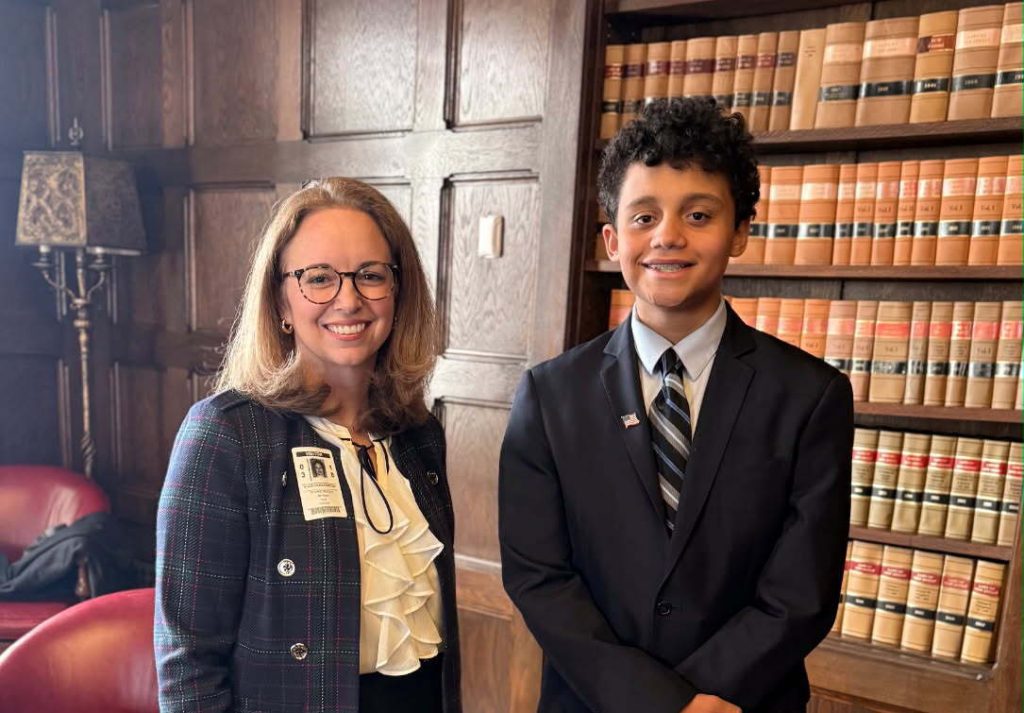
“When people think about school, they think about learning, friends and growing up. That’s what I think about, too. But today, students also think about safety in a different way than kids used to,” Marc said. The incident at Annunciation Catholic School, he said, “makes me think about how school safety is not a public school issue or a private school issue.”
“It is a national responsibility,” he said. “Private schools are not exclusively for the wealthy; many serve students from various economic backgrounds, ethnicities and cultures. Families with limited means often choose private schools specifically for a perceived safer environment. It also makes me think about how easy it has become for untrusted and ill-intentioned people to enter school grounds so easily, being met with no security forces.”
Marc admitted he was disheartened to learn from officials at St. Ann School that the school “cannot cover our security expenses with the money from the state.”
“This is the case for many private schools,” he said.
He said learning about his faith in a Catholic school setting is important to him and his family. But when speaking of safety issues, he said that “isn’t just about Catholic schools.”
“Students in Jewish schools, Islamic schools and other faith-based schools should also be able to learn about their faith, their traditions and their values in a safe environment,” he said. “No family should have to worry that choosing a school that reflects their beliefs could make their child less safe.”
Marc said he believes schools that openly live their faith can sometimes face increased risks because of that identity.
“My teachers and principal care about us and are working hard to protect us,” he said. “But they shouldn’t have to choose between spending money on safety and spending money on education.”