
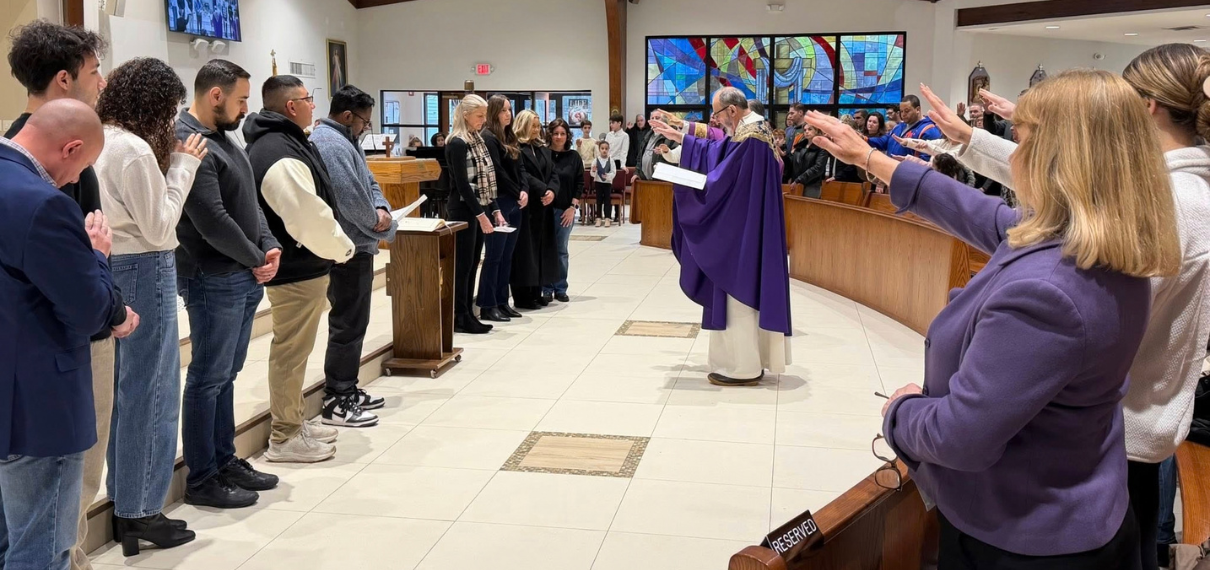
Top photo: Father Joseph Barbone, a weekend assistant in St. Gabriel Parish, Marlboro, and the congregation extend their hands as they pray over the elect and their sponsors during the Feb. 22 Rite of Election. Facebook photo
By Mary Stadnyk, Associate Editor, and Elizabeth Zimak, Correspondent
Something good’s been happening in the Diocese of Trenton when looking at an extraordinary jump in the number of people seeking to become Catholic over the past five plus years. The 1,095 who are expected to receive their Sacraments this year, dwarfs the numbers from 2020 and the years that followed.
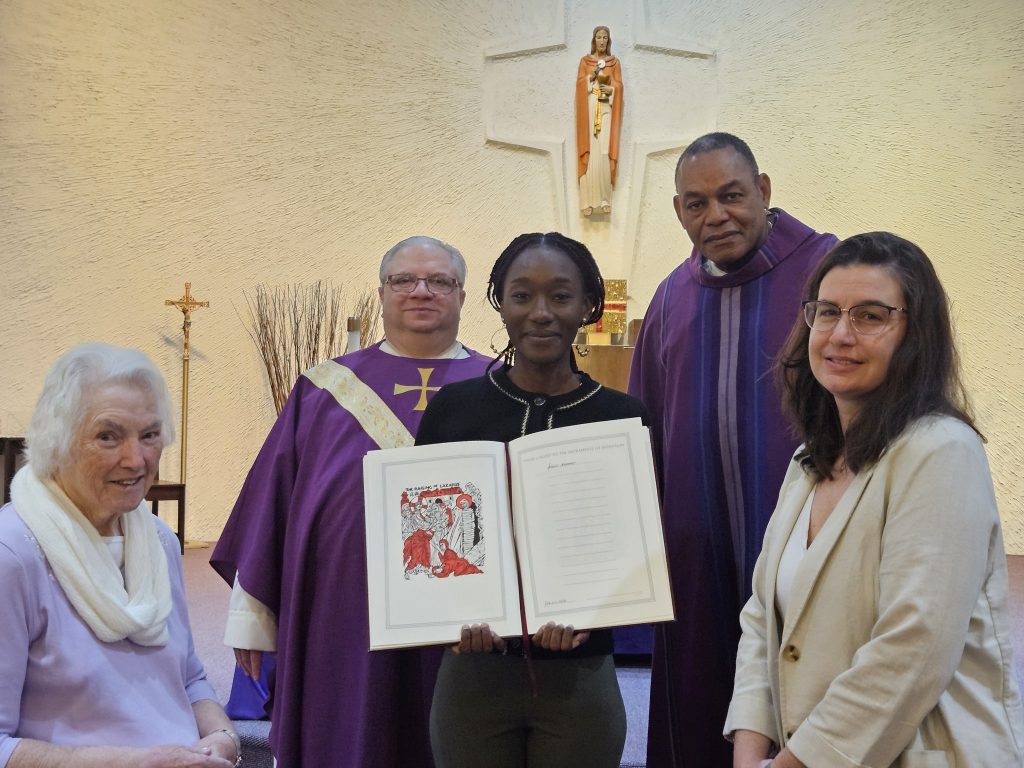
Though the initial thought for the increase “was simply a rebound from the COVID-19 decline, it now appears to reflect something deeper,” according to Denise Contino, director of the diocesan Department of Catechesis.
It seems that there has been a “renewed search for God in a world where many people are longing for hope, love and peace,” she said, adding that the uptick in numbers is happening overseas as well. Contino pointed to an increase in young adults who were never formally catechized coming into the Church as well as baptized individuals desiring to complete their initiation.
PHOTO GALLERY: Rite of Election in St. Gregory the Great Church, Hamilton Square
PHOTO GALLERY: Rite of Election in our parishes
Called by name
A milestone for the OCIA catechumens – those who are preparing for Baptism, Confirmation and Eucharist – occurred on the first Sunday of Lent when Catholic bishops throughout the world welcome them to the Rite of Election. This is when the Church, through the Bishop, formally elects those persons to receive the Sacraments of Initiation at the Easter Vigil, which this year is April 4.
Because of New Jersey’s state of emergency weather conditions on Feb. 22, Bishop David M. O’Connell, C.M., cancelled this year’s Rite of Election in St. Robert Bellarmine Co-Cathedral, Freehold, and instead delegated pastors and parish priests to conduct the rite in modified form in local parishes. Many of the 391 men, women and teens who were prepared to be with the Bishop in Freehold were instead welcomed in their local parish communities where they marked the milestone in their journeys to full initiation in the Catholic Church.
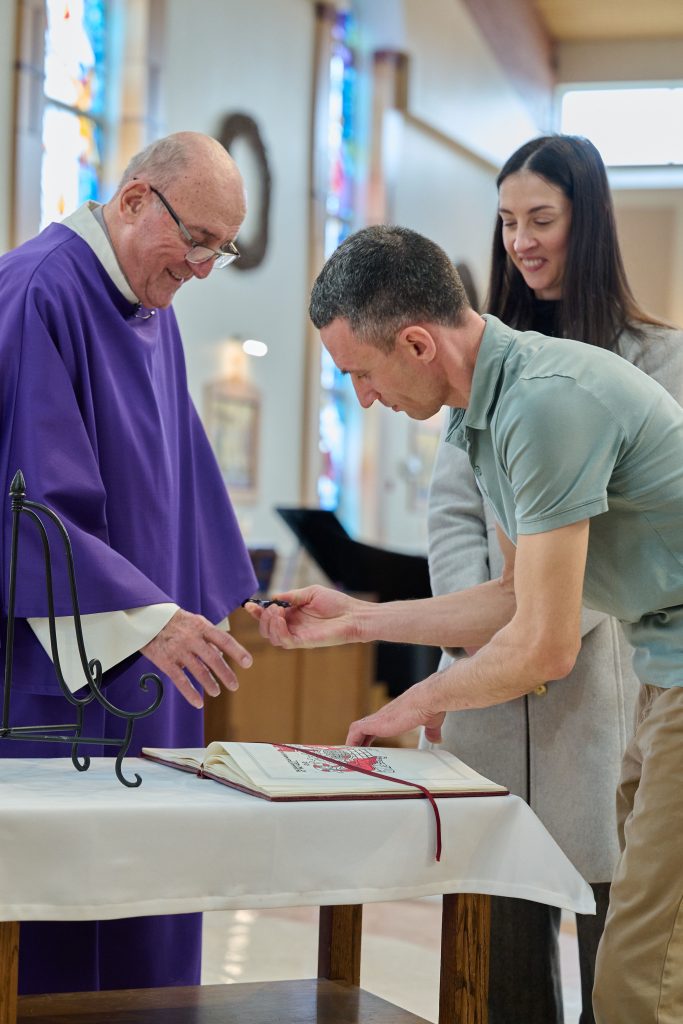
The key moments of the Rite of Election are the affirmation by the sponsors who testify to preparation and worthiness of the catechumens and the act of admission or election by the bishop. The Rite also includes the official enrollment of names of those seeking Baptism at the Easter Vigil. They publicly request to receive the Sacraments and their names have been previously recorded in the Book of the Elect.
In the homily he prepared for the Rite of Election, Bishop O’Connell asked the catechumens to reflect on a name “that now begins to shape your identity in a profound and lasting way: Christian … Catholic Christian.”
“To be called a Catholic Christian means you have discovered a light brighter than anything the world can offer – a light that pierces every darkness,” the Bishop wrote.
“It is the Light of Christ, the grace he pours into your life, the hope that strengthens you, the power that turns sin into forgiveness and death into life. Believe in his name. And you will be saved,” the Bishop said. “My dear catechumens – my dear elect – remain in his love. Let your new name, Catholic Christian, be your strength.”
‘Here I am, Lord’
There are many reasons why a person decides to become Catholic. Perhaps the idea was sparked by a conversation they had about the faith with a relative, friend or colleague. Maybe it was visiting a Catholic church for a wedding or a funeral Mass they found particularly moving. Perhaps, they heard a journey of faith story and realized that they too wanted to have Christ in their life and to be a member of his Church.
Madison Bratton, an elect in St. Gregory the Great Parish, Hamilton Square, shared that for most of her life, she knew very little about religion.
That changed, however, when she met her boyfriend, Andrew, who, as she put it, “represents what being a Roman Catholic is.”
It was through Andrew’s example that led Bratton to enroll in the parish’s OCIA process last fall. The more she learned about the Catholic faith, the more inspired she became by its richness. She added that learning about God’s never-ending love and forgiveness was something she found most meaningful.
“Before, it was very difficult for me to find the courage to forgive myself and others,” Bratton said. “Through my OCIA journey, this has become easier for me.”
Anyone who is considering becoming Catholic should enter the OCIA with an open mind, she recommended.
“Trust in God’s Word and have faith,” she said. “Life becomes more positive with God in it.”
John Czechowski, an elect in St. Mary of the Lakes Parish, Medford, recalled that while growing up in Philadelphia he was vaguely familiar with the Catholic Church. His mother was raised Catholic, but he had never really been exposed to the faith.
Years later after he married his wife, Jennifer, a lifelong Catholic, Czechowski wanted to raise their two children, Ryan and Emma, as Catholics.
“I always wanted God to be part of my kids’ lives,” he said.
Fast forward to early 2025 when Czechowski had his own conversion experience. He began struggling with crippling back pain and in desperation he reached out to God for help.
“I got down on my knees, grabbed the Bible my wife had given me for Christmas, and truly prayed for the first time in my life,” he said. Hours later he experienced what he referred to as nothing short of a miracle when his back pain completely subsided.
“I promised God at that moment that I was finally going to become Catholic,” he said. He enrolled in the OCIA and the experience has been “amazing,” he said. He added that it’s heartening to know that when he is baptized, he will be cleansed of all his previous sins and he’ll be able to begin his new faith life with a clean slate.
In St. Isaac Jogues, Marlton, Rich Sin is an elect while his wife, Mila, is a candidate.
Though he attended a Methodist church with his grandmother every Sunday as a child, by the time he reached his 20s, he strayed from the faith.
After Rich and Mila married, they attended a Presbyterian church with their now 12-year-old daughter, Victoria. But the couple experienced theological disagreements with the church, leading them to search for a new faith community.
When the Sins welcomed their son, Christopher, in 2024, Mila began making arrangements to have him baptized Presbyterian. However, Mila had, what she and Rich described, as an encounter with the Lord.
“My wife heard a voice way to her, ‘Why would you go where I haven’t called you?’” Rich said. Mila, without a doubt, knew she was being called to the Catholic Church.
Mila was ready to join the OCIA in St. Mary of the Lakes Parish, Medford, but Rich was skeptical. He decided he “wanted nothing to do with the Catholic Church,” and he researched whatever information he could use “to debunk Catholicism.”
“I wanted to prove to my wife that she was wrong,” he said. With time and the more Rich learned about Catholicism, however, it became clear “that I had to become Catholic,” and he also joined the OCIA. Eventually the couple transitioned to the OCIA in St. Isaac Jogues Parish and it’s been a process that both have found fruitful.
Mila, who will be confirmed and receive First Eucharist at the Vigil, said, “The Catholic faith is so rich and this journey has been so impactful to me.”
The OCIA Journey
The Order of Christian Initiation of Adults is the Catholic Church’s official process for preparing individuals who wish to join the faith. The process is a ministry within a parish and it may also be offered in other settings such as Catholic schools, college campus ministries and military bases.
OCIA participants come from a variety of faith experiences. Those who have never been baptized are called catechumens who prepare to receive the Sacraments of Baptism, Confirmation and First Eucharist. The OCIA is also for persons who are baptized in another Christian faith tradition and those who were baptized Catholic but had never been confirmed or received first Holy Communion. They are called candidates.
The OCIA is a process of study, exploration, faith-sharing and faith formation with specific liturgical rites that seekers go through before committing to become Catholic. They attend sessions to learn about the beliefs and teachings of the Church; they get to know other Catholics in their faith communities, and they meet other people who, just like them, are exploring the idea of becoming Catholic.
The OCIA includes four periods of formation:
Evangelization and Pre-Catechumenate: the time participants become familiar with the faith.
Catechumenate: the time of learning and formation that includes studying the Scriptures, tradition and doctrine of the Church and learning to pray. Participants are encouraged to get involved in parish life.
Purification and Enlightenment: occurs during Lent where participants reflect on their faith experience more intensely as they prepare to receive the Sacraments at the Easter Vigil.
Mystagogy: the time for the newly initiated to reflect on their experiences as new Catholics.