
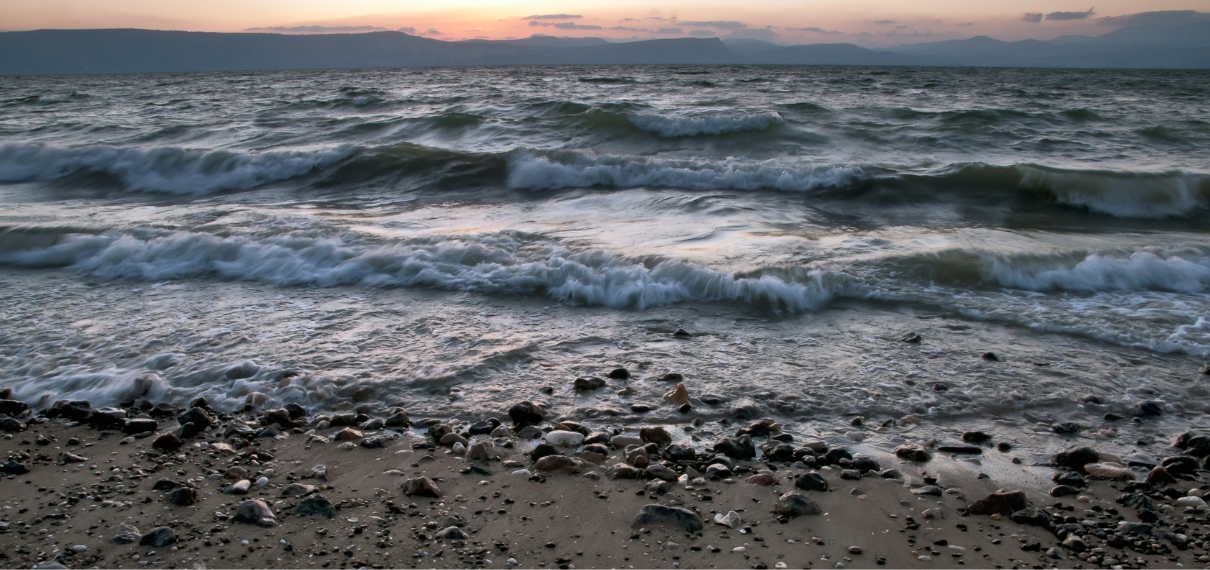
Top photo caption: Sea of Galilee, Getty image
Gospel Reflection for August 9, 2026, Nineteenth Sunday in Ordinary Time
Having just fled the threat against his life made by Queen Jezebel, Elijah fled to Mt. Horeb, awaiting revelation from God. The inner turmoil he experienced is reflected in the tumult around him: a great storm**;** an earthquake**,** and a flume of fire. It was only in the stillness of silence, and in a small whispering sound, that he knew the presence of God.
From there, Elijah received the commission to return to Israel, and to continue the line of prophets there by casting the mantle upon Elisha who would succeed him.
After the multiplication of the loaves, the disciples sailed on Lake Tiberius to return to Capernaum. They became uneasy and frightened as they were being tossed about in a night storm on the Sea of Galilee. Then, at first afraid they were encountering a ghost, Jesus came to them walking on the water, allaying their fears.
Peter, usually impetuous, has a key insight, but is still filled with doubt. His plea: “Lord, if it is you, command me to come to you on the water.” The “if” is his downfall. While Jesus does indeed beckon him to come forth onto the water, Peter is unable to sustain his faith, and quickly begins to sink. On his own, he could not manage the unimaginable — that he was actually walking on the water.
The lesson for us becomes very clear.
Our lives are filled with tremendous ups and downs. We all experience great joy in our lives, but all of our joys are tempered with loss, grief, pain, and illness. Some of our challenges are genuinely tragic. The impact of war, starvation, natural disasters, and human indifference on the lives of the innocent and the weakest members of society**,** leads many to doubt, and causes others to lose their faith entirely.
Like Peter, our expectations can get in the way. The often cited theodicy problem — why does an all good and all powerful God endure, permit, or perhaps even cause suffering — poses a significant challenge for many.
Many people wonder where God is in the midst of their struggles, yes, but also in the ordinary experiences of life.
Often, especially when someone is struggling with direction or discernment of the will of God for their lives, people look for signs: “If this happens, then I know what God wants me to do.” Then, when the sign occurs, we seek further validation through another test. When the sign does not occur, then either God has a different plan or I need to devise a different test.
We would all like to have the revelation of Moses — an encounter with the burning bush; or the apparition of the Angel Gabriel telling us what God wants us to do. Yet, we do not have those experiences.
Instead we have those quiet moments.
The internal burning desire that leads us to a deeper understanding of God’s will. The offhand comment from someone — a friend or even a stranger — who often unknowingly stands as a prophet for us. Sometimes we are in the right place at the right time, and the circumstance itself is God’s message to us.
Like everything else, we can miss them or overlook them. Elijah was shocked that the manifestation of God to him was the subtle whisper and not the mighty wind or earthquake. The internal realization of God’s will for him gave him the mission and the courage.
Peter was surrounded by the storm and rocky sea, but the assurances of the Lord did not fully allay his fears or strengthen his faith. His mission was not yet clear to him. He had more to learn at the feet of Jesus.
There is no shame, then, in the struggle. We all have the Elijah moments and we all have the Peter moments. We just need the wisdom, the guidance, and the courage to experience and understand them.
The Lord calms the storms of our lives in silence, but often we are searching for the majestic.
Father Garry Koch is pastor of St. Benedict Parish, Holmdel.