By Rhina Guidos | Catholic News Service
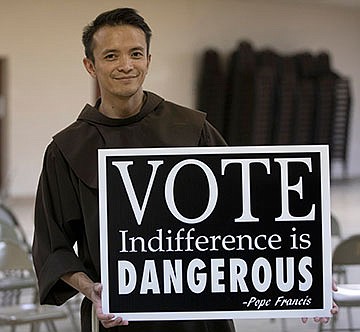
WASHINGTON – Just before the polls opened on Election Day on the West Coast, the Franciscan friars of the Province of St. Barbara in California tweeted a photo of Brother Sam Nasada in a brown habit holding a sign, imploring others to vote, using a quote from Pope Francis: “Indifference is dangerous.”
Religious groups such as the Franciscans in California were not the only ones urging voters to the polls during this year’s Nov. 6 midterm elections.
Months before the election, the Sisters of Mercy of the Americas used social media to encourage Americans to register to vote and on Nov. 6 provided polling information for different states online while encouraging those casting ballots to “Vote with Mercy.”
It’s hard to gauge just how much influence religious groups had on voter turnout, but many preliminary estimates released the day after the election said more than 113 million votes were cast – the highest turnout for a midterm election since 1966, said a report from the U.S. Election Project.
Preliminary analysis on how religious groups voted in the midterm elections released Nov. 7 by the Washington-based Pew Research Center showed that while many Christian denominations backed Republicans by large margins, Catholic voters remained almost evenly split between the country’s two major parties. Pew’s preliminary data showed that, of Catholics voting in the midterms, 50 percent voted for Democrats and 49 percent voted for Republicans.
E.J. Dionne, a columnist for The Washington Post, who is Catholic and has studied the relationship between religion and politics, also was on the panel.
“I am coming to the conclusion at this moment in history that religion . . . is often given as a reason but it’s actually a rationale … people are voting their identities and dressing them up in the decent drapery of religion,” he said during the panel.
He referenced the 2016 PRRI poll that show the difference between white Catholics and Latino voters in voting for and against Trump. “A very substantial majority of Latino Catholics voted against Donald Trump and for Hillary Clinton. That would suggest to us that there was not a particular Catholic thing going on there,” Dionne said. “They were voting other aspects of their identity.”
But he said Catholicism can exert a force on the views of people on both sides of the political spectrum.
What this political season has shown is that religious groups made a major effort in organizing their flocks, by mobilizing people to vote for their values, forming coalitions with other denominations in areas where they agreed and participating in big and small events attended by religious leaders seeking to persuade religious voters on certain issues, Rebecca Linder Blachly, director of government relations for the Episcopal Church said.