
By Deacon Joseph M. Donadieu | Special Contributor
What do you say to a saint – or someone you believe will someday be declared a saint?
I don’t know. I didn’t know then, and I still don’t know.
In 1988, my wife Phyllis and I visited India for about three weeks with a dear priest friend from India. Three years earlier, we had met Father Francis when he was assigned for several months to a parish in the Trenton Diocese. Unfortunately, he died Sept. 10, 2001, in an auto accident on his way to a Catholic village where he was going to explain a sponsorship program to parents of children in the nearby Catholic school.
Our visit to India was very much like a pilgrimage. We visited Catholic parishes, schools and institutions from Madras to Hyderabad and its environs, and were to end our visit in Calcutta (now known as Kolkata).
Of course, not everything goes as planned. We were to fly from Hyderabad to Kolkata in the late afternoon, but the Pakistani president had been killed in a plane crash, and the Indian government commandeered most of the planes in Indian Airlines to transport public officials and media to the funeral in neighboring Pakistan.
Because of the disruption in schedules, our late afternoon flight didn’t take off until after midnight. As a result, we arrived in the middle of the night.
By the grace of God, the Indian priest who was to accompany us on our return flight, and was returning to an assignment in the United States, was also delayed and, to our minds, arrived in timely fashion to rescue us from being lost in an unfamiliar place.
On our way to the hotel, we saw the city come alive with the dawn: people coming out to bathe at the hydrants in the streets, shop-owners rushing to open their store front stalls, and people of the street going into the city dump to scavenge.
Following a few hours of sleep, we met June, who was to be our guide for a tour of the historic city. She had been one of Mother Teresa’s students during her school days. After a couple hours of touring, she asked if we wanted to meet Mother Teresa, and we started off to the motherhouse of the Missionaries of Charity.
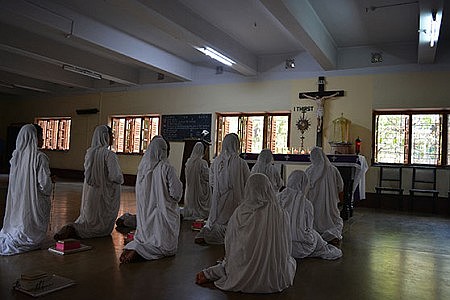
As we awaited Mother Teresa’s arrival for lunch, June gave us a tour of the motherhouse. Most impressive was the chapel on the second floor: 90 feet wide and 40 feet deep, with an altar in the middle; a slate floor on which the sisters kneel and sit during Mass, Adoration and times of prayer and meditation; casement windows on three sides overlooking the busy streets below (during our visit there was a labor demonstration going on in the street). Next to the altar was a four-foot statue of Our Lady of Fatima standing atop a gauze-wrapped circular table.
At some point, June started opening and closing closet doors with a sense of frustration. “Where is that bird?” she said. Finally, walking over to the statue of the Blessed Virgin Mary, she pulled aside the gauze and there, on the floor, was the Nobel Peace Prize (with its iconic image of a dove) that had been awarded to Mother Teresa in 1979.
What the world considered an outstanding achievement, Mother Teresa set aside as a distraction from more significant realities: Jesus in the Eucharist, the Blessed Mother and the poorest of the poor.
With word that “Mother is on her way,” we hurried downstairs to the entrance. Just two weeks earlier, Mother Teresa had cataract surgery and was still experiencing headaches, so when she stepped out of the car and walked toward the entrance, she was wearing sunglasses.
June introduced us as visitors from the United States, and then it was up to me. But what do I say? How are you doing? What’s your favorite color? What can you tell me about your spiritual life? Who has had the greatest influence on you?
I was tongue-tied! I think I mumbled something about admiring her work. Then I did something that was probably more articulate than anything I might have uttered. I reached out, took her hands in mine and kissed them.
Deacon Donadieu, retired editor of The Monitor, is assigned to Sacred Heart Parish, Riverton.