Story by Jennifer Mauro | Associate Editor
In an effort to raise awareness to the link between prescription drugs and the rising heroin abuse rates across the country, Partnership for a Drug-Free New Jersey has designated Oct. 6 as “Knock Out Opiate Abuse Day” in New Jersey.
The event is a grass-roots, one-day campaign in which nearly 2,000 volunteers will mobilize statewide to visit physician’s offices and homes within their communities to distribute information on the relationship between prescription opioids and addiction.
“We hope this will be an opportunity to provide important health information to the medical community and the public at large that we have an epidemic,” said Angelo Valente, Partnership for a Drug-Free New Jersey executive director, citing statistics that show 40 percent of parents in New Jersey don’t understand the link between prescription pain medication abuse and heroin.
Opioids are prescribed for the treatment of pain. Medical examples of prescription opioids include hydrocodone (Vicodin), oxycodone (OxyContin, Percocet), meperidine (Demerol) and methadone.
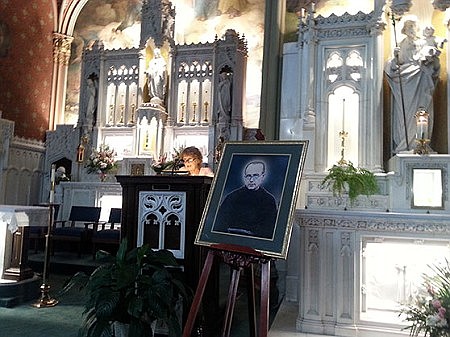
“Would you give your child heroin?” – the title of the organization’s “Before They Prescribe, You Decide” campaign – was also the question Valente put before the crowd that gathered Aug. 16 in St. Peter Church, Point Pleasant Beach, to learn about the prevalence of drug abuse among young people. “Because prescription drugs and heroin have the exact same components.”
Valente visited the parish at the request of Dorothy O’Reilly, president of the parish’s Altar-Rosary Society and a Secular Franciscan from the St. Maximilian Kolbe Fraternity. The evening event opened with a prayer in commemoration of the feast of St. Maximilian Kolbe, patron saint of drug addicts, and led into a presentation based on current research showing the dangers prescription opioids pose for children and young adults, specifically.
“This really is the No. 1 public health issue in our country,” Valente said. “We’re talking about a sensitive subject that’s impacting our children and grandchildren.”
During his presentation, Valente cited statistics finding that 50 percent of 12th-grade students admit to using illicit drugs in their lifetimes. Nearly one in five admitted to using a prescription drug non-medically.
“Young people just don’t understand the consequences,” Valente said. “Teenage brains continue to develop into the early 20s. Heroin impacts the way the brain functions and builds a dependency and addiction.”
““We are facing a prescription drug epidemic,” he said. “This affects people across all demographics. There’s no community spared from this disease.”
According to the Centers for Disease Control and Prevention, most opioid prescriptions were abused when they were obtained from a doctor. Since 2000, there has been a 200 percent increase in the number of deaths involving opioids; those who use prescriptions are 40 times more likely to move on to heroin.
Adding to that problem, Valente said, is that many parents are unaware that there are alternatives to prescription opioid pain relievers. Research shows that 40 percent of parents walk into a physician’s office not understanding the medicinal link to heroin abuse; one in three New Jersey parents of middle school children don’t think there is a connection between sports injuries or dentist office prescriptions and heroin abuse in the state.
Eileen Salsano, of St. Martha Parish, Point Pleasant, sat in a pew with St. Peter parishioner Debbie Kennedy, concern crossing their faces as they discussed the sobering statistics after Valente’s presentation. Salsano said the increasing number of addictions frighten her as a parent.
“When my children were in high school, they lost friends to drugs. So it’s touched home in a lot of ways,” she said.
Kennedy is the mother of four children, ages 16 to 22. She said three of her children recently had their wisdom teeth removed. “The doctor prescribed oxycodone. I filled the prescription, but I didn’t use it,” she said.
O’Reilly said she thought it was fitting for the Altar-Rosary Society to invite Valente to speak.
“Here we are meditating on the mysteries. What does that do? It leads us into action,” she said. “The program really seemed like part of Blessed Mother’s mission to go out and love thy neighbor. It seems everyone knows someone struggling with addiction.”
Valente is hopeful the “Knock Out Opiate Abuse Day” will bring awareness to the addiction issue, especially among physicians.
“The medical community is coming to the conclusion that they need to change the way opiates are prescribed. We believe most doctors understand this issue and want to do the right thing,” he said.
Anyone wanting to volunteer for “Knock Out Opiate Abuse Day” can visit Partnership for a Drug-Free New Jersey at http://drugfreenj.org/knockoutvolunteers.
For more information on drug abuse, visit http://www.drugfreenj.org/drug-encyclopedia/heroin/