
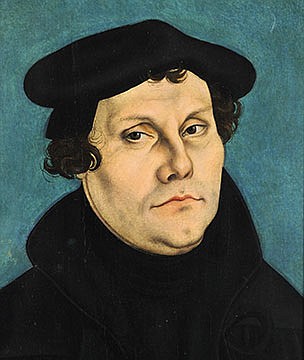
By Joseph F. Kelly |Catholic News Service
Martin Luther (1483-1546) was a German monk of the Order of St. Augustine. He was a biblical scholar and a successful preacher. He taught at a university and had a pastoral assignment as well. This latter assignment helped him to become a famous homilist.
For much of his life he worried about his personal salvation, and he did not find the theological traditions of the Catholic Church, including indulgences, to be satisfactory to explain salvation. He concluded that only God could justify a sinner and that the traditional Catholic methods of preaching salvation were insufficient.
He finally concluded that humans were saved when God justifies them and that traditional religious formulas like indulgences and grace gained via the sacraments would not do. People were justified through divine grace given directly by God.
Luther knew that he disagreed with most if not all Catholic theologians on this point, and he needed a methodology to justify his conclusions. He decided upon “Scripture alone,” that is, he would accept as his method what could be found in the Bible and there alone.
“Scripture alone” could not work for Catholics because church authorities, from Rome down to the parish level, accepted Scripture but only as interpreted by leading theologians, such as the Scholastic scholar Thomas Aquinas (1225-1274) in the universities and theological schools. Also, there were centuries of papal teachings that also had to be included on this topic.
Luther hoped to explain his views via a theological debate, which usually meant two or more theologians would debate religious theses. On Oct. 31, 1517, Luther tacked on the church door in Wittenburg a list of 95 theses that he would debate if any other theologian would take up his challenge.
But a debate would never take place because in that era there was no separation of church and state. To threaten one was to threaten both. The civil authorities became concerned about Luther’s views, not because of their theology but because if he challenged the church, he was challenging them.
Luther soon found himself both excommunicated and an outlaw in the Holy Roman Empire who frequently had to hide. But a sympathetic nobleman, the elector of Saxony, protected him, even though both the elector and Luther realized how dangerous the situation was becoming. The Holy Roman Emperor labeled Luther an outlaw and one possibly subject to the death penalty, a charge that haunted his life.
But Luther’s views were spreading in Germany, and the number of his followers grew. Luther had a great pastoral sense, and he wrote some marvelous sermons and also hymns. But perhaps his greatest step was to translate the New Testament into German because he felt it would show that the Scriptures make no reference to sacraments or indulgences or the papacy.
To be sure, Catholic theology has always accepted the development of doctrine and not a simple adherence to the Bible, but Luther’s translation was a sensation and won over many to his cause. Even some Catholics purchased his Bible so that they could read the scriptural texts. The popularity of Luther’s translation forced the German bishops to authorize an approved Catholic translation.
By the 1530s it was becoming clear that the schism in Germany would persist. Significantly, other reformers appeared, such as Luther’s associate Philip Melanchthon, the Swiss preacher Ulrich Zwingli, and the French theologian John Calvin. All called for reform of the church and broke away from Roman Catholicism. Even a non-theologian, Henry VIII, king of England, broke off from Rome. The split in the church would not be healed.
One minor event would have a significant future. In 1529 some followers of Luther and other dissidents demonstrated against the Holy Roman Emperor, who referred to the dissidents as “those who are protesting,” which in Latin is “protestantes.” The name caught on and then stuck for good — Protestants.
Later on Luther married and had children; his writings about family piety have long been considered as guidelines for German Lutherans.
Many practices that Luther introduced were adopted, although much later, by Roman Catholics, such as the liturgy in the vernacular, a product of the Second Vatican Council (1962-1965).
Luther was a remarkable man who risked his life for what he believed to be the truth. For centuries Catholics considered him a heretic at best and a resident of hell at the worst.
To be sure, the church still does not accept his basic teachings, but Catholics, including church authorities, do recognize that the church in the 16th century needed reform. They, of course, lament that Luther’s reform led to a break up. Indeed, many Catholic reformers hoped to effect change in their traditional beloved, church but Luther’s movement forced the issue before the reformers could do much.
People have joked that Catholic ecumenism will some day produce a St. Martin Luther. Not likely, but modern Catholic scholars and ecclesiastics acknowledge that Luther was not the unvarnished villain of traditional Catholicism and that he and his work deserve an open, honest evaluation.
Joseph F. Kelly is retired professor at John Carroll University in University Heights, Ohio.
Ecumenical dialogue: Steps of development
By Kurt Jensen | Catholic News Service
Martin Luther’s Reformation may be the only ongoing 500-year-old argument on earth.
The theological split inevitably looks to be permanent. Yet, reconciliation between Catholics and Protestants has taken place, in small steps, beginning in the years after World War II, accelerating with the Second Vatican Council, and culminating with 1999’s Joint Declaration on the Doctrine of Justification, which asserted “a common understanding of our justification by God’s grace through faith in Christ.”
“Certainly Catholics and Protestants have made major progress in agreement on the nature of justification by faith,” says Michael Root, a professor of systematic theology at The Catholic University of America, who was a member of the drafting team for the 1999 agreement. “It wasn’t until 1948 that Catholics and Protestants were officially allowed to pray together.”
“If we only look at the question of justification, then we’ve made major strides. There’s also continuing ecumenical dialogue on the presence of Christ in the Eucharist and the nature of baptism. So there’s significant progress.”
But Root thinks it’s also being derailed by conflicting beliefs over some moral issues. “There’s been no way to move forward on those, but you can’t predict when things can change.”
He remembered the last-minute intervention of Cardinal Joseph Ratzinger (later Pope Benedict XVI) on the joint declaration. “Particularly at the last minute, when everything look stuck, he got it unstuck.”
Several issues remain in the way of creating a common church life. “The matter of the sacraments remains unresolved,” Root observes. “It’s hard to move our communion closer together in the actual day-to-day practice.”
Msgr. John Radano, who teaches theology at Immaculate Conception Seminary at Seton Hall University and wrote a book exploring the centuries-long history of the relationship between Lutherans and Catholics in 2009, remains an optimist.
“I think part of the tragedy of the Reformation was because we were separated and couldn’t really talk about that very much,” he says. “I think we have entered into a new era.”
One area of agreement he’s noticed: “A divine inspiration is made up of human beings. Because human beings are sinners, there’s a continual need for reformation in the church. We can say that as Catholics.”
He also points to last year’s joint prayer service between Pope Francis and Bishop Munib Younan, president of the Lutheran World Federation: “A very, very important development. It shows that the dialogue of the last 50 years, since Vatican II, has been productive. Now we have to go from there.”
Jensen is a freelance writer.
Scripture, no longer a divider of Christians
By David Gibson | Catholic News Service
Future church historians will explain to my great-grandchildren how an age of dialogue arose during the 20th and 21st centuries, displacing the hostile, suspicious age of polemics that for 400 years shaped relationships between Catholics and members of the Reformation churches.
Divided Christians during the age of polemics shied away from examining faith together or remembering that Scripture constitutes a shared treasure.
The Bible became a point of contention.
Martin Luther, known as the Reformation’s 16th century founder, taught that Scripture is the paramount standard for church teaching. The Reformation maxim “Scripture alone” (“sola Scriptura”) came to reflect this conviction.
Catholics and Luther’s followers increasingly found themselves at loggerheads over this. While Catholics insisted that church tradition and Scripture must work hand in hand, Luther’s followers feared that tradition coupled with church authority risked abuses.
Defensive oversimplifications and misunderstandings peppered the age of polemics. Ordinary Catholics and Lutherans for centuries knew little about each other’s beliefs.
Some Catholics suspected that Luther’s accent on Scripture fostered an arbitrary, individualized faith. Some Lutherans doubted Catholics ever heard or read Scripture.
But let’s fast-forward to later times when dialogue and efforts to understand the Reformation and Counter-Reformation more accurately began opening windows in the walls dividing Christians.
Consider the 1998 Catholic-Lutheran World Federation Joint Declaration on the Doctrine of Justification. How did Catholic-Lutheran dialogue leaders manage to agree for the most part that little divided them in Luther’s teaching that God saves Christians through faith and not through merit on their part?
Moreover, this dialogue largely agreed that Christians naturally should express Christian faith through good works.
Lutherans and Catholics “together listened to the good news proclaimed in Holy Scripture,” the declaration explains. This led to a “shared understanding.”
So, divided Christians in the age of dialogue did something they tended not to do in the age of polemics: listened together to Scripture.
Here the Second Vatican Council was hugely influential among Catholics. Its 1964 Decree on Ecumenism welcomed the “love and reverence” for Scripture witnessed among other Christians. Its Dogmatic Constitution on Divine Revelation stressed that Scripture must nourish and regulate all Catholic preaching.
Scripture study groups popped up in Catholic parishes everywhere after the council.
In 1983 the international Roman Catholic-Lutheran Commission acknowledged that “elements of Luther’s concerns” are reflected in Vatican II’s documents, including his emphasis on Scripture’s “decisive importance” for church life.
Together with gratitude for Luther’s contributions, the statement said that Lutheran churches today are “aware of his limitations in person and work.” In citing Luther’s important strengths, it noted how he “directs us to the priority of God’s word.”
Not every troublesome question for Christians of differing denominations is confined yet to history’s annals. Pope Francis and Bishop Munib Younan, president of the Lutheran World Federation, prayed in a 2016 joint statement for healing of “the memories that cloud our view of one another.”
But these leaders affirmed that “while the past cannot be changed, what is remembered and how it is remembered can be transformed.”
Gibson served on Catholic News Service’s editorial staff for 37 years.
FOOD FOR THOUGHT
Martin Luther significantly influenced German hymnody. Contemporary Catholics would recognize and be able to join in song to hymns such as “A Might Fortress Is our God” and “Away in a Manager.”
Luther had a lifelong love of music. Born in to a musical family, he learned to play the lute and to write tablature, a form of musical notation, and he understood both the theory and practice of music. As an Augustinian monk, he learned the musical form of the Book of Psalms and the hymns in the Liturgy of the Hours.
Luther once said, “I have always loved music; I would not for any price lose my little musical power. It drives away spirit of melancholy, as we see in the case of King Saul. By its aid a man forgets his anger, lust, and pride, and expels many temptations and evil thoughts.”
Luther’s hymns express his theology. The simple lyrics made the Gospel visible and accessible to worshippers in their churches and homes. He composed more than 30 spiritual songs, setting the Psalms to music, adapting Latin hymns and translating Latin text into German.
“Music is a gift of God; it awakens and moves me so, that I preach with pleasure,” Luther said.