
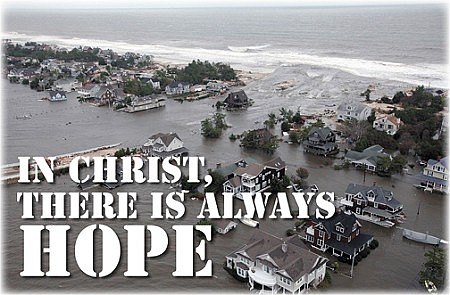
The relentless 48-hour assault waged by Hurricane Sandy against the Mid-Atlantic shoreline in October’s last days brought high winds with gusts as strong as 95 miles an hour and a devastating storm surge and high tides, often accompanied by driving rains. The storm carved a swath of destruction throughout and beyond the four counties of the Diocese of Trenton, leaving more than 100 persons dead and as many as 40,000 homeless, costing billions of dollars in damages and casting millions of residents into the cold and dark with power outages that stretched over more than a week.
But in the Diocese of Trenton, whose two shore counties — Ocean and Monmouth — suffered some of the worst devastation, the Catholic community answered back in faith and solidarity, mobilizing hundreds of thousands of its members into relief work on behalf of the victims and coming together to proclaim their unwavering belief that there is always hope with God.
Even as their own power was gone, communications crippled and staffs suffering staggering personal losses of homes and property, dozens of shore parishes opened their doors to serve as shelters from the storm, to share food and warmth where it could be found, and to partner with groups like the Red Cross and local fire departments to collect desperately needed items for local residents. Across the diocese, parishioners responded in countless grass-roots ways to the needs of residents in their local communities who were trying to stay warm, fed and dry.
Out in Lawrenceville, near the diocese’s western boundary, the Chancery had lost power through the storm and was only able to resume operations Nov. 2. The day was spent trying, and many times failing, to reach the shore parishes by phone in order to assess damages and determine their needs.
By mid-afternoon Bishop David M. O’Connell, C.M. had established a diocesan hurricane relief effort and called for the establishment of diocesan distribution centers in parishes and Catholic social service installations to provide people most seriously impacted by the storm with the resources they need to survive in the short-term and begin to explore what will be needed in the long-term. Bishop O’Connell directed that a diocese-wide collection will be held at all Masses Nov. 17 and 18 to raise money for the relief effort.
The most definitive answer to Sandy’s wrath occurred Nov. 4, the first Sunday morning after the storm, when the faithful overcame the limitations of gas shortages, roads blocked by debris and downed trees and wires, and dangerous intersections with nonworking traffic lights, to reach the nearest open church for the celebration of Mass. By the tens of thousands they filed into cold and nearly dark churches that were lit only by candles and generator-borne spotlights, and warmed solely by their own body heat.
From Day One of the recovery, Bishop O’Connell was present to his traumatized flock, visiting as many priests and churches in area that had become known as “Ground Zero” as he was permitted to during a tour escorted by the NJ State Police.
A few days later he was visiting hurricane relief centers in Monmouth County and he returned to the St. Rose community in Belmar Nov. 4 to celebrate Mass for the throngs who overflowed the darkened church that day.
Speaking from the bustling relief center at St. Benedict Parish, Holmdel, Nov.3, Bishop O’Connell encouraged all who were struggling with the effects of the storm’s devastation to remain calm and pledged the ongoing support of the Catholic community. He said, “God bless you, we love you and whatever we can do to help you we will.”
His recurring message to his people was that when they believe in God, no measure of adversity can destroy them. In a reflection published in this week’s issue of The Monitor, the bishop observes, “As Catholics, we humbly drop to our knees as we have so often done — in good times and in bad — to summon courage, to strengthen our resolve, to sustain our faith and to strive for that one, unshakable hope that God is with us and always will be — in good times and in bad.”
Through it all, Bishop O’Connell recognized and lauded the resilient spirit of the people he met. He marveled at their willingness to help one another, their determination to pick up the pieces and rebuild, and most importantly, their devotion to God. He recalled meeting Carol DeBartolo, president of the St. Rose Parish Conference of the St. Vincent De Paul Society, and several other women who were getting the relief effort organized in that parish. The women shared with the bishop a new saying in their little town: “Everyone’s safe. Just no power.”
Bishop O’Connell writes of women like these in his reflection, saying, “Difficult times often bring out the very best in people and that has clearly been the case along coastal New Jersey in the wake of this storm. Priests and parishioners, first responders and volunteers, community leaders and ordinary citizens, old and young alike have reached deep into their hearts and souls to care about and for one another. I believe it is the grace of our Lord Jesus Christ alive and at work in our Diocese.”