
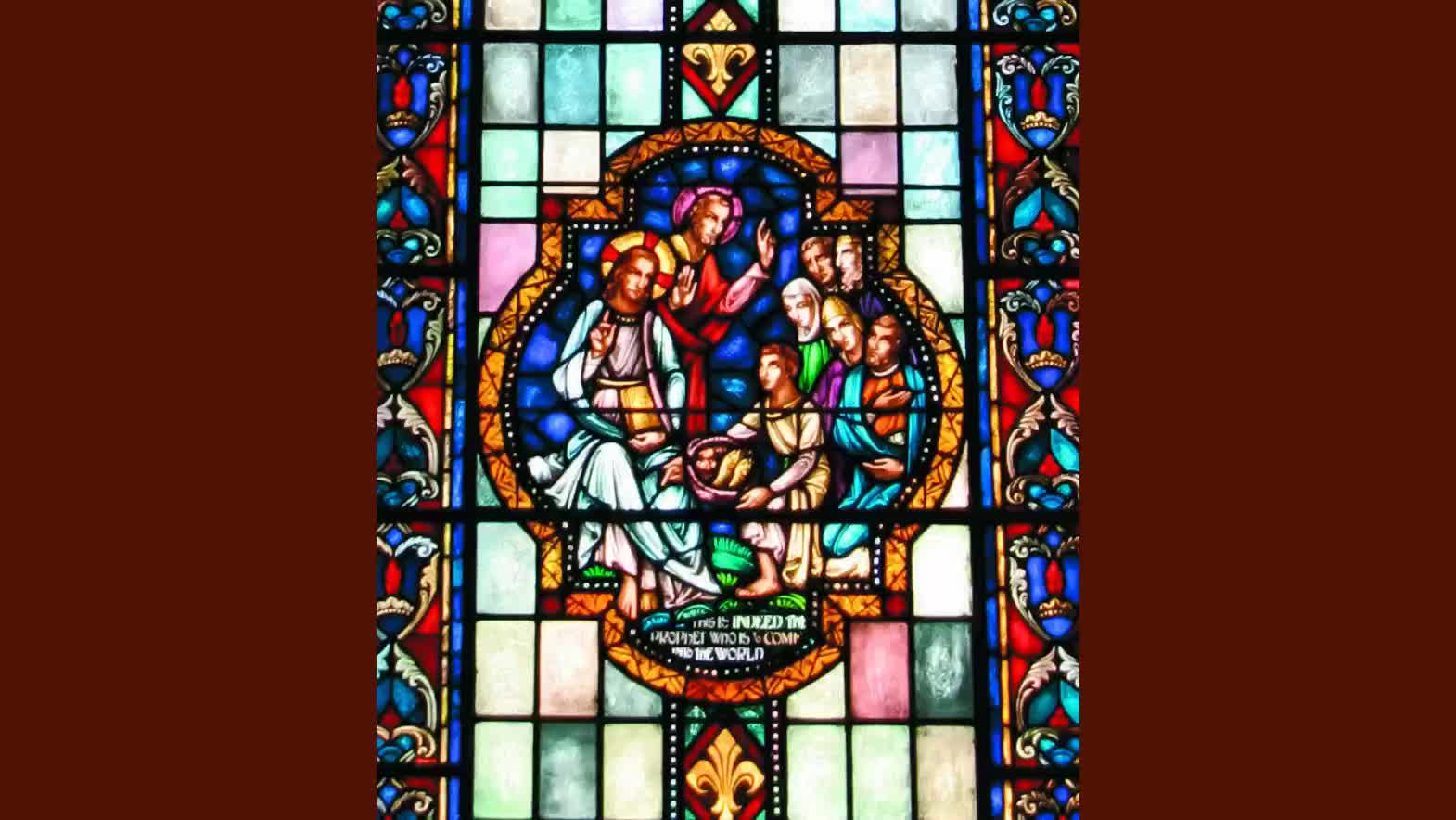
Gospel reflection for Aug. 2, 2026, 18th Sunday in Ordinary Time
The miracle that Jesus performed with the most depth of meaning, and even most frequently in his ministry was the multiplication of loaves and fish used to feed multiple thousands of people.
Although we pay less attention to it, mostly due to the familiarity of food and drink and that such usually tends to be the background to a significant event, food plays an important part in many biblical accounts. Food provides nourishment, of course, but also a context for communication, an expression of hospitality and a means of building community. Jesus taps into all of these elements, and then provides the Church with the Eucharist, which nourishes us for eternity.
We are approaching that point in Matthew’s Gospel where Jesus sets his face to Jerusalem and begins his procession to the Cross. He had just learned of the murder of John the Baptizer at the hands of Herod Antipas, and Jesus withdrew to prepare for his own Passion and Death.
A large crowd followed Jesus and, moved with pity he taught them and tended to their needs. They were lost, not that they didn’t know where they were, but they were confused by religious and political leaders who did not provide them with hope, direction or the wisdom that comes from a right relationship with God and the Law.
We do not know what Jesus taught them that day, but Jesus spent hours with this crowd. He now realized that his time with them was growing short, and he had much more that he wanted to do for them. They needed words of direction, encouragement and hope. So do the disciples standing near him. They, too, must have been struck by the murder of the Baptizer, but they did not yet come to the same realization as did Jesus about the implications of his Death.
The prophets of old, such as Isaiah, provided words of consolation and hope that their ancestors needed as they dealt with the pain of exile from their homeland and the destruction of the Temple. They struggled with hope and wondered how God would leave them to face this crisis. In the midst of that the prophet received and then spoke words of hope: “Thus says the LORD: All you who are thirsty, come to the water! You who have no money, come, receive grain and eat; Come, without paying and without cost, drink wine and milk!” The prophet offers the consolation of restoration and the plentitude of God’s table – the table of eternal life.
As the prophet had pronounced the bountiful table of the Kingdom of Heaven, so now Jesus sets this table for his followers – Jesus fed 5000 men (not counting women and children) with five loaves and two fish.
The crowd who followed Jesus to this deserted place could not help but be in awe of the work that he accomplished in their midst. He has shown them a glimpse of the bountiful blessings of God and given them a taste of eternal life.
Nonetheless Jesus knows that many in this same crowd will walk away, deny and betray him in the course of time. They may have tasted the bread of the angels but they will reject it, preferring their own bread and way of life to that which Jesus offers.
What they all know is that they were fed. It is not clear in the account that the crowd realized the miracle that Jesus had performed for them. The disciples do, but the crowd seems unaware. Jesus fed them; he met their basic needs and they ate in abundance.
This is the first time Jesus performs this miracle, but it is not the last time. Very shortly thereafter, Jesus will again feed a large crowd with a few loaves of bread and some fish.
As with everything he did, this was intentional and Matthew’s Gospel expresses this intentionality.
It is easy to note that this miracle prefigures the great miracle that Jesus leaves to the Church in the Eucharist. But we cannot then overlook the deep compassion that Jesus showed for this crowd of people in teaching them and feeding them. It is interesting that the evangelist only preserved the miracle and not the teaching of Jesus, so that the miracle itself becomes the teaching.
Earlier in his ministry Jesus taught his disciples to pray and there he used the expression — “Give us today our daily bread” while the Greek suggests not the bread we need today, rather the bread we need tomorrow. It was forward looking in perspective.
Our concern then, is two-fold. We need nourishment in this life and, like Jesus in this moment, we need to be concerned about the food for others. We provide food to the hungry. Yet, we also need the food that is necessary for eternal life – the very Body and Blood of Jesus himself – poured out and given to us in the miracle of the Eucharist. This, too, we must share in abundance with those who hunger for eternal life.
Father Garry Koch is pastor of St. Benedict Parish, Holmdel.