
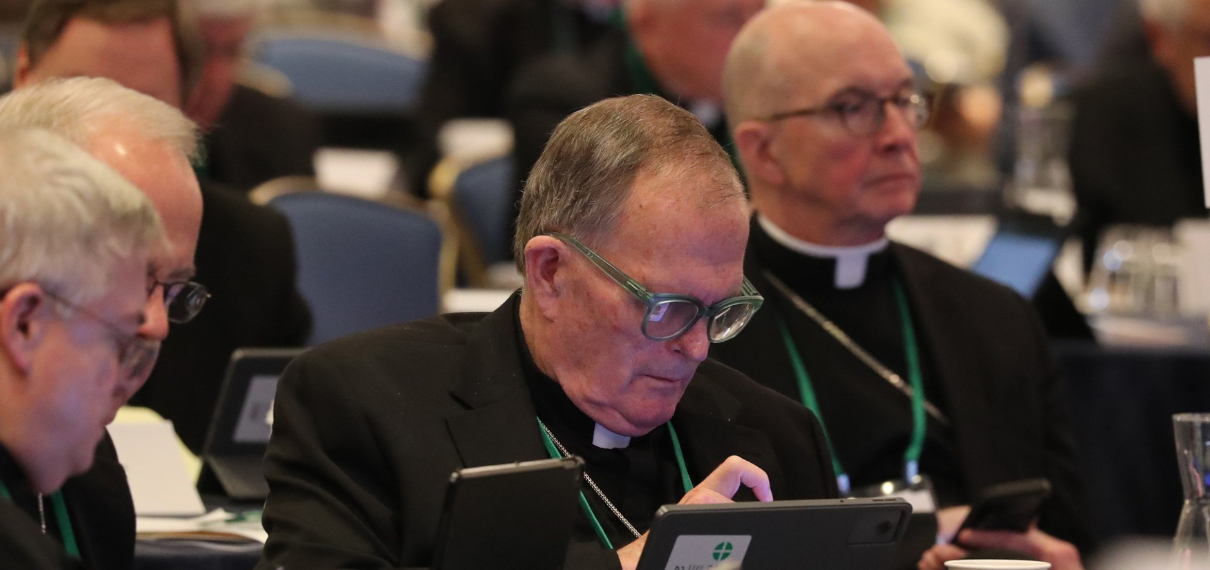
Top photo caption: Bishop David M. O’Connell of Trenton, N.J., attends a Nov. 17, 2026, session of the fall general assembly of the U.S. Conference of Catholic Bishops in Baltimore. OSV News photo/Bob Roller
By Maria Wiering, OSV News
OSV News – Communion and unity were at the crux of the messages Catholic leaders shared at the Nov. 17 opening of the U.S. Conference of Catholic Bishops’ fall plenary assembly in Baltimore.
In his address as conference president, Archbishop Paul S. Coakley of Oklahoma City called for a renewed sense of shared mission in “construction sites” central to human flourishing, while Archbishop Gabriele G. Caccia, apostolic nuncio to the U.S., emphasized the bishops’ unity with the Pope as successors of the apostles ahead of the bishops’ regional “ad limina” visits to Rome that will take place in 2027.
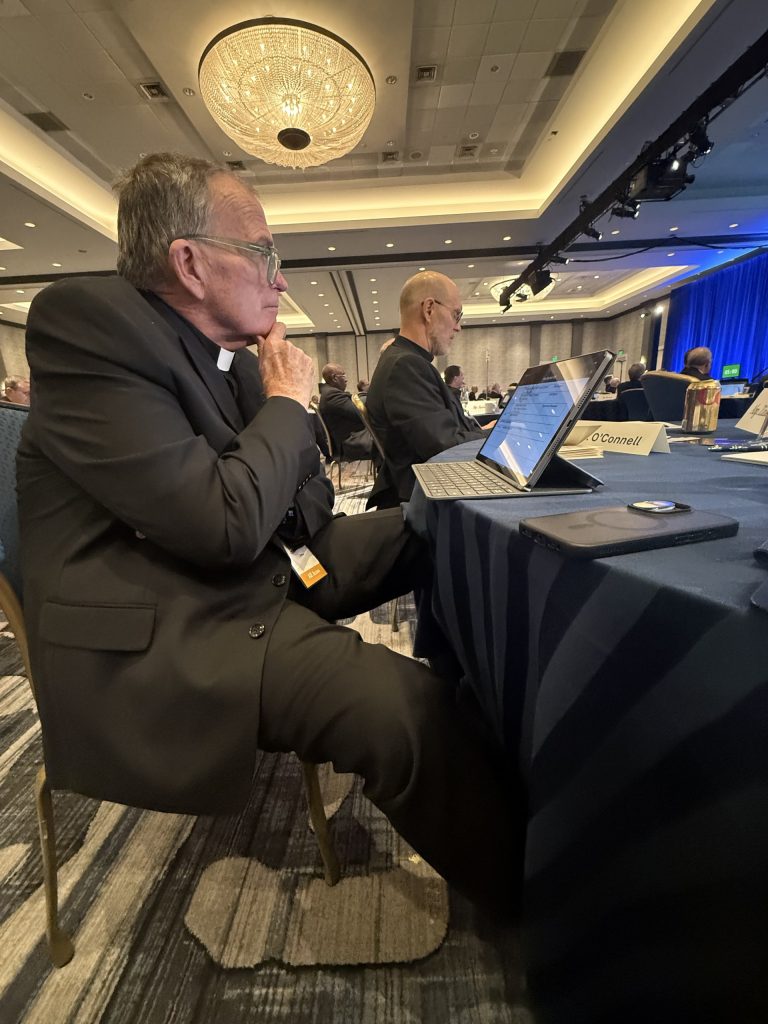
Speaking before bishops from across the country gathered Nov. 16-19 at the Baltimore Marriott Waterfront hotel, Archbishop Coakley said that the political terms and frameworks that had been applied to the recent U.S. midterm elections cannot “accurately portray the state of this Conference nor the Ch0075rch in the U.S. or the world,” even as many from within the Church use those “ideas and categories” to “interpret events and happenings in the life of the Church through political or ideological lenses.”
“And that’s the problem,” he continued. “For the world thinks in terms of power. The world sees things through a false binary logic, a world of yes or no, left or right, red or blue, either/or. But, as you know and I know, the Church thinks in terms of mission.”
– The Church’s mission –
Drawing from the image of two contrasting biblical building projects Pope Leo XIV used in his encyclical “Magnifica Humanitas” – the Tower of Babel and the walls of Jerusalem under Nehemiah – Archbishop Coakley noted that the first “is a worldly project, with worldly ambitions and leads to confusion, isolation and dehumanizing violence” while the second is “a construction site of hope.”
“That is the mission of the Church,” he said. “The mission is to make known the words of the Lord spoken through the prophet Jeremiah: ‘For I know well the plans I have in mind for you –plans for your welfare and not for woe, so as to give you a future of hope,'” quoting Jeremiah 29:11.
“To a world that is deprived of a sense of hope, where isolation, depression, confusion and anger all come into play, in such a world the mission of the Church is to act as a construction site of hope, where hope is rooted in Christ and his promise,” Archbishop Coakley said.
– Four ‘construction sites of hope’ –
The USCCB president pointed to four overlapping “construction sites” where the Church is working: rebuilding the family, worship, synodal dialogue and discernment, and civic life.
Archbishop Coakley called for efforts to promote family life through strong, sacramental marriages and pointed to the catechumenate model as a helpful approach. For worship, he praised the “varied fruits and rich results” of the 2022-2025 National Eucharistic Revival, which included the National Eucharistic Pilgrimage and the 10th National Eucharistic Congress, and said, “We need to build on that foundation with intense and intentional liturgical formation for clergy and laity alike.”
Speaking to “the rediscovery of dialogue and discernment in the synodal way,” he said, “not just as buzzwords, but authentic dialog and authentic discernment.”
“I encourage us to be about developing these skills even more carefully as we continue to walk together receiving and implementing the fruits of that recent synod,” he said, pointing to the worldwide Synod on Synodality held 2021-2024.
Regarding civic life, “the polarization, isolation and anger in our communities and even our families can only be overcome when we rediscover a shared hope,” Archbishop Coakley said. “Let us, by word and deed, show how that hope can be found in a common understanding of the dignity of human life and of each person; in a renewed appreciation of our ‘magnificent humanity’ amid the challenges and opportunities of artificial intelligence with which we all must grapple and come to terms.”
He told his fellow bishops that the state of the Church and the USCCB “is good” and called the bishops members to work together “with fraternal respect, with renewed cooperation and always, of course, with pastoral charity.”
– Bishops’ visits to Rome strengthen communion –
Archbishop Caccia, whom Pope Leo appointed as the U.S. nuncio in March, reflected on three principal moments during the bishops’ upcoming ad limina visits that “strengthen our hierarchical communion and renew our dedication to the apostolic mission.”
In those moments – the pilgrimage to the Apostles’ tombs, the meeting with the Holy Father, and the discussions with the Roman Curia – “you bring to Rome the life of your particular Churches, in each of which the one Church of Christ is present and active,” said the nuncio, who previously served as the permanent observer of the Holy See to the United Nations in New York. “Through this encounter, their gifts enrich the whole Church, and you receive encouragement for the ministry to which you will return.”
– Blessed Sheen’s example –
He encouraged the bishops to draw from the example of Blessed Fulton J. Sheen, who wrote about his own ad limina visit in his autobiography, by adopting dispositions of “humility to examine our ministry honestly, and the openness to renew the love for Christ and his Church that sustains our mission.”
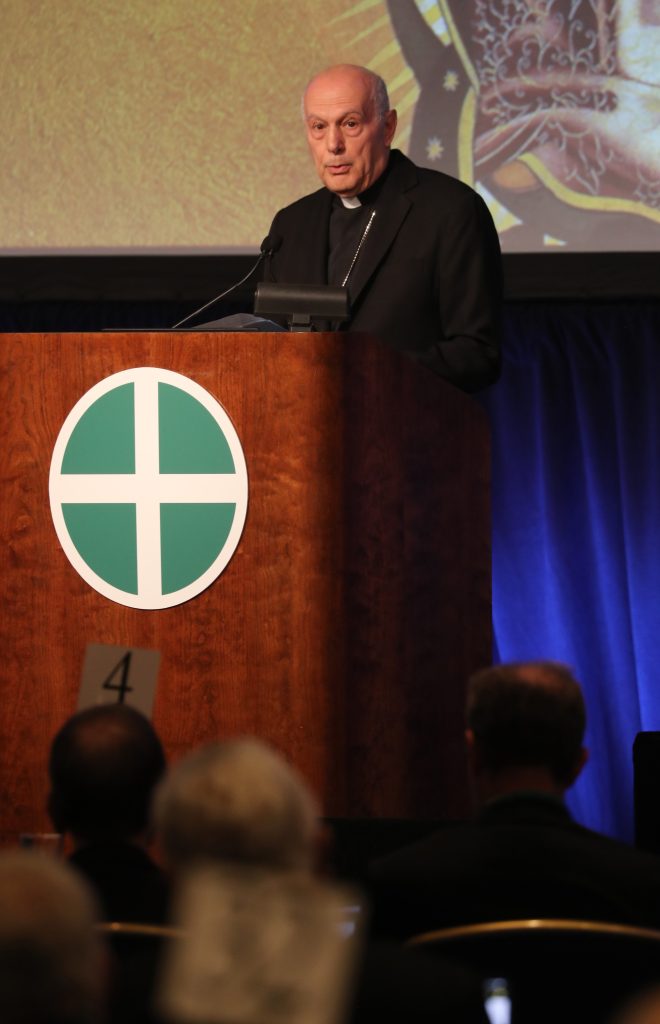
That posture should lead the bishops to reflect on their prayer practices, fraternity with his diocese’s priests and care for the poor, Archbishop Caccia said.
– Communion sustains mission –
He noted that St. John Paul II in “Pastores Gregis,” his 2003 post-synodal
apostolic exhortation on the ministry of a bishop, “compared the communion between the universal Church and the particular Churches to the circulation of blood: from the heart to the body’s extremities and back again.”
“This image helps us to see how communion sustains mission,” Archbishop Caccia said. “You come to Rome, to the heart of our visible unity, bringing the faith of your people, their gifts, hopes and wounds. Through prayer and encounter with the Successor of Peter and your brother bishops, the bonds of communion are strengthened. Then, as blood flows from the heart to nourish the body, you return to your churches with renewed strength to proclaim Christ and draw others into his life. The movement toward the heart becomes a fresh impulse for mission.”
Pope Leo’s apostolic visits, including his Nov. 6-17 visit to South America, “offer us an example of this pastoral movement: a shepherd going out to meet his people, not waiting for them to come to him,” Archbishop Caccia said.
“May his missionary example inspire us to seek those who have become distant from the Church, those who feel forgotten, and those who have yet to hear the Gospel,” he said.
Maria Wiering is senior managing editor for OSV News.
Catholic journalism is needed now more than ever. Please consider supporting this work by signing up for a SUBSCRIPTION (click HERE) or making a DONATION to The Monitor (click HERE). Thank you for your contribution.