
Top photo caption: People in Raeford, N.C., pray after viewing the body of George Floyd June 6, 2020. Demonstrations continue after a white police officer in Minnesota was caught on a bystander’s video May 25 pressing his knee into the neck of George Floyd, an African American, who was later pronounced dead at a hospital. OSV News photo/Jonathan Drake, Reuters
By Gina Christian, OSV News
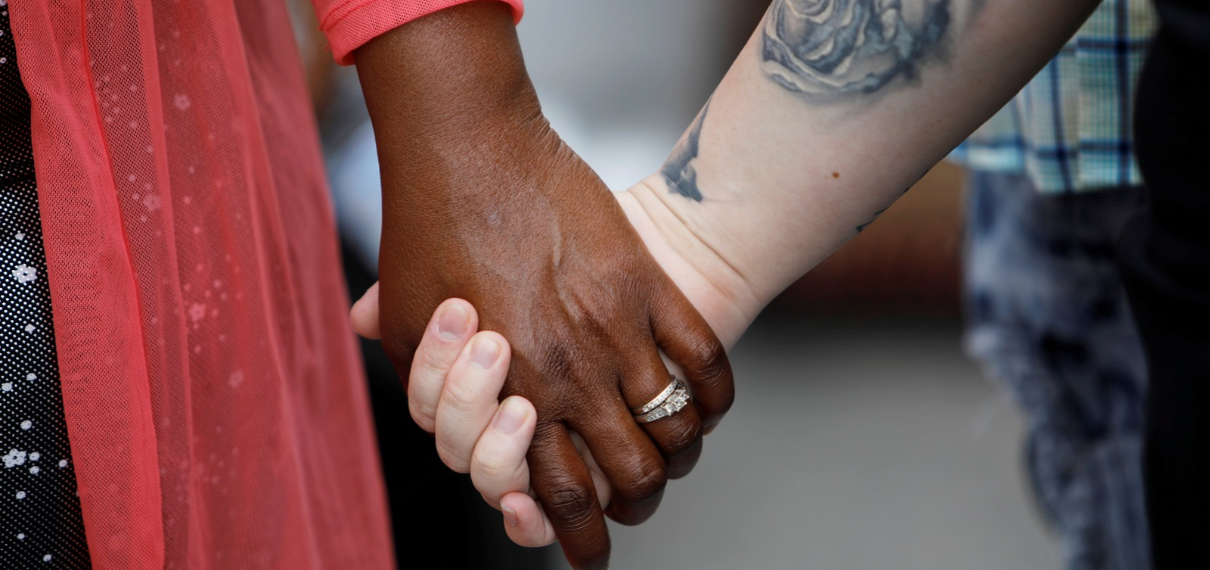
OSV News – A new report indicates that 60% of adult Catholics in the U.S. believe racism exists within their local community, with about 4 in 10 (39%) saying they have experienced racial discrimination generally.
That figure was higher among Black Catholics (66%), Hispanic Catholics (54%) and Asian Catholics (54%).
In addition, 10% of Catholics polled said they have experienced racial discrimination within their parish community, and 11% within Catholic education.
Black Catholics are also more likely to experience racial discrimination within their parish and in Catholic education, according to the report.
The findings were released Oct. 26 in “Experiences of Race, Diversity, and Racism: A National Survey of Adult Catholics.”
The report, published by the Center for Applied Research in the Apostolate, was funded by the Sisters of Charity Ministry Foundation in Cincinnati; the Jesuits USA East Province in New York; the Sisters of the Precious Blood in Dayton, Ohio; the Baltimore-based National Black Catholic Congress; and individual CARA donors.
CARA researchers Mark M. Gray and Ali Mumbach conducted the national survey between May 15 and June 30 among 2,401 self-identified Catholics.
Gray told OSV News that one key takeaway from the report was the impact of faith formation on the issue of racism, which Catholic teaching denounces as a sin and incompatible with God-given human dignity.
“It does appear that the more formation you’ve had as an adult, you probably have a better understanding of the Church’s teachings, and that’s showing up in the results here,” he said.
CARA partnered with enterprise software survey firm Qualtrics, which used its opt-in sampling panels for the study.
The data was statistically adjusted to ensure the sample of adult Catholics aligned with recent estimates from the General Social Survey, one of the most widely used for social science research on the American public.
The online survey was available in both English and Spanish.
Most (53%) of the adult Catholics surveyed described themselves as non-Hispanic white, with 38% Hispanic or Latino. Another 5% of the respondents were African American, Black, African or Afro-Caribbean, while 3% identified themselves as Asian, Pacific Islander or Native Hawaiian. American Indian, Native American, Native Alaskan or Indigenous participants represented 1% of the survey pool.
Survey respondents were evenly split between male and female, with their ages most typically between 45 and 29. Generation X (born 1962 to 1981) accounted for 39% of the survey participants.
The survey’s typical respondent fell between ages 45-49, and most (88%) had become Catholics by the time they were teenagers. The majority (81%) reported attending a parish near their home.
Gray said the data showed respondents were “least likely to experience racism” in parishes, compared to other social contexts.
He pointed to the survey’s question on racism in several institutions, which found that U.S. adult Catholics tend to see racism as an issue – either “a great deal” or “a lot” – for police
(36%), government (35%), housing (34%) and business (31%).
Among Hispanic Catholics, government (44%) was viewed as a significant context for racism, while Black Catholics (54%) viewed racism as a key issue regarding the police.
“Black Catholics also are especially likely to see racism as being this kind of an issue for business (49%), housing (45%), and education (41%),” said the report.
Most of the survey’s respondents agreed with statements derived from Church documents addressing racism. Almost three quarters (74%) affirmed racism is sinful; 74% concurred racism can take the form of a sin of omission, where injustice is left unchallenged; and 67% supported tackling “policies and institutional barriers” to eradicate racism.
Yet awareness of pastoral letters and other documents by the U.S. Catholic bishops on racism remains incomplete, with roughly half of respondents saying they were “very” or “somewhat” aware of a given document, and the other half saying they were “not at all” or “not very aware.”
At the same time, said the report, “Black Catholics are generally more likely than others to be ‘very aware’ of many Church letters, statements, or documents.”
Just about one third (28%) of adult Catholics said they had heard preaching on racism in a parish homily over the past year. That number was higher for Black (43%) and Latino (34%) Catholics.
Close to half of adult Catholics (49%) said they would like to hear more at their parishes about Church teaching on racism.
The report found that 47% of U.S. adult Catholics – and 57% of Black Catholics – feel that canonizing Black, brown and Indigenous faithful is important.
At the same time, the report found that most respondents (46%) considered racism a social rather than religious (16%) issue. Another 30% viewed it as a political problem and 24% considered it economic in nature. Thirty-two percent said racism was “all of the above” and 8% said none of those options applied. Asian Catholics (45%) were more likely than others to view racism as a political issue, said the report.
Racism (38%), along with healthcare (38%), ranked behind other issues described as “among the most important” by respondents, behind inflation and the cost of living (73%); unemployment (45%), poverty, hunger and homelessness (43%); immigration (41%); and fuel and oil prices (39%).
Gina Christian is a multimedia reporter for OSV News. Follow her on X @GinaJesseReina.
Catholic journalism is needed now more than ever. Please consider supporting this work by signing up for a SUBSCRIPTION (click HERE) or making a DONATION to The Monitor (click HERE). Thank you for your contribution.
Montse Alvarado prepares to step into Vatican communications prefect role Nov. 1
Top photo caption: Pope Leo XIV poses with Maria Montserrat “Montse” Alvarado, president and chief operating officer of EWTN News, during a private audience at the Vatican Aug. 3, 2026. Alvarado, who was appointed by Pope Leo June 2 as prefect of the Vatican’s Dicastery for Communication, will officially take her new role on Nov. 1. OSV News photo/Simone Risoluti, Vatican Media via Catholic Press Photo
By OSV News
OSV News – The Holy See’s Dicastery for Communication’s incoming prefect called her new role “a privilege and honor” and “a great adventure” just days before it was to begin Nov. 1. Pope Leo XIV appointed Maria Montserrat “Montse” Alvarado, then EWTN News’ president and COO, to the position June 2.
“My entire life has been a surrender to Jesus Christ and his Church in the hopes that others would have a relationship with him,” she said. “The fact that God could use me as an instrument for something so great is incredibly humbling.”
In an interview with Colm Flynn on the TV program “EWTN News in Depth,” Alvarado reflected on her communications experience, personal vocation and how she expects to approach leadership of the dicastery. She said that as she has met with Pope Leo in preparation for assuming the role, “We’re getting to know what this is, what it should be, what the desire of his heart is, and what the Holy Spirit has really given him as the mandate for his pontificate,” she said.
“And my job is to serve him and the Church and to serve the dicasteries and serve the curia,” she continued. “In no way am I imposing a vision. I’m very much receiving one and executing it.”
– First laywoman to lead a dicastery –
Alvarado will be the first laywoman who is not a religious sister to lead a dicastery, and, at age 39, will be the youngest prefect in the Roman Curia. A native of Mexico City living in Washington before moving to Rome, Alvarado holds a bachelor’s degree in political science from Florida International University and a master’s degree in political management from George Washington University. She began working in communications for the Becket Fund for Religious Liberty, a Washington-based nonprofit law firm that defends religious freedom cases, in 2009, rising to vice president and executive director in 2017.
In 2021, she began a professional transition to Catholic media, becoming the host of the weekly news show “EWTN News In Depth” while still working for the Becket Fund. She was named president and COO of EWTN News in 2023.
As prefect of the Dicastery for Communication, Alvarado will oversee the Holy See’s media and communication efforts, including Vatican News, Vatican Media, Vatican Radio, L’Osservatore Romano newspaper, the Holy See Press Office, and the Vatican’s publishing house (LEV), internet service, printing press, photography service and film library.
Under Pope Francis, the Holy See’s various communications arms were united in 2015 in the newly founded Secretariat for Communication, which was renamed the Dicastery for Communication in 2018 with Paolo Ruffini, a layman and a journalist, named as prefect. Alvarado is his immediate successor.
She called the interview with Flynn, published online Oct. 23, “a bittersweet goodbye to my EWTN family.”
– How she came to be considered for the role –
Asked how she came to be considered for the role by Pope Leo, Alvarado pointed to connections she made to cardinals through EWTN in preparation to host a live, video-based conversation with Pope Leo during the National Catholic Youth Conference in Indianapolis in November 2025, as well as her company’s work with the Vatican ahead of the May publication of “Magnifica Humanitas,” the Pope’s first encyclical, which addressed artificial intelligence.
“Those were the moments where I had that opportunity to kind of get to know the inner workings, but I didn’t apply. I wasn’t chosen,” she said.
Pope Leo “reached out” personally “and it’s very special,” she said, but she declined to elaborate further about how she was asked to consider the role.
“Those are the kind of stories that I’d love to just keep in my heart,” she told Flynn. “But it is an appointment from the Holy Father and one that is very humbling for many reasons.”
However, she said she believed Pope Leo asked her to step into the prefect role because “we are in a moment where digital communications and traditional communications are coming together.”
She said that accepting the role “took a little more prayer than I would care to admit.”
Acknowledging that with an attitude of “anything for the Church” she would offer “a resounding yes,” the role also required her to move to a new country and learn a new language.
“All of those pieces, leaving everything behind. They’re big to overcome,” she said. “I’m a little more human than I would care to admit in my willingness to say yes. But I’m very grateful for the opportunity. So, so grateful.”
She said that she expects coming to understand the inner workings of the Vatican to confirm, rather than rattle her faith, as some have suggested.
– To see the humanity of the Church is ‘affirmation that Jesus Christ is real’ –
“A lot of people say something that I find very silly,” she told Flynn. “They say that going into the Vatican, I have to be careful because I might lose my faith seeing the humanity of the Church. And I like to turn that on its head and say I’m going to see the humanity of the Church, which for me has always been an affirmation that Jesus Christ is real and his Church is the true Church. Because in seeing the way things work, I actually find that it’s miraculous.”
She plans to approach the position with a posture of listening and learning, she said.
“Taking the time to get to know the person in front of you, taking the time to get to know the kind of work, the intention, the desire that is behind something before executing and that listening period – not to use a word that everybody seems to hate – synodality, right?” she said.
She continued: “The Church is actually a great listener, and Pope Leo is a great listener. He’s asked us to come into dialogue. And so, I am hard-charging, sure. I think that’s a blessing and a curse at the same time. But over time, in my own process of maturity, I’ve also learned that the best decisions are taken when you have the most context.”
Alvarado noted that it was never her dream to achieve success in media, but she felt called to serve the Church in communications.
“My great ambition has always been to get married and have children,” she said. “My mother and my father have the most beautiful marriage and are the most wonderful parents, are my best friends. That’s what the desire of my heart truly is. This was never in the plans for me. I studied music. I served at my Church very lovingly. I considered possibly whether Our Lord was leading me into a (religious) vocation. … If you tell me like, oh, is this what you want to do? No, but it’s what I’m called to do. And those are two very different things.”
– Alvarado: ‘There’s providence in everything’ –
She credited her coworkers and mentors with her career trajectory, including EWTN’s Mother Angelica, who “spoke to my heart,” she said.
“I walked out of Becket thinking about the importance of religious freedom and the Constitution and the American dream. And I said, well, what’s it all for if not for heaven?” she said. “And so coming in here and having an environment where I was only talking about Jesus every day and only trying to communicate him to the world, was a great honor for me and my spiritual life, but also seemed like a very logical thing to do when I thought about it from a calling and spiritual perspective.”
Flynn noted that Alvarado’s appointment was distinguished by her young age and vocation as a lay woman who is not a consecrated religious. “And I’m annulled in the Church, too. So that’s also bizarre,” she responded.
An annulment, or declaration of nullity, is received from a Church tribunal after it has determined that one’s union was not a valid sacramental marriage. Alvarado has previously spoken publicly about experiencing what she described as “a failed marriage.”
However, “I think more people have spoken to me about that than anything else,” Alvarado said of the annulment process. “Their desire to pursue an annulment, to consider that reunification with the Church after divorce – not that you need it if you don’t want to marry again, but if you do – there’s a lot of confusion around that.”
She added, “I don’t think that’s why I was chosen, but there’s providence in everything, right? All of our mistakes and all of our flaws, our Lord uses everything for good.”
She acknowledged that her appointment has drawn some criticism.
“The blowback certainly was around, ‘Oh, is she going to have an ideology because of this, or does her background tell you that?,” she said. “And for me, I’ve always been in service of the Church, Church teaching, Church realities. There’s no political affiliation that could ever be more important than my Catholic identity and the beliefs of the Church.
“Yes, there was tons of blowback because people who don’t know me were making assumptions about who I am and what I believe,” she continued. “But every Catholic that has read the Catechism and the Bible knows what I believe.”
Maria Wiering is managing editor for OSV News.
Catholic journalism is needed now more than ever. Please consider supporting this work by signing up for a SUBSCRIPTION (click HERE) or making a DONATION to The Monitor (click HERE). Thank you for your contribution.