
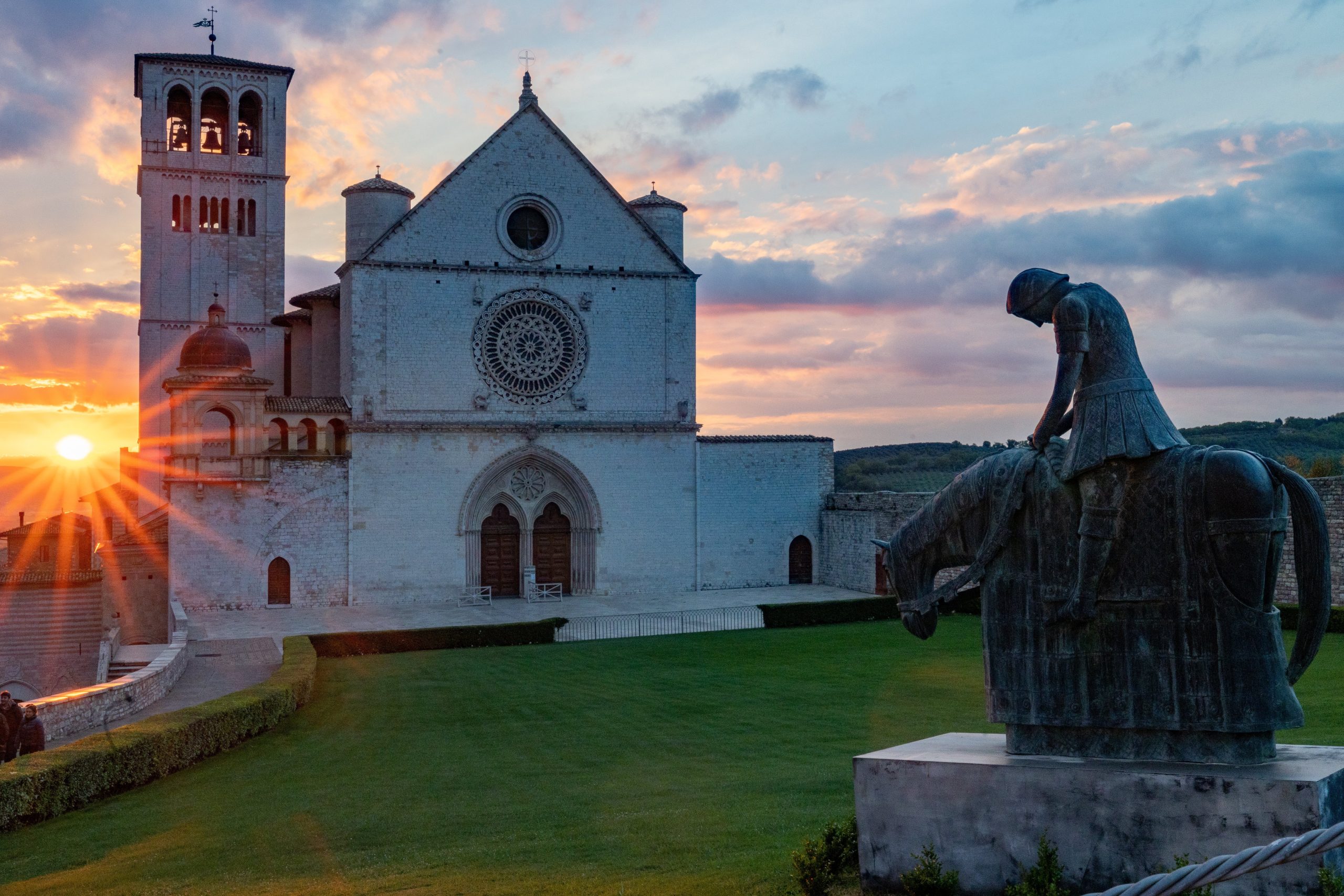
Top photo caption: The Basilica of St. Francis of Assisi in Assisi, Italy. Each year on Oct. 3, the followers of St. Francis of Assisi (1181-1226) mark the globally popular saint’s own journey from life to death, his “Transitus,” through special community commemorations. OSV News photo/courtesy Basilica of St. Francis of Assisi
By Kimberley Heatherington, OSV News
OSV News — Each year on Oct. 3, the followers of St. Francis of Assisi (1181-1226) — friars; nuns; laypeople — mark the globally popular saint’s own journey from life to death, his “Transitus” as it is known in Latin, through special community commemorations.
But what meaning does the Transitus hold — especially on this 800th anniversary of St. Francis’ death, and during the Jubilee Year of St. Francis proclaimed by Pope Leo XIV — if you aren’t a Franciscan?
“I think the answer is self-evident. We are all going to die,” Father Joseph Mary Elder, director of vocations and communications for the Capuchin Franciscans of the Province of St. Conrad, in Denver, told OSV News.
“The Transitus is the celebration of the passing of St. Francis of Assisi from earthly life to heavenly glory,” he explained. “It is not so much the passing of St. Francis — everyone dies after all — but the manner in which St. Francis of Assisi died. St. Francis embraced death in much the same way he had learned to live his life: with a radical and total fearlessness.”
That fearlessness led the saint to actually recite his own poetic acclaim of God as he began to expire.
“As St. Francis was dying, his body was racked with pain; he was nearly blind — and yet, he was speaking aloud the ‘Canticle of Creation’ he had written only shortly before,” said Father Joseph.
The “Canticle of Creatures,” also called the “Canticle of the Sun,” was written by St. Francis between 1225-1226. It lyrically praises God through the elements of nature: “Be praised, my Lord, for all your creation and especially for our Brother Sun, who brings us the day and the light … Be praised, my Lord, for Sister Moon, and for the stars.”
“In the painful darkness of encroaching death, Francis was singing a composition praising the glory of God revealed all around him in the brilliance of creation,” said Father Joseph. “What a paradox! May this be true for each and every one of us.”
One way to learn about St. Francis and his spirit of surrender is to attend or watch a Transitus ceremony, which can be found at many Franciscan-staffed parishes or livestreamed online. Some typical elements are highlights from Francis’ life by his early biographers; recitation of his writings; Scripture; hymns; and prayer.
The Franciscan University of Steubenville in Ohio is marking the 800th anniversary of St. Francis’ death with a special on-campus conference, “Sister Death – Gate of Life,” from Nov. 5-7.
During the gathering — which will bring together theologians, philosophers, medical professionals, ethicists, clergy and scholars from a variety of disciplines — participants will explore St. Francis, his view of death and eternal life, the lasting relevance of his witness today, and how the Christian understanding of death speaks to some of the most pressing questions facing contemporary society.
“This conference came about as a way to celebrate the 800th anniversary of St. Francis’ passing from death to eternal life — and so that is at the heart of our idea of the Transitus,” James Matenaer, a professor of history at the university, told OSV News.
“But it’s also a way to celebrate the Jubilee year that Pope Leo proclaimed to celebrate St. Francis of Assisi,” he added, “and the importance that the Franciscan movement and charisms have in our Catholic faith.”
There are approximately 650,000 Franciscans in 110 countries. Nearly 35,000 Franciscan friars belong to the First Order of Friars Minor, the First Order of Capuchin Franciscans, the First Order of Conventual Franciscans and the Third Order Regular. Followers of St. Clare (Poor Clares) number about 60,000 cloistered religious women. There are close to 155,000 Third Order Regular religious sisters and brothers. Additionally, 400,000 single and married women and men follow the way of St. Francis as Secular Franciscans.
In the 800 years since St. Francis’ death — and with so many Franciscans spread across the globe — his life and its legends have travelled far and wide.
“We have our own ideas of Francis, and they can be all over the place,” Father Greg Friedman, an author, journalist, and Franciscan friar in the Province of Our Lady of Guadalupe, told OSV News.
“Sometimes they’re accurate; sometimes they’re not,” he explained. “And sometimes the emphasis is so much on Francis that we forget what the key thing about his life was — and that is the following of Jesus in the Gospel.”
So what might St. Francis hope faithful Catholics and other Franciscan friends will remember the 800th anniversary of his death?
For Father Greg, who will be in Rome for the Transitus, a motto of St. Francis comes to mind.
“‘I have done what is mine; may Christ teach you what is yours.’ I think this is a very important saying of Francis. What he would want — in this 800th anniversary year — would be to say, ‘How are you focusing on what is yours to do? What is yours to do, in the spirit of Jesus?'”
While Transitus traditions might in some ways appear slightly puzzling to non-Franciscans, Father Greg offered a helpful context.
“If somebody said to me, ‘Why do you guys do this? Why do you celebrate the death of St. Francis every year?’ I would say, ‘Well, how do you remember the people in your family? How do you remember your grandparents; your great-grandparents?'” he said. “You tell the story.”
Kimberley Heatherington is an OSV News correspondent. She writes from Virginia.
Catholic journalism is needed now more than ever. Please consider supporting this work by signing up for a SUBSCRIPTION (click HERE) or making a DONATION to The Monitor (click HERE). Thank you for your contribution.