
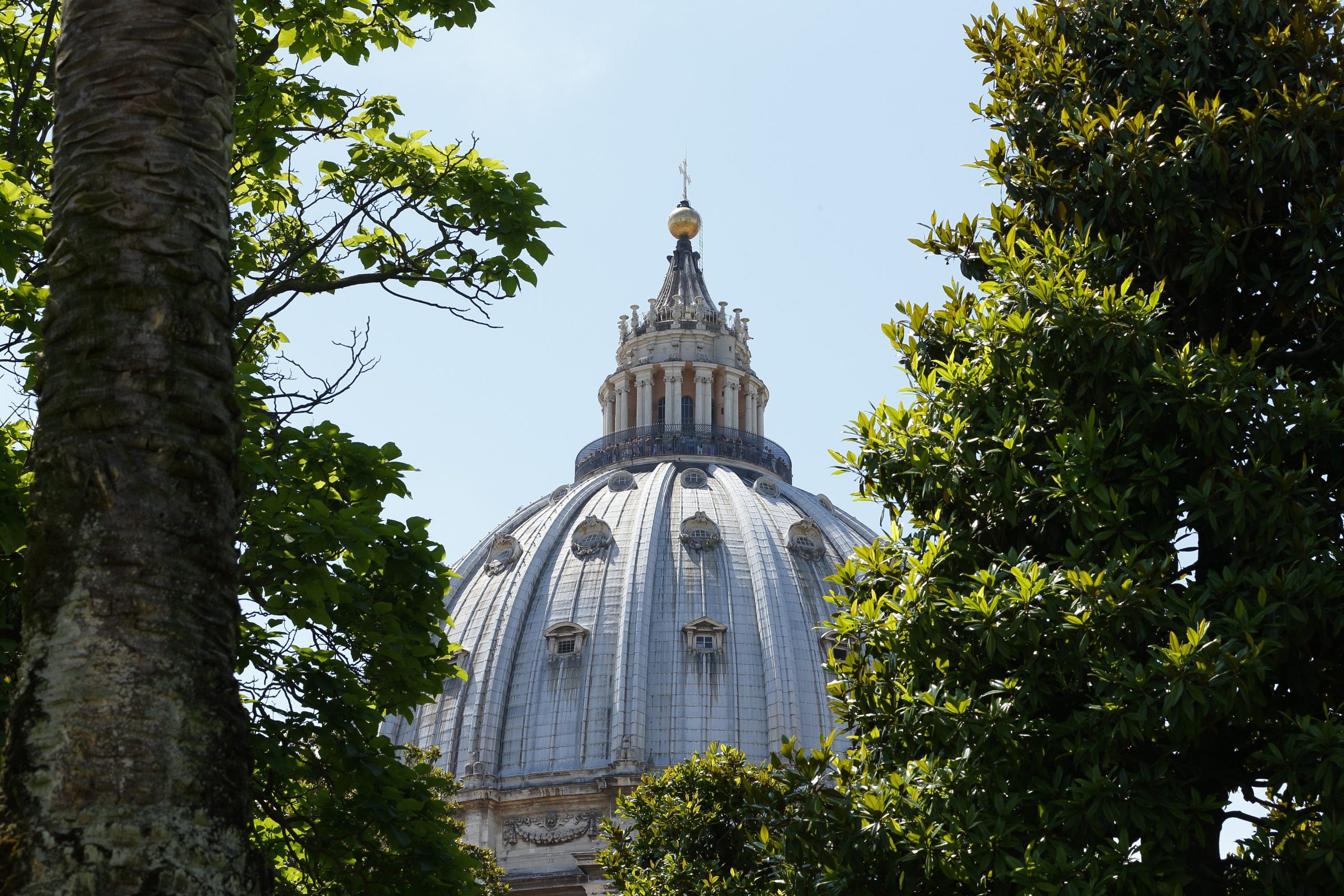
Top photo caption: The dome of St. Peter’s Basilica at the Vatican is framed by trees in this file photo. CNS photo/Paul Haring
By Jenna Marie Cooper, OSV News
Q: In the Gospel’s account of Peter’s confession of Christ, Jesus responded with: “You are Peter, and upon this rock I will build my Church.” I sometimes wonder if it wouldn’t have been better if Jesus would have skipped the wordplay and simply said: “Peter, I’m making you the first head of my Church.” The verse as is, seems subject to a lot of interpretation. When I was Protestant we all said that the verse implied that the Church would be built on a general confession of Christ, and Peter’s was but one example. Could you comment? (Indiana)
A: I have to admit that my first thought upon reading your question was that if Jesus, the Incarnate Word, appreciates a good pun, then who are we to complain?
But more seriously, of course I don’t know exactly why Jesus decided to describe St. Peter’s vocation as the first Pope in exactly the way that he did. I will note, however, that in the Gospels Jesus does seem to be rather fond of using poetic imagery — even when he must have known that some would misunderstand him.
For example, after Jesus angrily cleanses the temple in Chapter 2 of St. John’s Gospel, he tells the offended Jewish leaders: “Destroy this temple and in three days I will raise it up.” This apparently went completely over the leaders’ heads, as they responded with: “This temple has been under construction for forty-six years, and you will raise it up in three days?” The evangelist himself has to explain to the readers that Jesus “was speaking about the temple of his body” as a way of foretelling his future death and resurrection.
Similarly, in Chapter 16 of St. Matthew’s Gospel, Jesus’ “wordplay” confuses even the apostles who were right there with him. As we read: “In coming to the other side of the sea, the disciples had forgotten to bring bread. Jesus said to them, ‘Look out, and beware of the leaven’ of the Pharisees and Sadducees.’ They concluded among themselves, saying, ‘It is because we have brought no bread'” (Mt 16:5-7).
In the following verses, Jesus seems to be a bit exasperated with his apostles’ lack of insight, and reminds them that he is perfectly capable of creating all the bread they might need, as was evident in his recent miraculous multiplication of the loaves and fishes. It is only after Jesus patiently walks them through all this that the disciples “understood that he was not telling them to beware of the leaven of bread, but of the teaching of the Pharisees and Sadducees” (Mt 16:12).
My own personal guess about why Jesus would often communicate through metaphors rather than explicit statements is that metaphors tend to carry a deeper emotional resonance that can “stick with us” longer and help us appreciate the truth on a deeper level.
If Jesus had merely said something like: “Simon son of John, I’m making you the first head of my Church; now let’s talk about the scope of your governing responsibilities” in a very technical and cut-and-dried way, I’m sure that still would have been very interesting to people like biblical scholars.
But the fact that Jesus calls Peter the rock on which he will build his Church — changing his name to actually mean “rock” — communicates a much more profound sense of leadership and firm foundation. St. Peter and his ministry as the “rock” that supports the structure of the Church is a much more meaningful and beautiful image that the average praying Catholic can meditate on fruitfully.
But even beyond this, since we as Catholics understand the truths of our faith to be revealed not only through Scripture alone, but also through sacred tradition, Jesus must have known that he didn’t need to spell out his message for the benefit of future Christians. That is, the authoritative interpretation of his words would have been handed down across the generations of faithful Catholics.
Jenna Marie Cooper, who holds a licentiate in canon law, is a consecrated virgin and a canonist whose column appears weekly at OSV News. Send your questions to CatholicQA@osv.com.
Catholic journalism is needed now more than ever. Please consider supporting this work by signing up for a SUBSCRIPTION (click HERE) or making a DONATION to The Monitor (click HERE). Thank you for your contribution.