
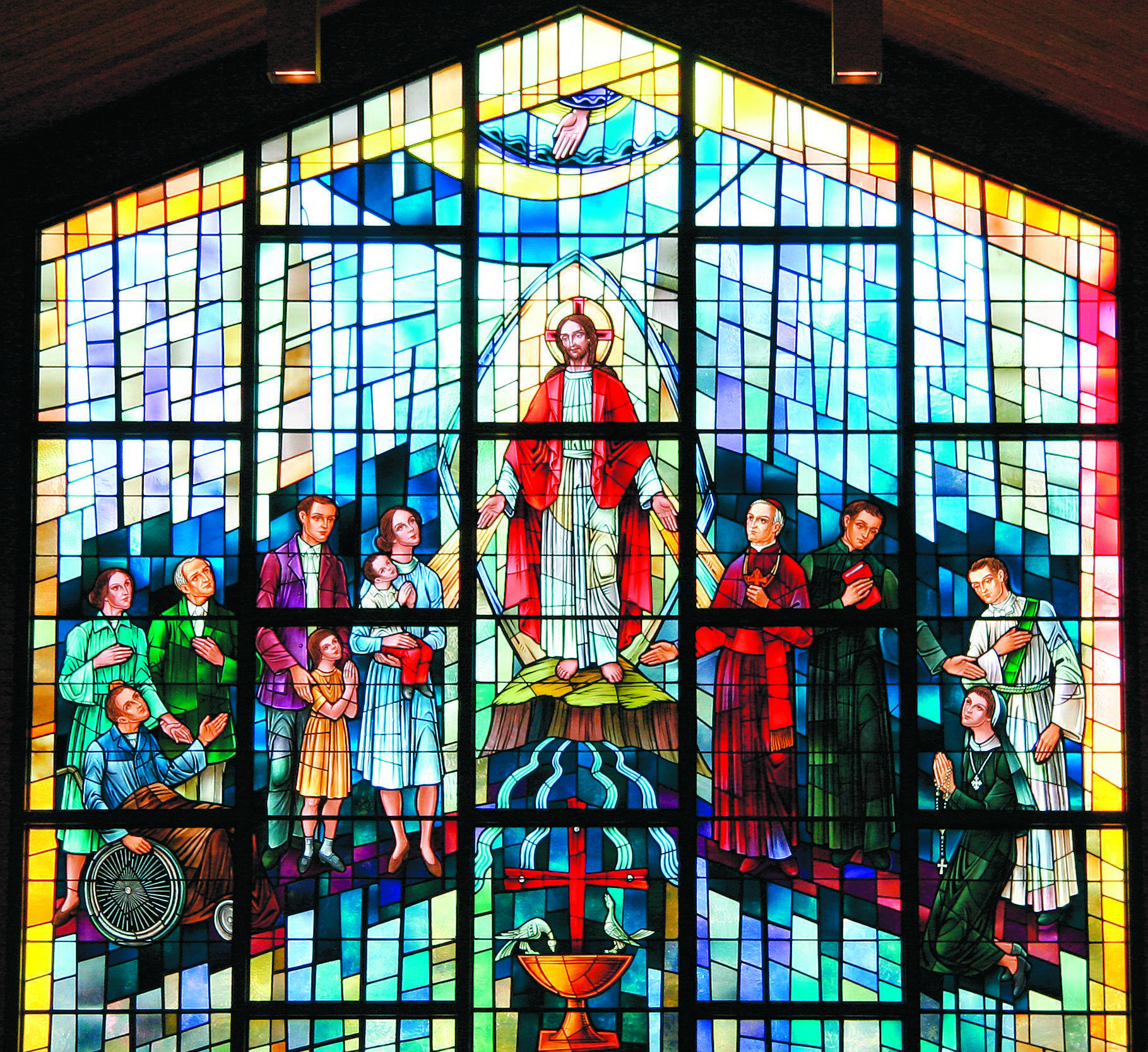
In photo above is a stained glass window found in St. Ann Church, Lawrenceville.
Gospel reflection for Aug. 16, 2026, 20th Sunday in Ordinary Time
The apostles and the early Church struggled with the desire of the Gentiles to become followers of Jesus. While there are different accounts of Jesus performing miracles for non-Jews, including the healing of the Canaanite woman’s daughter, they generally saw their primary mission to the Jews. Once all of the Jews were baptized, then they would spread the Gospel to the ends of the earth. The dialogue between Jesus and this Canaanite woman reflects that tension and stands as a reminder to the disciples and a call to the Church that the desire to encounter God and to be touched by him is universal, and not a matter solely of birthright.
As the Jewish people were a distinct minority within the Roman world, they were well aware that their observance of the Mosaic Law set them apart from their Hellenized neighbors. The Galilean and Judean Jewish communities viewed those from the other areas of the Empire as intruders and oppressors. Many of those foreigners were there as part of the occupying military force, as representatives of the Roman authority, or as opportunists taking advantage of their resources and economy.
They lived together in an uncomfortable peace which, as the first century progressed after the Paschal events, matters only grew more tense, leading to the destruction of Jerusalem and its Temple.
The earliest Christians lived as a minority within a minority. They were treated as Jewish by the Romans, but they were also increasingly marginalized by their Jewish neighbors.
A close reading of the Acts of the Apostles shows the slow, and yet at times dramatic acceptance of the Gentiles into full inclusion in the Church. Drawn to the simplicity of life, the power of their proclamation, and the sincerity of their communal life, many Gentiles sought Baptism and full initiation into the Church. It was, however, a slow process, one that was solidified at the Council of Jerusalem after the boldness of Paul in his preaching, and the assent of Peter, James and the other apostles.
At the end of the Babylonian Captivity, 538 BC, the prophecy of Isaiah foresaw, not just the return of the captives, but the day when all nations would see in Jerusalem the hope of their salvation and the presence of God.
It is that foundational text, a dramatic shift in the self-understanding of the Jewish community, that the mission of the Church is foreshadowed.
By the time St. Paul wrote his Letter to the Romans, in the mid to late 50’s AD, the Gentiles were already well-incorporated into the Christian community, probably already outnumbering their Jewish brothers and sisters, which added to the tension between them.
For this reason, then, St. Matthew preserved the story of a Canaanite woman who approached Jesus for the healing of her daughter. She is not the first Gentile to make such a request of Jesus, Earlier, Jesus healed the boy of a Roman Centaurian. Like the Canaanite woman, his plea comes not with the child present, but rather while the child is at home. When Jesus offered to go to the home of the Centaurian, he objected due to his unworthiness to have Jesus come under his roof. Jesus pronounced the healing and the man left.
This Canaanite woman, however, faced a struggle to get Jesus to listen to her. Although Jesus and his disciples were in the district of Tyre and Sidon, Gentile territory, the disciples rebuked her for approaching Jesus. She recognized Jesus, calling him “Son of David,” and yet was put aside. Even Jesus seemed to have nothing to do with her and, like the disciples, put her off. Yet, she remained persistent and Jesus sent her away with assurance that her daughter was already healed of her affliction.
This unnamed woman, a woman of a mysterious and yet great faith, serves as a warning and as a sign for the early Church.
The love and mercy of God belongs to all people. St. Paul tells the Romans that: ‘For God delivered all to disobedience, that he might have mercy upon all.”
The inclusion of the Gentiles into the Christian way of life was the plan of God from the beginning. In his mercy, he intends the salvation of all people, for all are created in his image and likeness.
The mission of the Church is always universal, transcending ethnic or national boundaries. The uncertainty and the underlying biases of the first Christians were overcome by the power of the Holy Spirit at work in and through them. Today, the Church present throughout the world, rooted in men and women of every race, culture and ethnicity, often stands at odds with those who see all men and women, not as brothers and sisters, but as tools to be exploited, disdained or set aside.
Father Garry Koch is pastor of St. Benedict Parish, Holmdel.